
Child Support Calculator: A Tutorial
There is no child support percentage set by law. What does exist is a range established in court practice, and the website’s calculator presents it as a reference, including its application to the thirteenth-month salary and vacation pay.
What the child support calculator does
The tool’s first piece of information is also the most important: no legal provision sets a child support percentage. The legal standard is the balance between the needs of the person receiving support and the ability of the person paying it, measured by proportionality.
In the absence of a table, a practice has developed. In settlements and court decisions, percentages generally fall within a range that varies according to the number of children and the support payer’s employment status. This range does not bind anyone, but it guides negotiations.
There is also a technical issue that frequently leads to disputes: what the percentage applies to. When the support payer is a formally employed worker, the same percentage applies to the thirteenth-month salary and the vacation bonus, an interpretation established in a repetitive-appeals ruling by the Superior Court of Justice.
The website’s tool organizes these elements and provides a reference range with minimum, average, and maximum amounts, as well as an annual projection.
When the tool helps in a specific case
Its most common use is preparing for a negotiation. Coming to the conversation with a reference range and an annual projection changes the quality of the agreement.
Other recurring situations include:
- estimating the actual annual cost of the support obligation;
- comparing the percentage method with a needs-based calculation;
- understanding how the number of children affects the usual percentage;
- checking whether support applies to the thirteenth-month salary and vacation pay;
- assessing the difference between a support payer with formal and informal employment.
The needs-based method is the alternative offered by the tool for situations in which the support payer’s income is informal or unknown. In those cases, the amount is generally set based on documented expenses.
Child support percentages are not set by law. The usual range is a matter of court practice, and no calculator replaces an analysis of need and ability to pay.
The tool itself displays this warning next to the range, and it should guide how the result is read.
Step by step through the tool’s screens
The calculator is in the website’s tools section, among the family-law tools, and works in your browser.
1. Open the tool and identify the fields
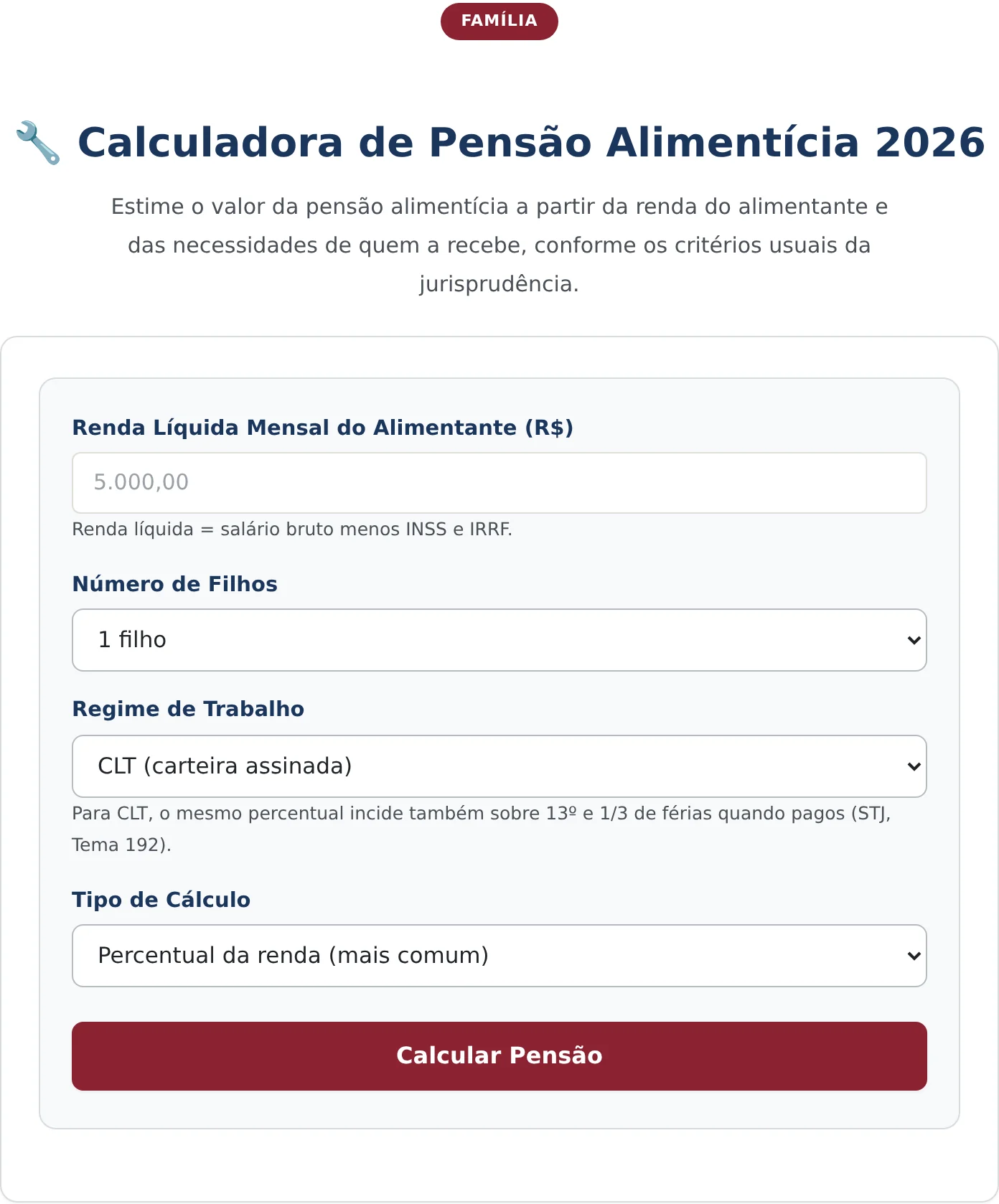
The screen has five fields. The first is the support payer’s monthly net income, with guidance that this means gross salary minus social security contributions and income tax.
The other fields are the number of children, employment status, calculation type, and, when applicable, the estimated monthly need per child. The employment-status field notes that the percentage applies to the thirteenth-month salary and vacation pay in cases of formal employment.
2. Enter the case details
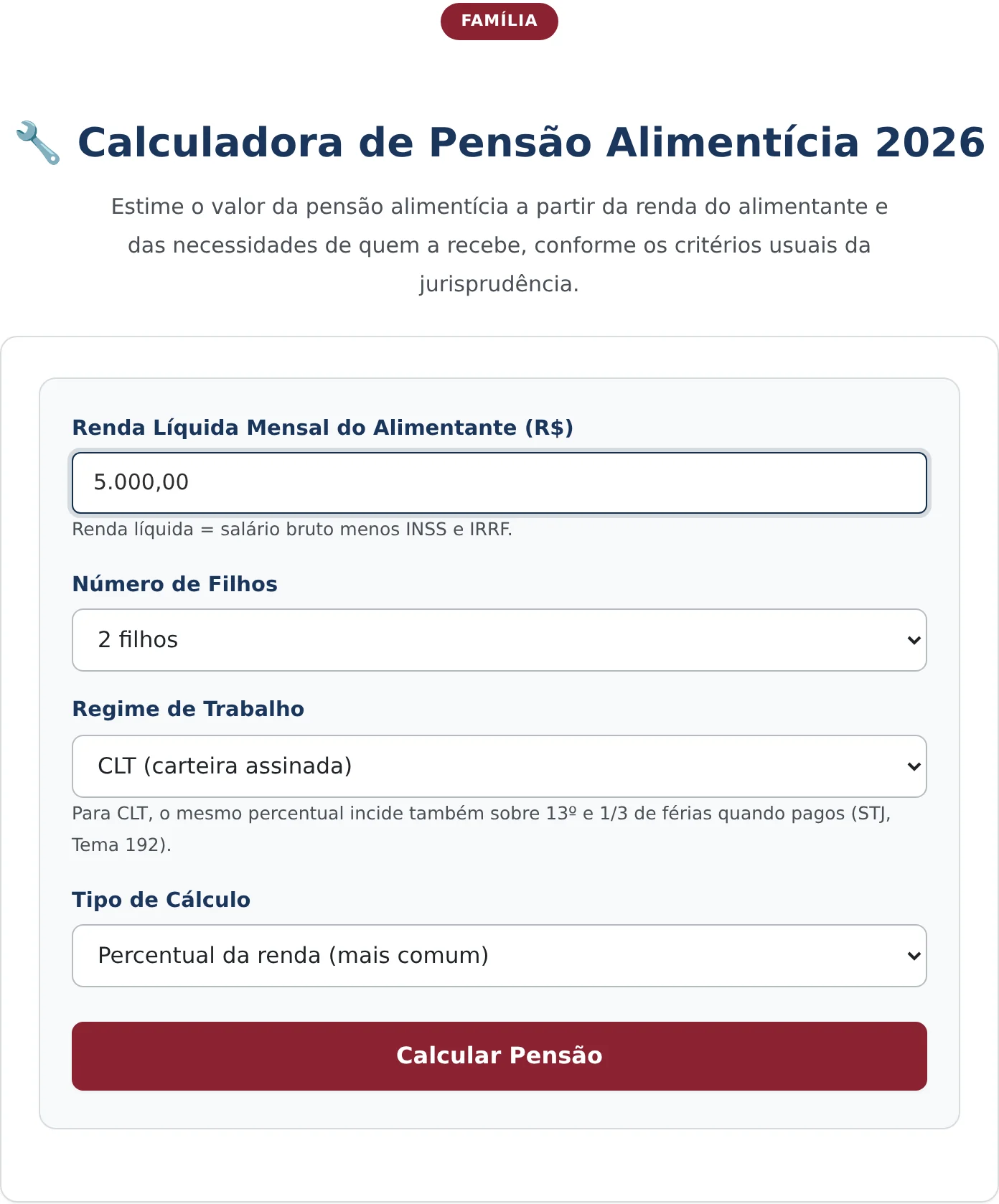
In the example, net income is R$ 5.000,00, there are 2 children, the status is formal employment, the selected method is a percentage of income, and the stated monthly need per child is R$ 1.500,00.
Choosing between the two methods changes the nature of the result. The percentage method starts with the support payer’s ability to pay; the needs-based calculation starts with the expenses of the person receiving support. In an actual negotiation, comparing both results is usually more useful than adopting only one.
3. Calculate and read the reference range
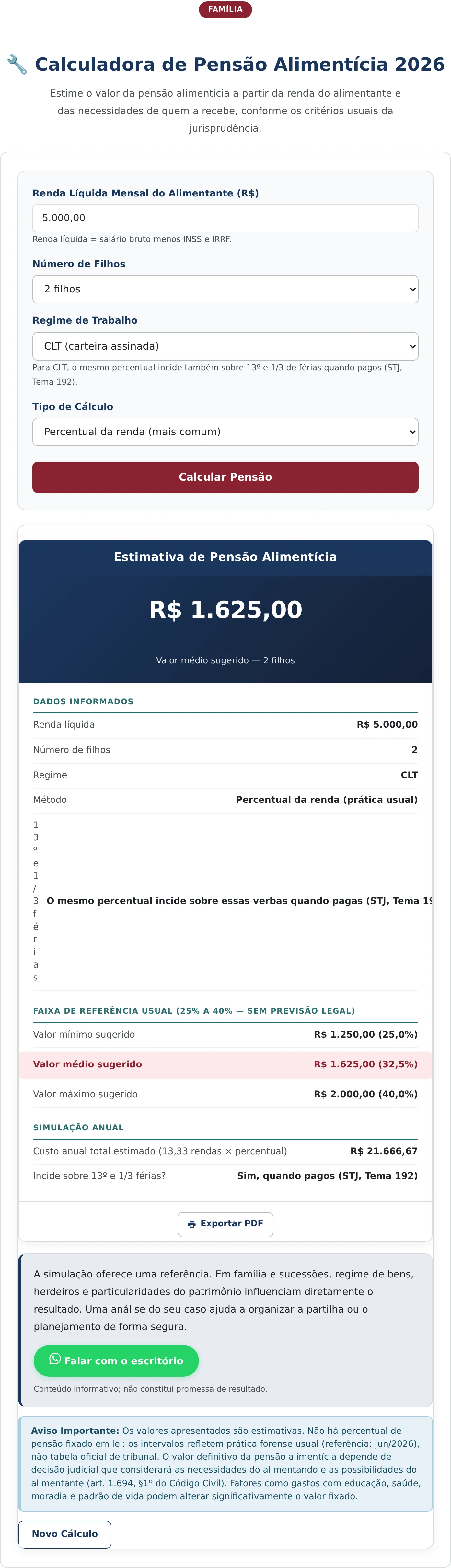
The “Calculate Support” button opens a card featuring the suggested average amount, the information entered, the three-amount reference range, and the annual estimate.
How to read each line of the result
In the example, the suggested average amount is R$ 1.625,00 for two children. The data block confirms the net income, number of children, employment status, and method used.
Just below is the line about the thirteenth-month salary and the vacation bonus, stating that the same percentage applies to those payments when they are made. This is one of the most relevant pieces of information in the result because it significantly affects the annual cost.
The reference range shows three amounts: a minimum of R$ 1.250,00, equivalent to 25% of income; an average of R$ 1.625,00, equivalent to 32,5%; and a maximum of R$ 2.000,00, equivalent to 40%. The range label expressly states that it is not established by law.
The annual estimate is the figure often missing from discussions. The estimated annual cost is R$ 21.666,67, calculated over 13,33 monthly incomes, a figure that already includes the thirteenth-month salary and the vacation bonus. Thinking about the obligation annually, rather than monthly, changes the perception of the commitment.
The footer closes with the central warning: the ranges reflect usual court practice as of the indicated reference date and do not constitute an official table.
The factors that determine the actual amount
The range is a starting point. What determines the amount in a specific case is the balance between need and ability to pay, and several factors are part of that assessment.
On the needs side, relevant factors include the children’s ages, education and health expenses, ongoing treatment, and the standard of living before the separation. Extraordinary expenses, such as surgeries or specific courses, are generally handled separately from monthly support.
On the ability-to-pay side, relevant factors include formal income, other income sources, assets, and the existence of other children to whom the support payer also owes support. A person with children from different relationships does not pay the same percentage for each child as though the others did not exist.
There is also shared custody, in which the division of parenting time and the support payer’s direct payment of expenses affect the amount of the cash payment.
These factors explain why two people with the same income may pay different amounts, and why the range is a reference, not a result.
What the calculator does not do
The tool does not set child support. It organizes a reference range and projects the annual cost, while the amount itself depends on an approved agreement or a court decision.
It also does not address modification of support, which requires proof of a change in either party’s financial circumstances, or enforcement of overdue support, which follows the procedures provided for in procedural law.
Nor does it calculate support owed to a spouse, domestic partner, or ascendant, situations governed by criteria different from those applicable to children.
Frequently Asked Questions
Is there a child support percentage set by law?
No. The legal standard is proportionality between the needs of the person receiving support and the ability of the person paying it. The usual percentages reflect court practice, and the tool itself notes this qualification next to the reference range.
Does child support apply to the thirteenth-month salary and vacation pay?
When the support payer is a formally employed worker and support was set as a percentage of compensation, the same percentage applies to the thirteenth-month salary and the vacation bonus, according to an interpretation established in a repetitive-appeals ruling by the Superior Court of Justice.
What if the support payer has no formal income?
In that case, a percentage-based calculation becomes less useful, and the amount is generally set based on the documented needs of the person receiving support and evidence of the support payer’s financial capacity. The tool offers the needs-based method specifically for this situation.
Receba novidades por e-mail
Cadastre-se gratuitamente para receber nossos novos artigos.
Seus dados estão protegidos conforme a LGPD.
Ficou com dúvidas? Fale com um advogado especialista.
📱 Falar pelo WhatsAppAs informações deste artigo são de caráter informativo e não substituem consulta jurídica individualizada. Cada caso possui particularidades que exigem análise específica.


