
Asset Division Calculator: Complete Tutorial
Under the partial community property regime, property purchased before the marriage is not divided, while property purchased during the marriage is divided even if it is in only one spouse’s name. The calculator on the site separates the two property pools and calculates the division.
What the asset division calculator does
Asset division depends on the marital property regime, and the regime is determined before any calculation is made. Under the partial community property regime, which is the default legal regime when there is no prenuptial agreement, property acquired for consideration during the marriage is shared, while property acquired beforehand and property received as a gift or inheritance remain separate.
The detail that most surprises people is that title is irrelevant. A property purchased during the marriage and registered in only one spouse’s name is still marital property and is included in the division. The name on the property record does not determine whether the property is shared.
There is also subrogation, which preserves the nature of the property. A vehicle purchased with proceeds from the sale of property acquired before the marriage remains separate property because it merely replaced property that was already separate.
The calculator on the site takes the marital property regime and a list of assets, including their classification and ownership, and returns the two separate property pools and the result of the division.
When the tool helps in a specific case
Its most common use is to organize assets before a discussion about an uncontested divorce, when the parties want to know what each of them will receive.
Other recurring situations include:
- comparing the effect of different regimes on the same assets;
- separating separate property from marital property in a long list;
- estimating a possible cash equalization payment in the division;
- checking how property received by inheritance during the marriage is treated;
- preparing the asset division draft for formalization.
Comparing regimes has strong educational value. The same set of assets produces very different results under partial community property, universal community property, and total separation of property, and seeing all three side by side clarifies what a prenuptial agreement actually determines.
Property purchased during the marriage is marital property even if it is registered in only one spouse’s name. Title does not govern whether property is shared.
The example in this tutorial shows exactly that, using fictitious assets selected for demonstration purposes.
Step by step with the tool’s screens
The calculator is located in the family-law tools section of the site and works in your browser.
1. Open the tool and understand its structure
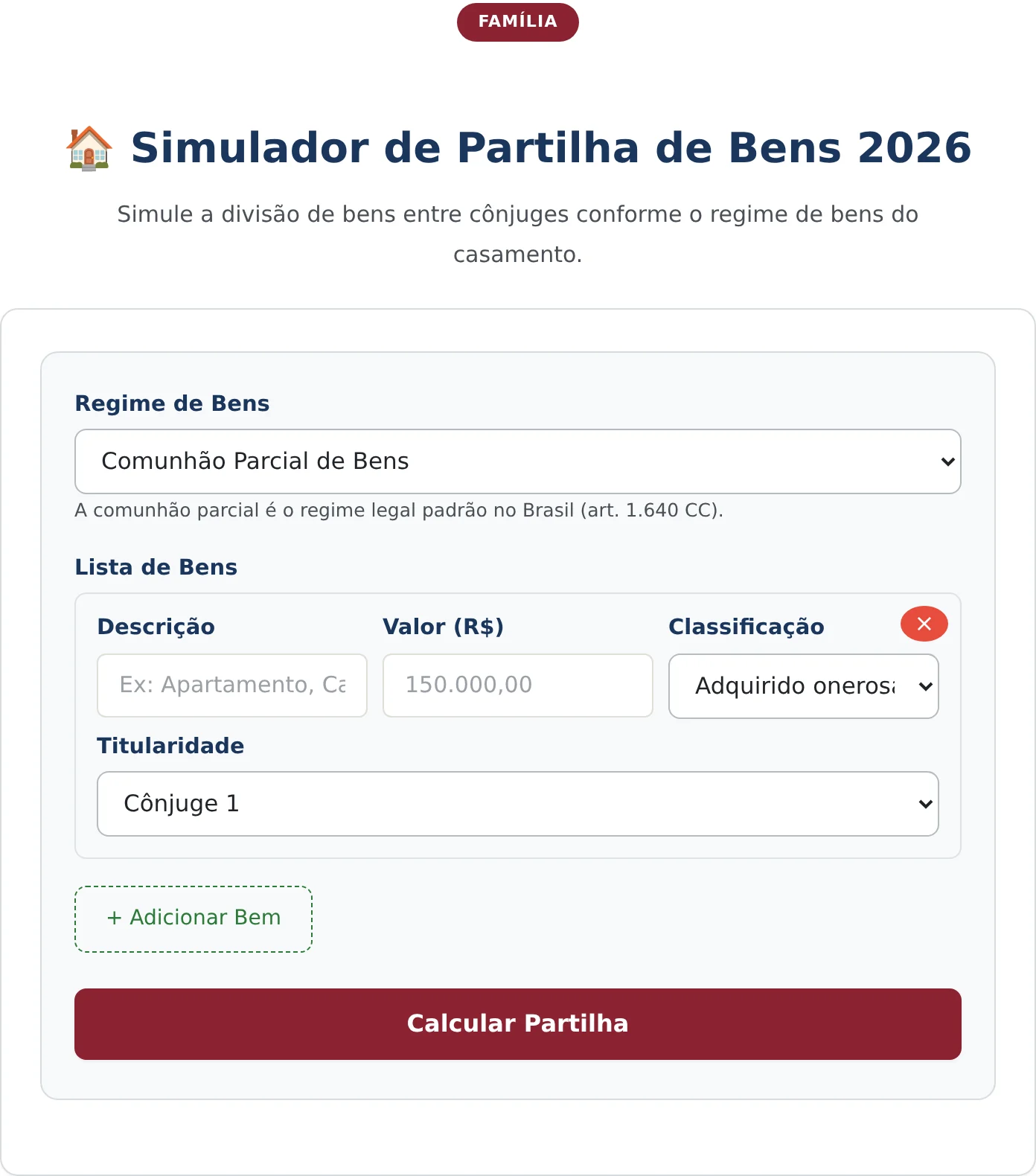
The screen has two parts. At the top is the marital property regime selector, with four options: partial community property, universal community property, total separation of property, and final participation in acquired assets. The guidance below the field notes that partial community property is the default legal regime.
Below is the asset list, with one line already open. Each line includes a description, value, timing classification, and ownership, as well as a button to add new lines.
2. Enter the assets
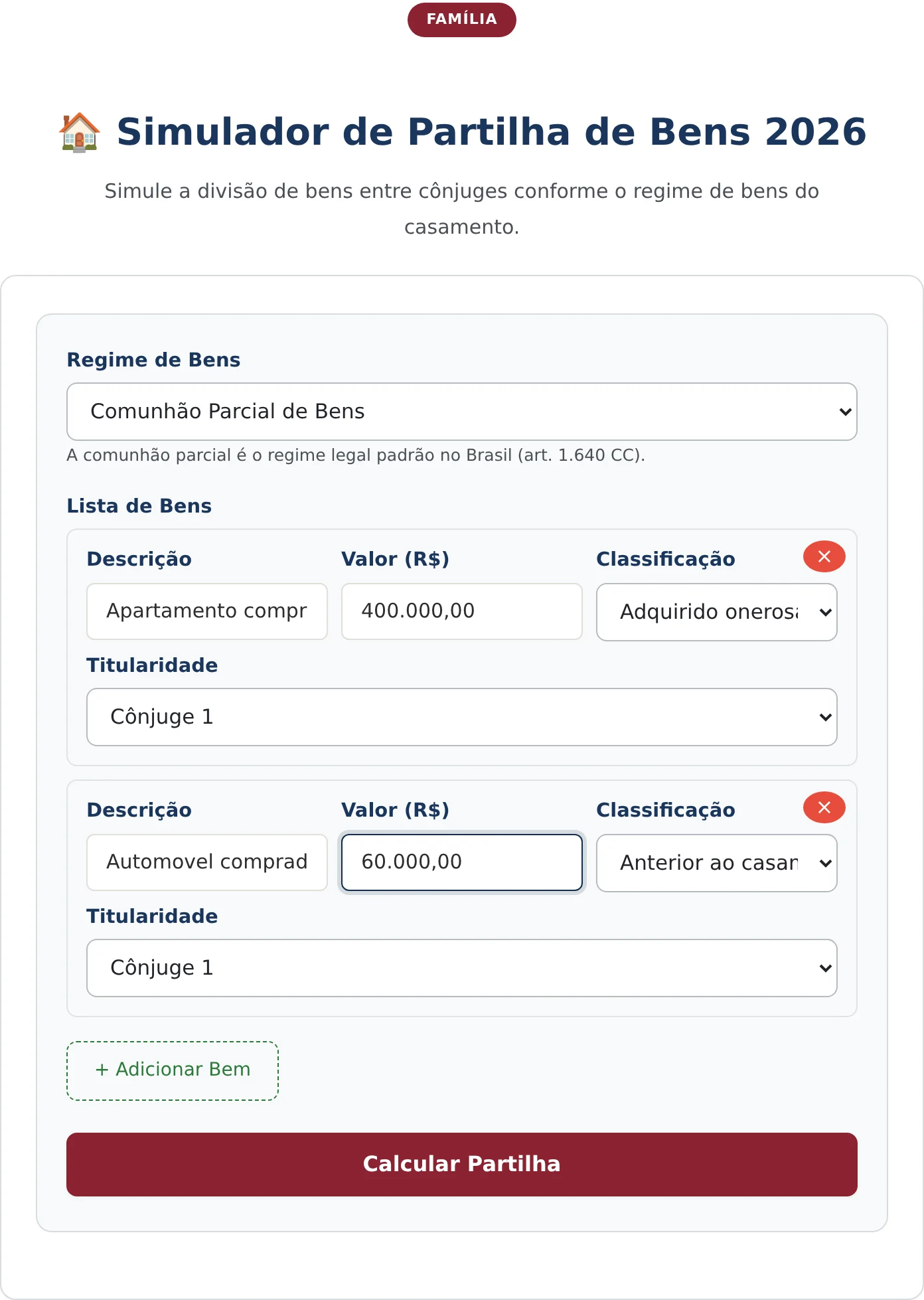
In the example, the regime is partial community property. The first asset is an apartment purchased during the marriage, valued at R$ 400.000,00, classified as acquired after the marriage and assigned to the first spouse. The second is a vehicle purchased before the marriage, valued at R$ 60.000,00, classified as acquired before the marriage.
The timing classification is the decisive field. It shows whether the asset was acquired before or during the marriage, and it determines whether the asset is shared. Ownership matters only for separate property, which remains with its owner.
3. Calculate and read the division
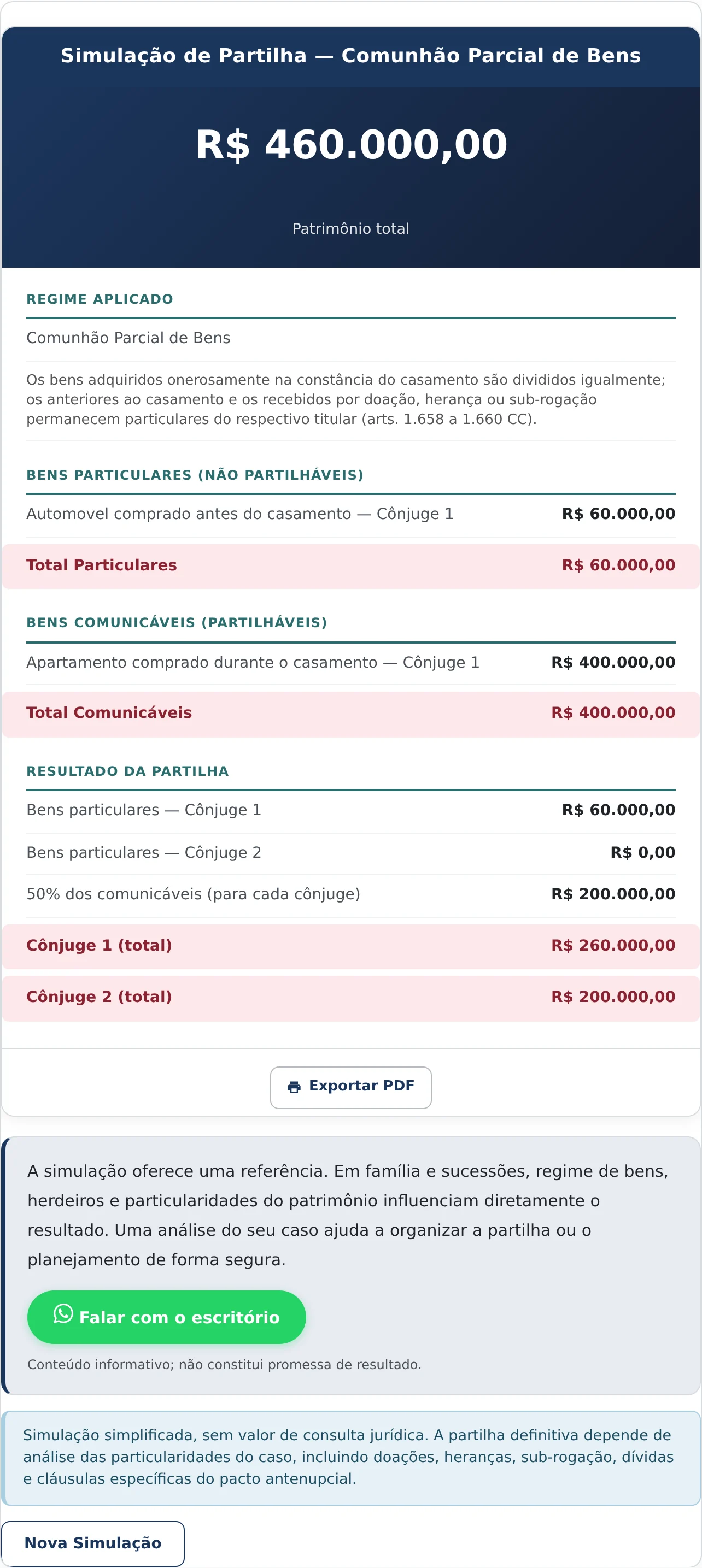
The “Calculate Division” button opens a card showing the total assets prominently, an explanation of the regime applied, the two separate property pools, and the result for each spouse.
How to read each line of the result
In the example, the total assets are R$ 460.000,00. Immediately below, the tool explains the regime applied in a sentence that summarizes the relevant articles of the Civil Code, which provides an immediate check.
The separate property section lists the R$ 60.000,00 vehicle, assigned to the first spouse, for a total of R$ 60.000,00. These assets are not included in the division.
The shared property section lists the R$ 400.000,00 apartment. Note that it appears with an indication that it belongs to the first spouse and nevertheless forms part of the property subject to division. This is a practical demonstration that registration does not prevent property from being shared.
The result of the division completes the calculation: the first spouse receives R$ 60.000,00 in separate property plus R$ 200.000,00 representing half of the shared property, for a total of R$ 260.000,00. The second spouse receives R$ 200.000,00, representing that spouse’s half of the marital property.
The difference between the two totals is not inequality in the division: it is the consequence of one spouse having separate property. The division of marital property was strictly equal.
What changes under each marital property regime
Changing the regime selector changes the result, and it is useful to understand the logic of each one.
Under universal community property, nearly all assets, whether acquired before or after the marriage, are shared, subject to the exceptions provided by law, such as property subject to a non-communication clause and property received as a gift with that restriction.
Under conventional total separation of property, each spouse retains his or her own assets, with no sharing, and the division consists only of identifying ownership of each asset.
Under final participation in acquired assets, each spouse manages his or her own assets during the marriage and, upon dissolution, the increase in each spouse’s assets is determined and divided. It is the most complex regime and the least used in practice.
There is also mandatory separation of property, imposed by law in certain situations, whose practical application allows for discussion regarding the sharing of property acquired through joint effort.
Two aspects of asset division usually require attention beyond the arithmetic of the division.
The first is the indivisibility of certain assets. A single property cannot be physically divided, and the practical solution follows one of three paths: assigning it to one spouse with a cash payment or other assets to compensate the other, maintaining co-ownership between both spouses, or selling it and dividing the proceeds. The calculator indicates the value of each share, while the manner of carrying it out is subject to negotiation.
The second is liabilities. Debts incurred for the benefit of the couple are also shared, and a division that divides only assets may produce an unfair result. Outstanding mortgage financing is the most common case: the outstanding balance follows the property, and assigning the property to one spouse usually comes with assuming the debt, which depends on the creditor institution’s consent.
What the calculator does not do
The tool does not appraise assets. Values are entered by the user, and valuation disputes are, in practice, the main source of litigation in asset divisions.
It also does not address debts, which are likewise shared when incurred for the benefit of the couple, or assets held in co-ownership with third parties, situations that require their own treatment.
Nor does it replace formalization. Asset division is carried out through a public deed when it is uncontested and there are no legally incapacitated persons, or through the courts, and it depends on payment of the taxes applicable to the transfer.
Frequently Asked Questions
Is property in only one spouse’s name included in the division?
Under partial community property, it is included if it was acquired for consideration during the marriage, regardless of whose name appears on the registration. Ownership is determinative only for separate property, which remains with its respective owner.
Is an inheritance received during the marriage divided?
Under partial community property, it is not divided: property received by inheritance or gift remains the separate property of the heir or donee. Under universal community property, the rule is that it is shared, unless the donor or testator imposed a non-communication clause.
What is the marital property regime when there is no prenuptial agreement?
Partial community property, which is the default supplementary legal regime. It automatically applies to marriages entered into without an agreement, and it also governs a stable union when the partners have not provided otherwise in a written contract.
Receba novidades por e-mail
Cadastre-se gratuitamente para receber nossos novos artigos.
Seus dados estão protegidos conforme a LGPD.
Ficou com dúvidas? Fale com um advogado especialista.
📱 Falar pelo WhatsAppAs informações deste artigo são de caráter informativo e não substituem consulta jurídica individualizada. Cada caso possui particularidades que exigem análise específica.


