
Social Security Historical Series: A Tutorial
The special-service-time conversion factor, the points required each year, the historical qualifying period, and small-claims payment order limits are governed by different rules. The site’s historical series bring together ten social security tables on one screen.
What the historical series solve
Social security work requires frequent consultation of historical data. What was the minimum wage in a given year, what qualifying period was required for a particular benefit, how many points applied on a particular date, what conversion factor applies to a period of special service.
This information exists, but it is scattered across decrees, ordinances, constitutional amendments, and resolutions. Gathering it for each case takes time without adding value, and rushed research is a frequent source of error.
The site’s tool brings together ten sets of data in tabs: minimum wage, general-regime cap, qualifying period, contribution rates, points and age, special service, coefficients, additional contribution period, federal small-claims payment order, and benefit types by code.
Each tab includes a table with its legal basis and allows searching and exporting.
When the tool helps in a specific case
Its most frequent use is for a quick lookup while preparing a calculation or filing, when a specific historical data point is needed.
Other recurring situations include:
- finding the special-service-time conversion factor by sex and required period of exposure;
- checking the points required in a given year under the transition rules;
- consulting the qualifying period required for a benefit at a particular time;
- confirming the benefit-type code of an awarded benefit;
- checking the federal small-claims payment order limit.
The special-service tab is probably the most frequently consulted, because conversion factors vary by sex and required period of exposure, and relying on memory is not very dependable.
Special-service-time conversion applies only to periods worked through November 13, 2019. After that, special service counts toward special retirement, not conversion.
This warning appears at the top of the conversion tab itself, and it is one of the ways the tool prevents a costly mistake.
Step by step through the tool’s screens
The tool is located in the site’s tools section, among the social security tools, and works in your browser.
1. Open the tool and identify the tabs
The screen opens on the minimum-wage tab, with a table of amounts by year and the legal basis for each benchmark. Above the table are the ten tabs, each with an icon and a short name.
Each tab has its own controls: a search field, an export button, and a button to clear the filter. The structure is repeated, making navigation predictable.

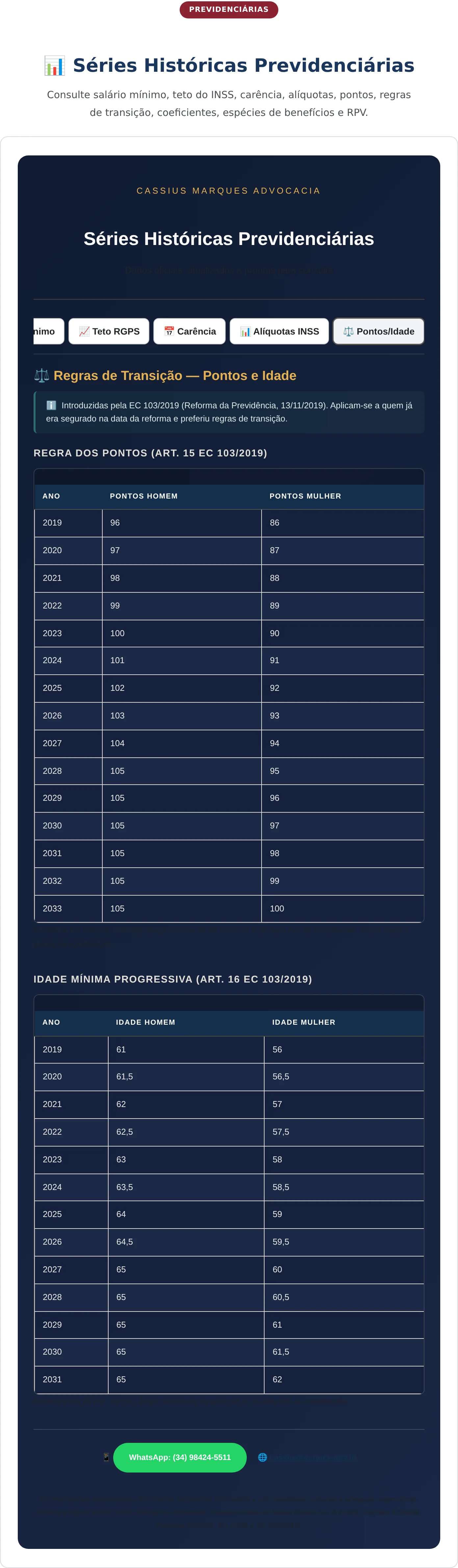
2. Consult the points and age tab
The points tab shows the year-by-year progression of the transition rules. It answers the most common retirement-planning question: how many points are required in a given year for men and women.
The annual progression is why the table exists. The required score rises each year until it reaches a limit, and consulting the wrong number shifts the retirement projection by years.
3. Consult the special-service tab
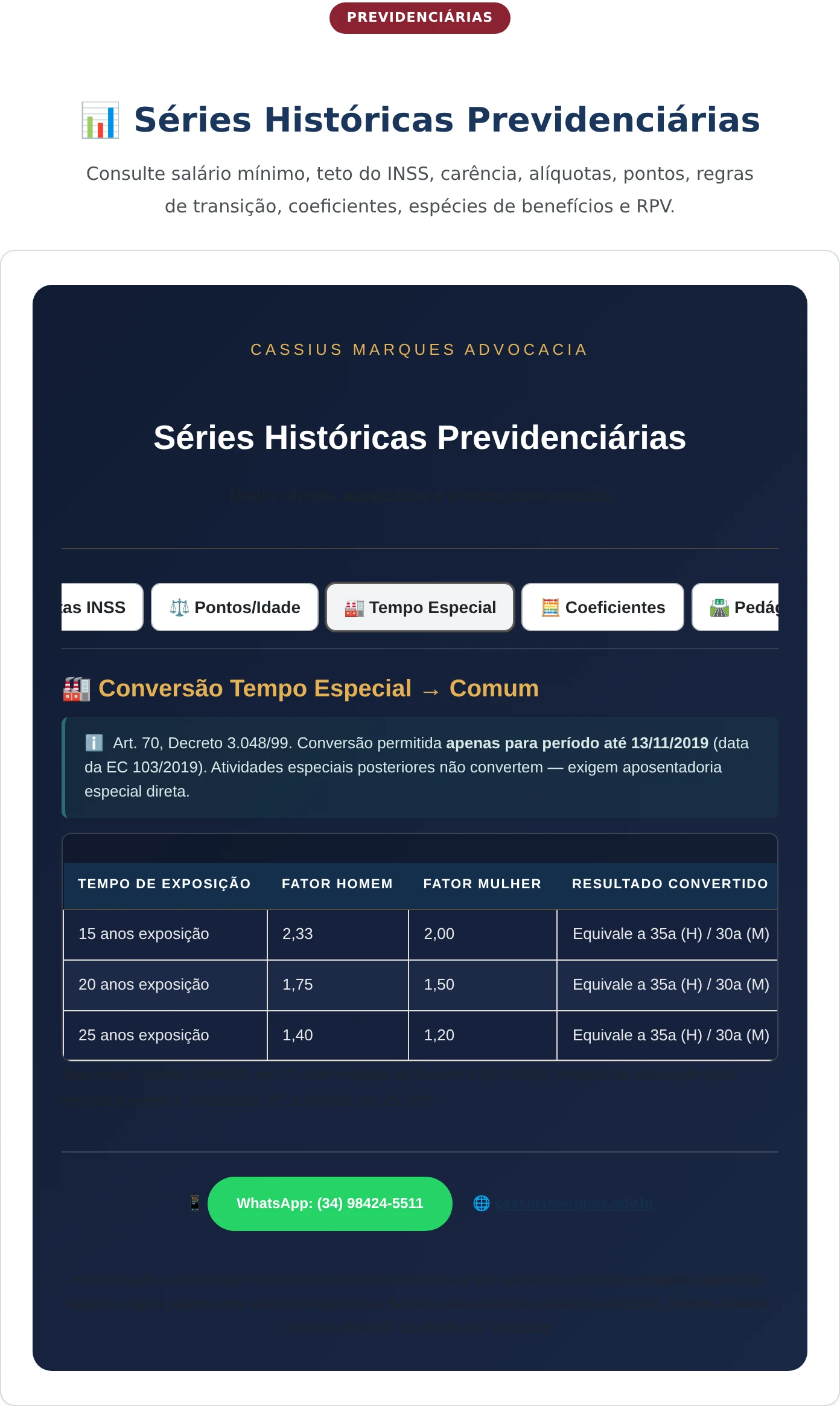
The special-service tab provides conversion factors into ordinary service time, separated by sex and required period of exposure, with the converted result shown alongside.
How to read the conversion table
The conversion table requires the closest reading, so it is worth explaining in detail.
The first column indicates the required period of exposure that characterizes special service: 15, 20, or 25 years, depending on the harmful agent. Most agents, including noise, fall under the 25-year period.
The next two columns provide the conversion factors for men and women. For 25-year service, the factors are 1,40 and 1,20. For 20 years, 1,75 and 1,50. For 15 years, 2,33 and 2,00.
The last column shows the result of full conversion: any of the periods, once converted, is equivalent to 35 years for men and 30 years for women, which were the periods required for retirement based on contribution time.
The tab heading states the legal basis and the time limitation on conversion, which covers only periods worked through the date of the social security reform.
The other tabs and what each one answers
The ten tabs cover different questions, and knowing the layout saves time.
The qualifying-period tab provides the number of contributions required for each benefit, with changes over time, including the reduced qualifying-period rule that applies after reentering the system.
The contribution-rates tab brings together contribution brackets by period, useful for reconstructing deductions for earlier contribution months in disputes regarding the contribution wage base.
The coefficients tab addresses the percentage applied to the average wage, which determines the benefit amount under each rule, while the additional-contribution-period tab details the additional requirements of the corresponding transition rules.
The small-claims payment order tab provides the federal limits, which are essential for determining whether a credit will be paid through a payment order or a precatório (court-ordered government debt payment), with a direct impact on the time to receive payment.
The benefit-types tab lists benefit codes, which identify the nature of the awarded benefit and appear in award letters and statements.
One methodological observation helps you get more value from the tables: they are most useful when read together, rather than in isolation.
The analysis of a special-retirement case, for example, involves at least three tabs. The special-service tab provides the conversion factor. The coefficients tab indicates the percentage applicable to the average. The points and age tab provides the requirement of any applicable transition rule.
The same is true when reviewing an older benefit. The minimum-wage and cap tabs define the floor and limit at the time; the qualifying-period tab confirms whether the contribution requirement was met; the benefit-types tab identifies the nature of the awarded benefit through the code stated in the letter.
This sequence is what turns a collection of tables into a working tool, and it is why they are gathered on a single screen, with tabbed navigation, rather than scattered across separate pages.
What the tool does not do
The historical series do not calculate. They provide the parameters, and calculations depend on the other tools in the collection, such as the retirement simulator and the contribution-time calculator.
They also do not replace reading the rule when the parameter is disputed, although the stated legal basis makes it possible to locate the act precisely.
Nor do they include parameters from public-sector pension systems, which are governed by the specific legislation of each federative entity.
Frequently Asked Questions
What is the conversion factor for 25 years of special service?
It is 1,40 for men and 1,20 for women, according to the table in the special-service tab. Any period of special service, once fully converted, is equivalent to 35 years for men and 30 years for women.
Is special-service-time conversion still possible?
Only for periods worked through November 13, 2019. Special-service activities after that date are not converted into ordinary service time and count toward direct special retirement, according to the warning displayed at the top of the tab.
What is the small-claims payment order tab for?
It is used to check the limit below which a credit against the federal Treasury is paid through a payment order, rather than a precatório. The difference matters because the payment timeline for the two methods is quite different.
Receba novidades por e-mail
Cadastre-se gratuitamente para receber nossos novos artigos.
Seus dados estão protegidos conforme a LGPD.
Ficou com dúvidas? Fale com um advogado especialista.
📱 Falar pelo WhatsAppAs informações deste artigo são de caráter informativo e não substituem consulta jurídica individualizada. Cada caso possui particularidades que exigem análise específica.


