
Court-Fee Calculator: Tutorial
Court fees vary by court, type of division, and claim-value bracket, and the special civil court has its own rules. The website calculator estimates the initial outlay based on the state and procedure selected.
What the court-fee calculator does
Court fees are state taxes, so there is no national fee schedule. Each court applies its own legislation, with structures that vary between a percentage of the claim value, fixed amounts by bracket, and combinations of both methods.
This diversity creates a concrete practical challenge. Those litigating in different states must consult different fee schedules, with different terminology, to answer a simple question: how much does it cost to file a lawsuit?
There is also a distinction between court fees and the judicial tax, which in some states are separate charges, with their own bases and purposes, added to the initial outlay.
There are also exemption rules. The special civil court waives payment at the trial level, and the Labor Courts have their own rules, with payment at the end by the losing party.
The website tool takes three pieces of information and provides an estimate based on the branch of the judiciary and the state.
When the tool helps in a specific case
Its most frequent use is to prepare a budget for a potential claim when assessing the economic viability of litigation.
Other common situations include:
- comparing the cost of ordinary proceedings and the special civil court;
- estimating the initial outlay in a high-value action;
- checking the court-fee rules in the Federal Courts;
- reviewing the payment slip issued by the court system;
- assessing the risk of an adverse-cost award by adding court fees and attorneys’ fees.
The comparison between procedures is often decisive in lower-value claims. The absence of trial-level court fees in the special civil court changes the economic equation, even though that procedure has evidentiary and appellate limitations.
There are no court fees at the trial level in the special civil court. In lower-value claims, this difference changes the decision about where to file.
The tool separates the four systems so that the comparison is immediate.
Step by step: using the tool screens
The calculator is located in the website’s tools section, among the civil and procedural tools, and works in your browser.
1. Open the tool and identify the fields
The screen contains three fields. The first is the claim value. The second is the state, with a note that the detailed fee schedule is available for one specific state.
The third is the type of court or division, with four options: state civil court division, special civil court, Federal Courts, and Labor Courts. Each option triggers a different calculation system.
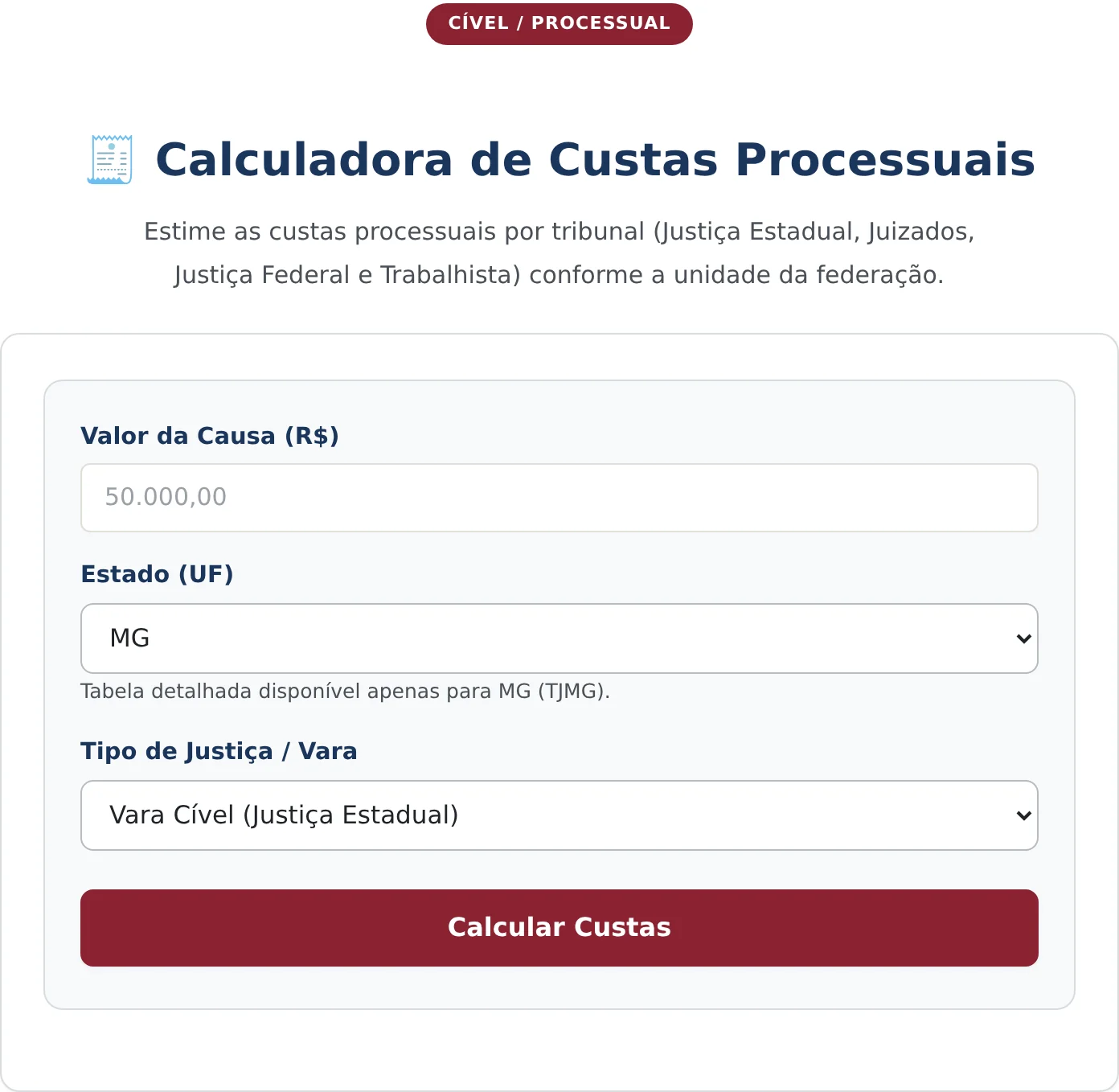
2. Fill in the case information
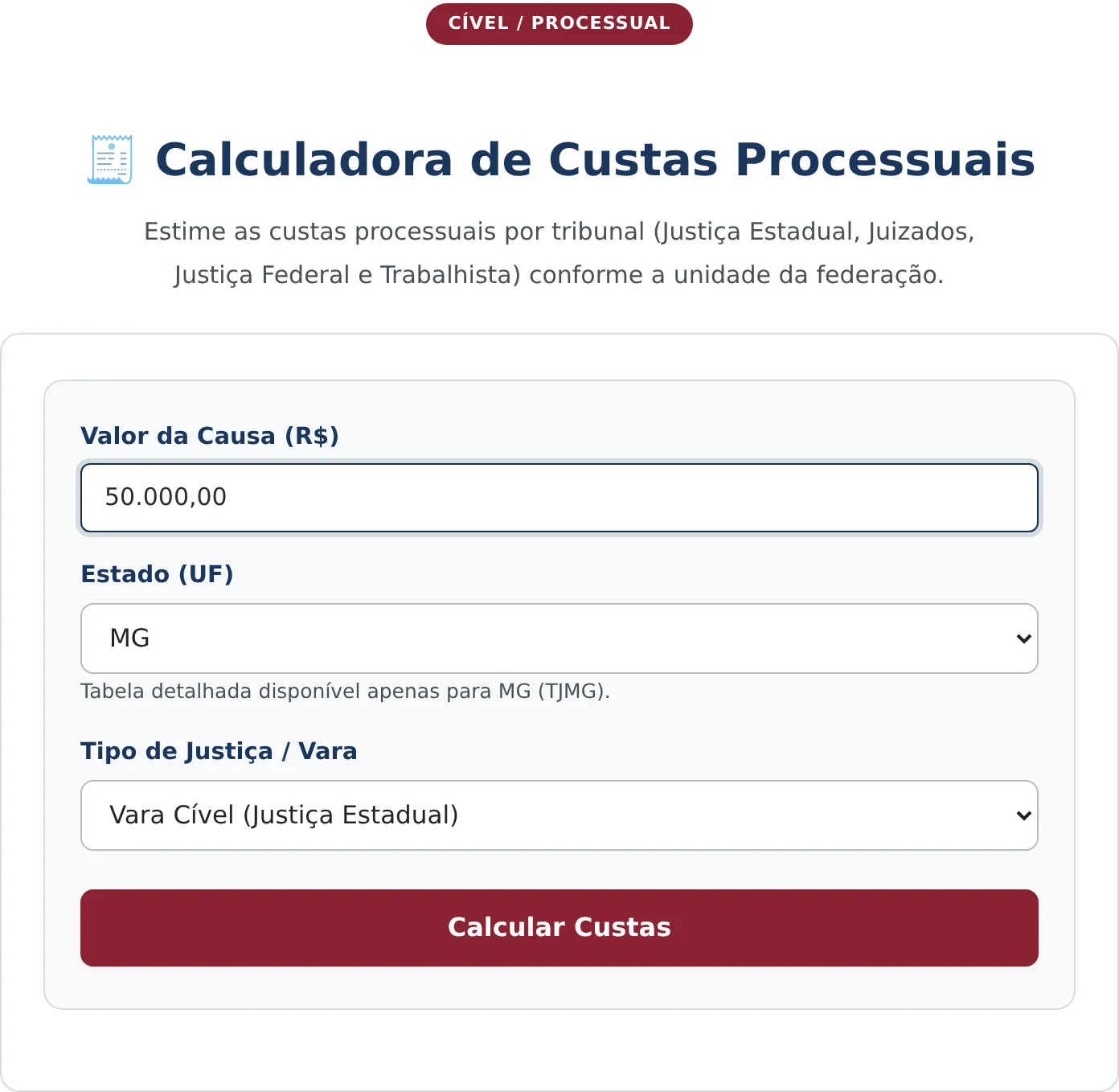
In this example, the claim value is R$ 50.000,00, the selected state is the one whose detailed fee schedule is loaded in the tool, and the type is a state civil court division.
The choice of state matters because court-fee legislation is state-based. For states without a detailed fee schedule loaded, the tool provides an estimate, and you must still verify it in the court system.
3. Calculate and read the result
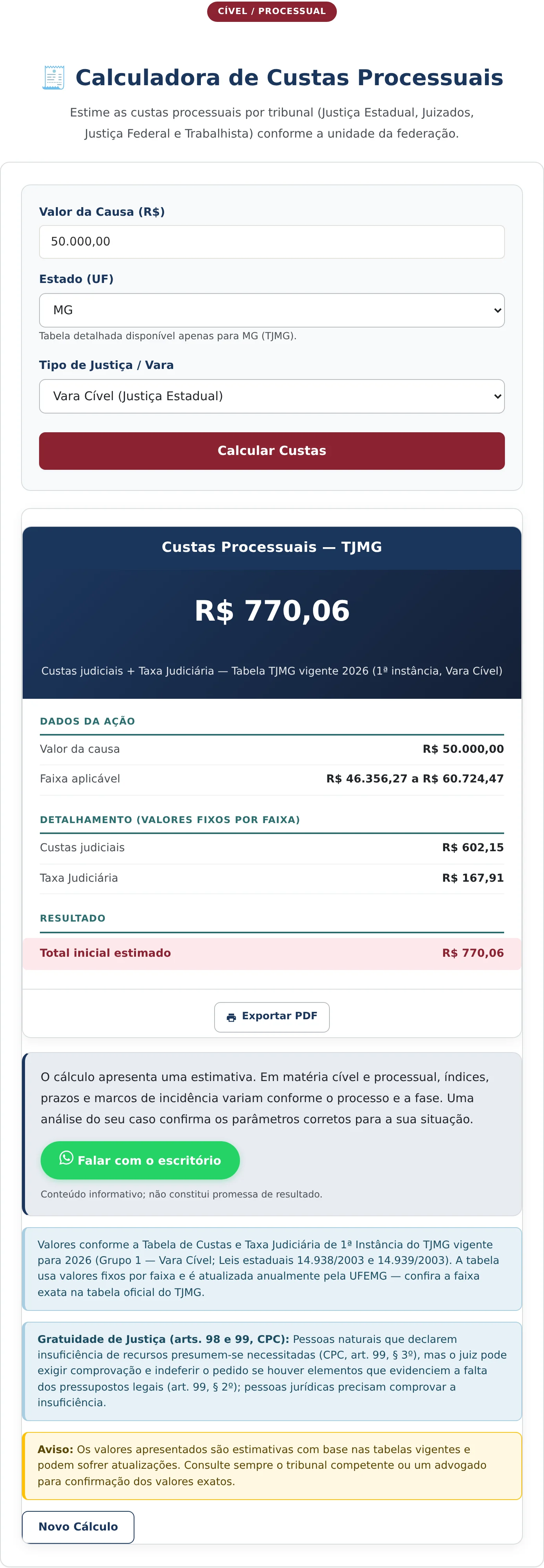
The “Calculate Fees” button opens a card showing the highlighted total, case information, applicable bracket, itemized charges, and notes on the fee schedule used.
How to read each line of the result
In the example, the estimated initial total is R$ 770,06, identified as the sum of court fees and the judicial tax, for trial-level proceedings in a civil court division.
The information section shows the claim value and, immediately below it, the applicable bracket, with its lower and upper limits. This information matters because the schedule uses fixed amounts by bracket, not a continuous percentage.
The practical consequence is significant: within the same bracket, any claim value produces the same fee. An adjustment of a few reais to the claim value does not change the outlay, but an adjustment that crosses the bracket threshold does.
The itemization separates the two charges: court fees of R$ 602,15 and a judicial tax of R$ 167,91. This separation is useful because the charges have different purposes and, in some cases, their own exemption rules.
The footer identifies the fee schedule applied, the court-division group, the effective year, and the state laws governing it, allowing you to compare the estimate with the official source.
The four systems and what changes in each
The selected type of court or division changes the calculation, so it is worth understanding the logic of each system.
In a state civil court division, fees follow the court’s schedule, with initial payment by the plaintiff and additional payments at later stages, such as when filing appeals.
In the special civil court, there are no court fees at the trial level. Payment arises only on appeal, when the appealing party bears the court fees and the appellate filing fee, including amounts waived at the outset.
In the Federal Courts, fees follow a separate federal schedule, with a structure and limits different from state schedules, and the federal special courts also waive the initial payment.
In the Labor Courts, fees are calculated at the end, based on the amount awarded or the claim value, and paid by the losing party; there is no initial outlay by the claimant at the trial level.
There is also fee waiver based on inability to pay, which may apply under any of these systems upon proof of insufficient resources and whose grant suspends the enforceability of court fees and attorneys’ fees.
Two practical observations about payment complete the picture.
The first is timing. The initial payment accompanies filing, and the absence of proof of payment results in a notice to cure the defect. If the defect is not cured, the case is dismissed without a decision on the merits, which may result in the loss of a limitations period that expires in the interim.
The second is reimbursement. When an action is dismissed before service of process, part of the amount paid may be refunded under applicable state legislation, a little-used procedure that requires a separate request.
There is also a final award of court fees. The losing party reimburses the expenses advanced by the prevailing party, meaning that the plaintiff’s initial outlay is recoverable if successful. That recovery is part of the adverse-cost calculation and is often overlooked when assessing the economics of a claim.
What the calculator does not do
The tool estimates the initial outlay. It does not calculate subsequent litigation expenses, such as expert-witness fees, service by judicial officers, publications, and appellate filing fees.
It also does not issue a payment slip or replace the court system, which is the official channel for calculation and payment.
And it does not assess eligibility for a fee waiver based on inability to pay, which depends on the party’s financial circumstances and a specific request in the case record.
Frequently Asked Questions
Are there court fees in the special civil court?
Not at the trial level. Payment occurs only on appeal and includes the amounts waived at the outset, making the appellate stage considerably more costly than filing the action.
Why do claims with different values generate the same fee?
Because the schedule uses fixed amounts by bracket, not a continuous percentage. Within the same bracket, the outlay is identical; variation appears only when the claim value crosses the threshold for the next bracket.
Who pays court fees in the Labor Courts?
The losing party, with payment at the end, calculated on the amount awarded or the claim value. There is no initial outlay by the claimant at the trial level, which distinguishes this system from the one applicable to state civil court divisions.
Receba novidades por e-mail
Cadastre-se gratuitamente para receber nossos novos artigos.
Seus dados estão protegidos conforme a LGPD.
Ficou com dúvidas? Fale com um advogado especialista.
📱 Falar pelo WhatsAppAs informações deste artigo são de caráter informativo e não substituem consulta jurídica individualizada. Cada caso possui particularidades que exigem análise específica.


