
Judicial Index Lookup: Complete Tutorial
Accumulating indices through multiplication and through simple addition produces different results, and judicial calculations do not always allow the former. The website’s index lookup provides the accumulated factor and states the method used.
What the index lookup does
Adjusting amounts requires an accumulated factor, and obtaining that factor means gathering dozens of monthly rates and combining them. The work is mechanical, repetitive, and prone to typing errors that go unnoticed because the result appears plausible.
There is also the issue of method. Accumulating through multiplication, by multiplying the monthly factors, is the mathematically standard procedure. Accumulating through simple addition of the rates is a different procedure, adopted in certain judicial calculation manuals for certain indices.
The difference between the two methods increases with the length of the period and the level of the rates. Over long periods, it ceases to be marginal and becomes a matter for challenge.
The website tool provides the accumulated factor between two reference periods for seven different series, stating the method used and the data coverage.
When the tool helps in a specific case
Its most common use is to obtain the factor for a liquidation spreadsheet, without having to compile the series manually.
Other recurring situations include:
- checking the factor used by the opposing party in a calculation;
- comparing the effect of different indices over the same period;
- adjusting a specific amount by entering the original amount;
- checking the accumulated change of an index over a given interval;
- checking whether there are reference periods without official data available in the database.
That last point is the tool’s quiet advantage. When a reference period is missing from the database, it states how many were actually considered, rather than providing an apparently complete factor.
A factor calculated with a missing reference period is not an incorrect factor: it is an incomplete factor. The difference appears only if the tool gives notice.
The example in this tutorial contains exactly that situation, and the notice appears in the result.
Step by step through the tool screens
The lookup is in the website’s tools section, among the civil and procedural tools, and works in your browser.
1. Open the tool and identify the fields
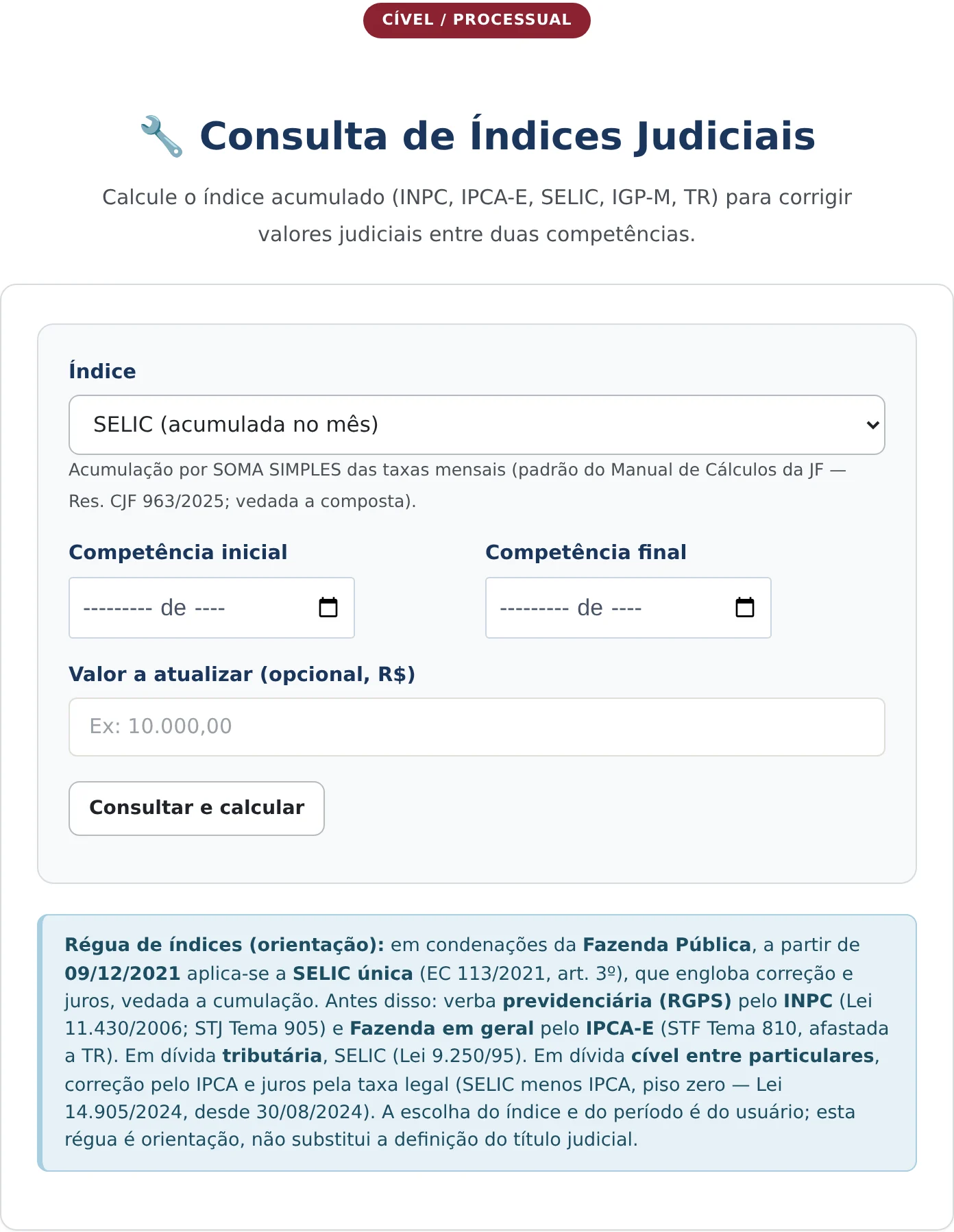
The screen has four fields. The first selects the index, with seven options that include the basic rate, consumer price indices, the general market index, the benchmark rate, and savings-account yield.
The next two define the initial and final reference periods, entered by month and year. The fourth is optional and accepts the amount to be adjusted, if you want more than the factor.
Below the selector is a relevant technical note stating the accumulation method used and its corresponding basis in the applicable calculation manual.
2. Define the index and period
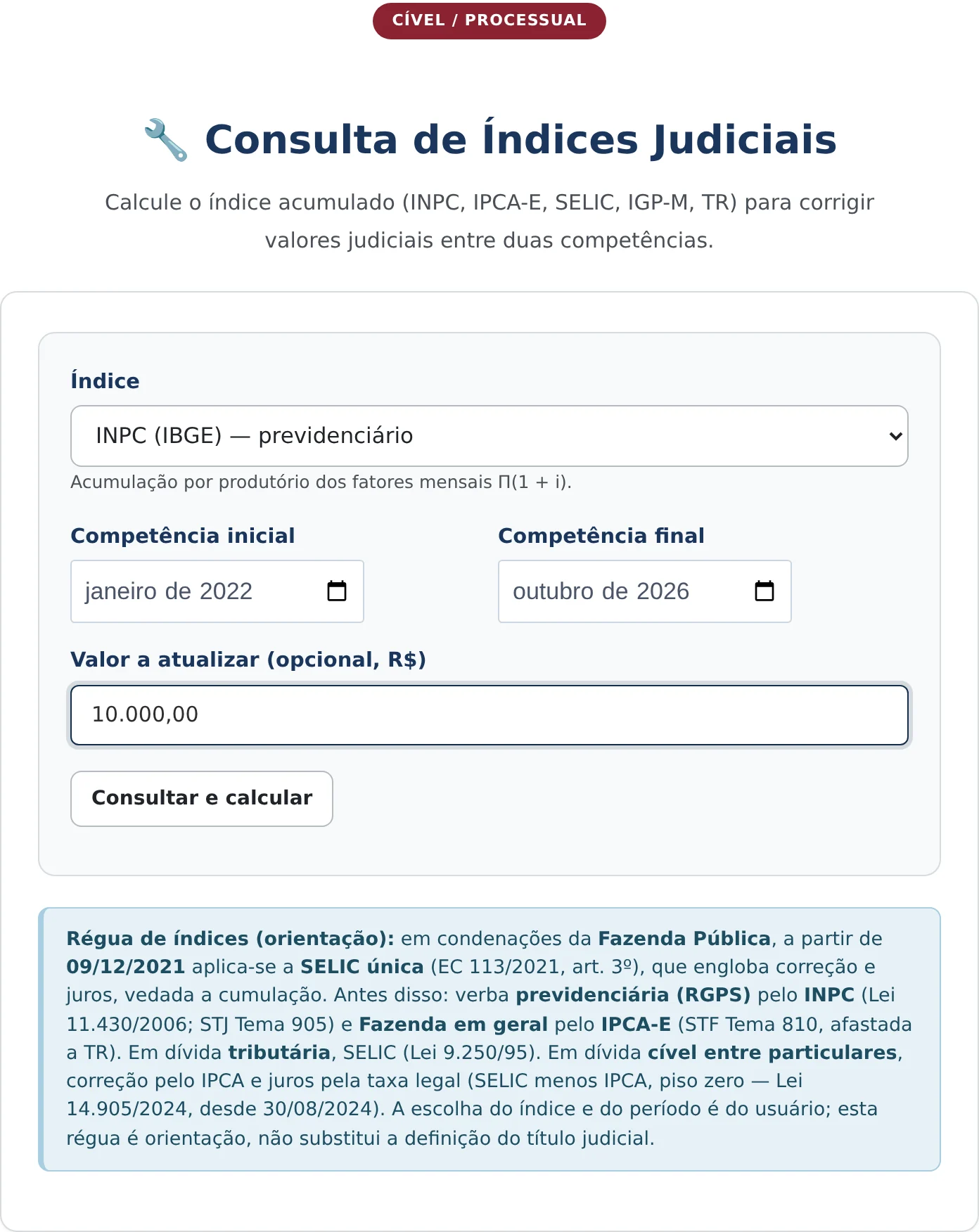
In the example, the selected index is the consumer price index used in social security matters, the period runs from January 2022 through October 2026, and the amount entered is R$ 10.000,00.
The choice of index must follow the legal regime applicable to the claim, not the convenience of the result. The tool labels each series with its typical application, which guides the selection.
3. Run the lookup and read the result
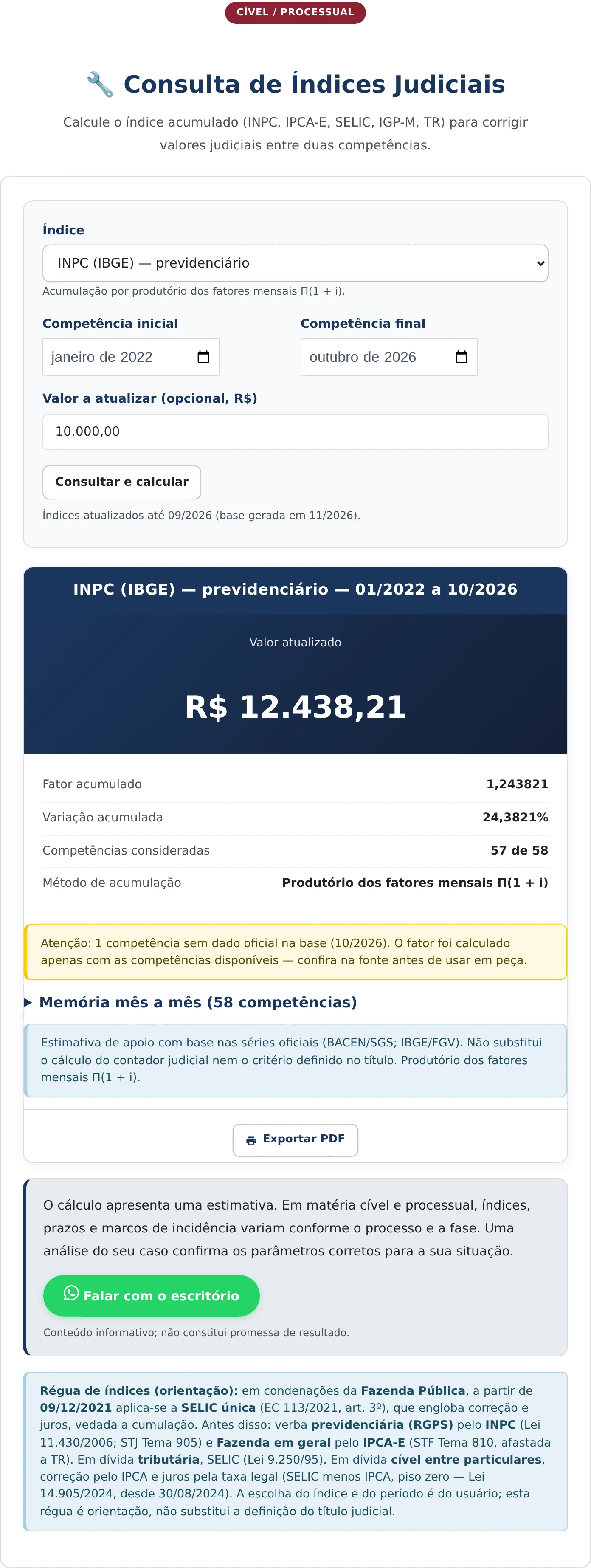
The lookup button opens a card displaying the adjusted amount prominently, the accumulated factor, the percentage change, the number of reference periods considered, the accumulation method, and the month-by-month breakdown.
How to read each line of the result
In the example, the adjusted amount is R$ 12.438,21, with an accumulated factor of 1,243821 and a change of 24,3821% over the period.
The line for reference periods considered shows 57 of 58, and the corresponding notice appears immediately below: one reference period had no official data in the database, and the factor was calculated only with those available.
This notice is the most valuable information on the card. It indicates that the factor is understated in relation to the full period and recommends checking the source before using it in a filing.
The method line states the multiplication of the monthly factors, with the formula shown. This statement makes it possible to compare the result with spreadsheets that use simple addition and explains any discrepancy without having to redo the entire calculation.
The expandable month-by-month breakdown shows each reference period with its respective index. It is the tool for line-by-line verification when there is a challenge.
The footer identifies the sources of the series and states that the lookup does not replace the judicial accountant’s calculation or the criterion defined in the governing instrument, properly defining the tool’s scope.
Multiplication and simple addition: why the difference matters
The distinction between the methods is worth developing because it is a frequent source of disagreement in enforcement proceedings.
With multiplication, each monthly factor is multiplied by the previous accumulated amount. A rate of one percent over two months produces an accumulated increase of 2,01%, not 2%, because the second month applies to the amount already adjusted.
With simple addition, the rates are merely added together, and the result for the two months is exactly 2%. The method disregards application to the accumulated amount, making it similar to a simple-interest regime.
The choice between the methods is not mathematical: it is regulatory. Judicial calculation manuals require simple addition for the basic rate in certain contexts, precisely to avoid compounding, while price indices are traditionally accumulated through multiplication.
The practical consequence is that the same index, over the same period, may produce two valid factors depending on the applicable regime. That is why stating the method in the result is not a technical detail: it is a condition for the calculation to be reproducible.
A word about the choice of index, because it determines the result before any calculation is made.
For social security awards before unification under the basic rate, the usual adjustment index was the consumer price index aimed at lower-income brackets, because it better reflects the insured person’s purchasing power.
For awards against the public treasury in non-tax matters, a broad special consumer price index applied, and in tax matters the basic rate applied, as it already serves a dual function.
In contracts, the agreed-upon index prevails, and replacing it requires an agreement or a decision recognizing that the selected index is abusive or unsuitable.
This distribution explains why the tool offers seven series and labels each with its typical application: the choice is not a preference, but a consequence of the legal regime governing the claim.
What the tool does not do
The lookup does not determine the applicable index, which follows from the governing instrument, the decision, or the nature of the debt.
It also does not calculate default interest or combine monetary adjustment and interest, an operation that requires a defined regime and is addressed by another tool in the collection.
And it does not replace checking the official source when a reference period is missing, a situation the tool itself flags.
Frequently Asked Questions
What is the difference between multiplication and simple addition?
With multiplication, the monthly factors are multiplied, so that each month applies to the previous accumulated amount. With simple addition, the rates are merely added together. The second method produces a lower result and is adopted in certain judicial calculations to avoid compounding.
What does a reference period without official data mean?
It means that the index for that month has not yet been published or is not included in the database used. The factor is then calculated only with the available reference periods, and the result is understated in relation to the full period requested.
Can the factor obtained be used in a court filing?
It can be used as a verification and estimation tool. The official calculation follows the criterion defined in the governing instrument or by the court, and the result footer states that the lookup does not replace the judicial accountant’s calculation.
Receba novidades por e-mail
Cadastre-se gratuitamente para receber nossos novos artigos.
Seus dados estão protegidos conforme a LGPD.
Ficou com dúvidas? Fale com um advogado especialista.
📱 Falar pelo WhatsAppAs informações deste artigo são de caráter informativo e não substituem consulta jurídica individualizada. Cada caso possui particularidades que exigem análise específica.


