
Disability Retirement Benefits: A Tutorial
Disability retirement benefits reduce the required time based on the degree of disability and pay 100 percent of the benefit calculation base. The website’s simulator converts periods between degrees and projects the date you first qualify.
What the disability retirement simulator does
The supplementary law governing this matter created a separate framework that is more advantageous than the general rules in two ways at the same time.
The first is the required time. Based on contribution time, retirement is available to men with twenty-five, twenty-nine, or thirty-three years, depending on whether the degree of disability is severe, moderate, or mild, with an equivalent reduction for women.
The second is the amount. Unlike the rules introduced after the reform, this option preserves payment of 100 percent of the benefit calculation base under the contribution-time option, without the progressive coefficient.
There is also an age-based option, at sixty for men and fifty-five for women, requiring fifteen years of contributions as a person with a disability.
The complexity lies in the conversion. Periods worked at different degrees of disability, or without a disability, must be converted to the predominant degree using specific tables.
The website’s simulator performs this conversion and projects the date when the requirements will be met.
When the tool helps in your specific case
Its most valuable use is planning, because the difference in required time compared with the general rules is often many years.
Other recurring situations include:
- converting periods worked at different degrees of disability;
- comparing the contribution-time option with the age-based option;
- identifying the predominant degree throughout your career;
- estimating the benefit amount under each option;
- assessing the impact of periods worked without a disability.
Identifying the predominant degree is often misunderstood. It is not the person’s current degree, but rather the degree at which they accumulated the most contribution time throughout their career.
The degree that determines the rule is the one in which the person accumulated the most contribution time, not the person’s current degree.
The example in this tutorial uses a single period at the moderate degree, which makes the mechanics clear.
Step by step with the tool’s screens
The simulator is in the website’s tools section, among the social security tools, and works in your browser.
1. Open the tool and understand its structure
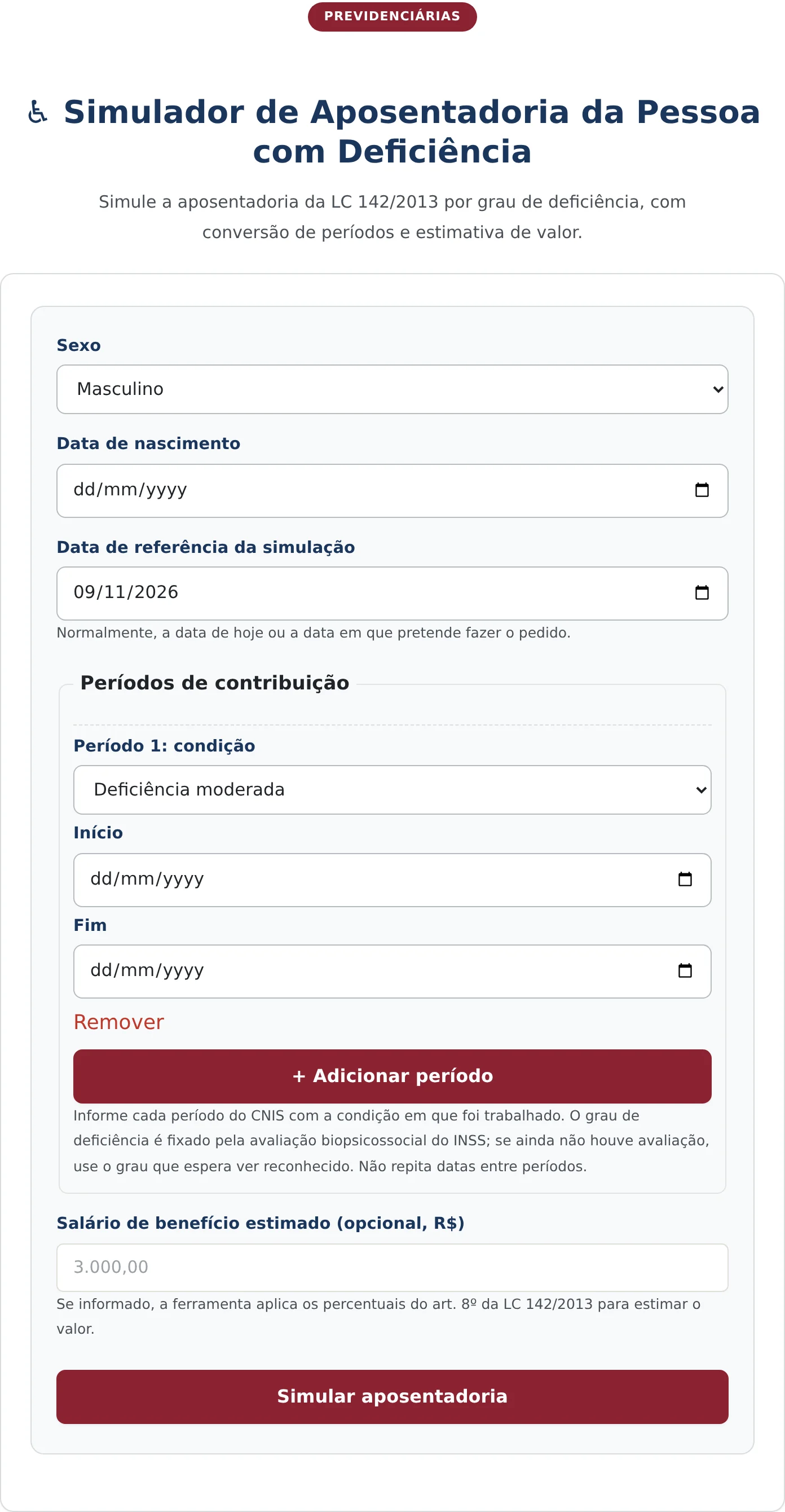
The screen has two sections. At the top are sex, date of birth, and the reference date for the simulation. Below is the list of periods, with one row already open and a button to add others.
For each period, enter the condition, choosing among severe, moderate, mild, or no disability, and the start and end dates. The final field, which is optional, is for the estimated benefit calculation base used to project the amount.
The guidance for the condition field clarifies an essential point: the degree is determined by the biopsychosocial assessment conducted by the social security agency, and the selection on the form is a working assumption.
2. Enter the periods
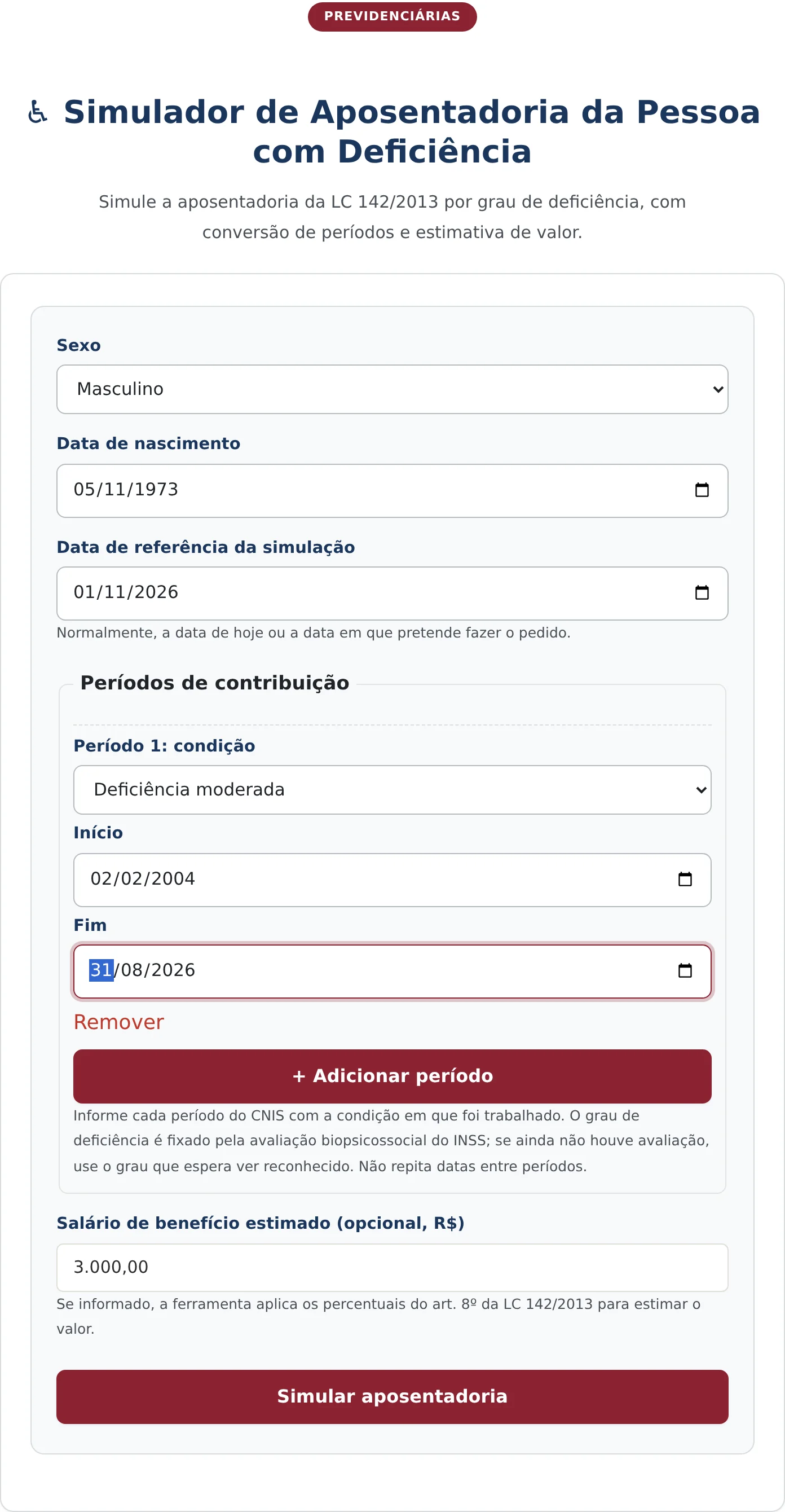
In the example, the person is a man born in November 1973, with a reference date of November 2026, one period at the moderate degree from February 2004 to August 2026, and an estimated benefit calculation base of R$ 3.000,00.
Actual careers often involve several periods. If you acquired a disability during your lifetime, enter the earlier period as no disability and the later periods at the corresponding degree, and the conversion handles the rest.
3. Run the simulation and read the result
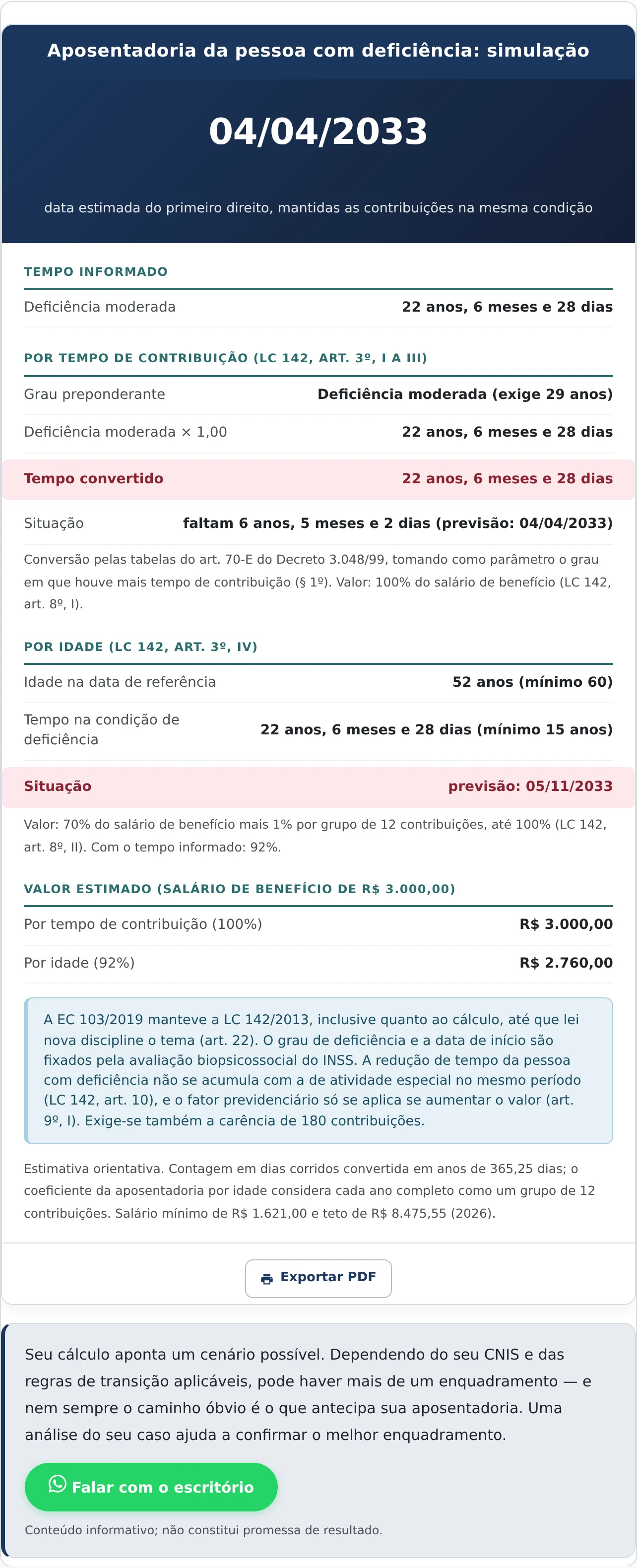
The simulation button opens a card highlighting the estimated date you first qualify, the time entered, the contribution-time analysis, and the age-based analysis.
How to read each line of the result
In the example, the estimated date you first qualify is April 2033, assuming contributions continue under the same condition.
The reported-time section records the period at the moderate degree, totaling twenty-two years, six months, and twenty-eight days.
The contribution-time section identifies the predominant degree as moderate and states the corresponding requirement of twenty-nine years. Because all time was completed at that degree, the conversion factor is neutral and the converted time equals the reported time.
The status line closes the section: six years, five months, and two days remain, with the corresponding projected date. Below it, the tool states the legal basis for the conversion and indicates that the amount equals 100 percent of the benefit calculation base.
The age-based section tests the alternative option. At fifty-two years old on the reference date, compared with the minimum age of sixty, the age requirement has not yet been met, which explains why the contribution-time option comes first in this case.
For careers with little contribution time, the relationship is reversed, and the age-based option becomes the closer one, which is why the simulator tests both.
Conversion between degrees and the biopsychosocial assessment
Two aspects of this framework deserve further explanation.
Conversion exists because a career rarely unfolds entirely under the same condition. Periods at a more severe degree carry greater weight when converted to a milder degree, and the reverse also occurs, according to regulatory tables.
The predominant degree is the conversion parameter, determined by the criterion of the longest period. This choice has an important practical effect: someone who spent little time at a severe degree and much time at a mild degree will have the mild degree as the parameter, with favorable conversion of the more severe period.
Determining the degree is not merely declaratory. It results from a biopsychosocial assessment conducted by a medical team and social services, which considers not only the impairment, but also the barriers it imposes on social participation.
This assessment also determines the date the condition began, which defines which periods may be credited as worked while the person had a disability.
That is why the simulator states that it works with an assumption: until the assessment takes place, the degree entered is an estimate, and the result shares that nature.
It is worth noting that proof of disability in past periods is often the most labor-intensive part of the application.
The assessment determines not only the degree, but also the probable date the disability began, and that date defines which periods may be credited under the condition. Medical documentation from the relevant periods supports that recognition.
Medical reports, examinations, medical records, leave records, and documents granting other benefits make up this body of evidence. The older the period you seek to classify, the more important evidence from that time becomes.
What the simulator does not do
The tool does not conduct or anticipate the biopsychosocial assessment, which is an act of the social security agency and determines the actual degree.
It also does not credit special service time for exposure to harmful agents, a separate situation governed by its own conversion rules and not to be confused with disability.
And it does not calculate the average contribution salaries, so the projected amount depends on the estimate entered by the user.
Frequently Asked Questions
How much contribution time is required?
It depends on the predominant degree: twenty-five, twenty-nine, or thirty-three years for men, depending on whether the degree is severe, moderate, or mild, with an equivalent reduction for women. There is also an age-based option, with fifteen years of contributions under the condition.
How is the degree of disability determined?
Through a biopsychosocial assessment conducted by the social security agency, with medical and social services participation, which considers the impairment and barriers to social participation. The degree entered in the simulator is a working assumption until that assessment.
Is the benefit amount paid in full?
Under the contribution-time option, it equals 100 percent of the benefit calculation base, without the progressive coefficient under the general rules. This is one of the most relevant advantages of this framework, alongside the reduction in required time.
Receba novidades por e-mail
Cadastre-se gratuitamente para receber nossos novos artigos.
Seus dados estão protegidos conforme a LGPD.
Ficou com dúvidas? Fale com um advogado especialista.
📱 Falar pelo WhatsAppAs informações deste artigo são de caráter informativo e não substituem consulta jurídica individualizada. Cada caso possui particularidades que exigem análise específica.


