
Rural and Hybrid Retirement Benefits: Simulator Guide
If you worked in rural areas and later in the city, you do not have to choose: hybrid retirement adds both periods together. The website’s simulator compares the three age-based benefit types and shows which requirements you already meet.
What the rural and hybrid retirement simulator does
Three age-based retirement benefit types may apply to the same life history, and their requirements differ considerably.
Rural retirement requires a lower age, sixty for men and fifty-five for women, along with fifteen years of rural activity. The benefit equals one minimum wage, and a segurado especial (special rural insured person) does not need to prove contributions.
Urban retirement requires sixty-five years of age for men and sixty-two for women, as well as a minimum contribution period that varies depending on whether enrollment occurred before or after the 2019 reform.
Hybrid retirement bridges the two. It combines rural and urban time to meet the required minimum, using the age requirement for urban retirement. Rural time counts even without contributions, including older periods and periods before 1991, as established in a repetitive-appeals ruling by the Superior Court of Justice.
The website’s simulator takes seven pieces of information and tests all three options, showing which requirements have already been met and what remains for each one.
When the tool helps in your specific case
Its greatest value is in screening people who worked on farms when they were young and later moved to the city, an extremely common profile that is often poorly advised.
Other recurring situations include:
- discovering that you already qualify for hybrid retirement while you do not yet qualify for rural retirement;
- measuring what remains for each benefit type separately;
- checking the effect of the recent rural activity requirement;
- comparing the estimated amount under each benefit type;
- assessing the impact of enrollment before or after the reform.
The recent rural activity requirement is the trap in rural retirement. It requires farm work during the period immediately before the application or the month in which you reached the required age, and people who left rural work decades ago lose access to this benefit type, even if they have fifteen years of farm work.
People who left rural work decades ago lose rural retirement, but they do not lose that time: it still counts toward hybrid retirement.
The example in this guide shows exactly that situation, using fictional information selected for demonstration purposes.
Step by step through the tool’s screens
The simulator is in the website’s tools section, among the social security tools, and works in your browser.
1. Open the tool and identify the fields
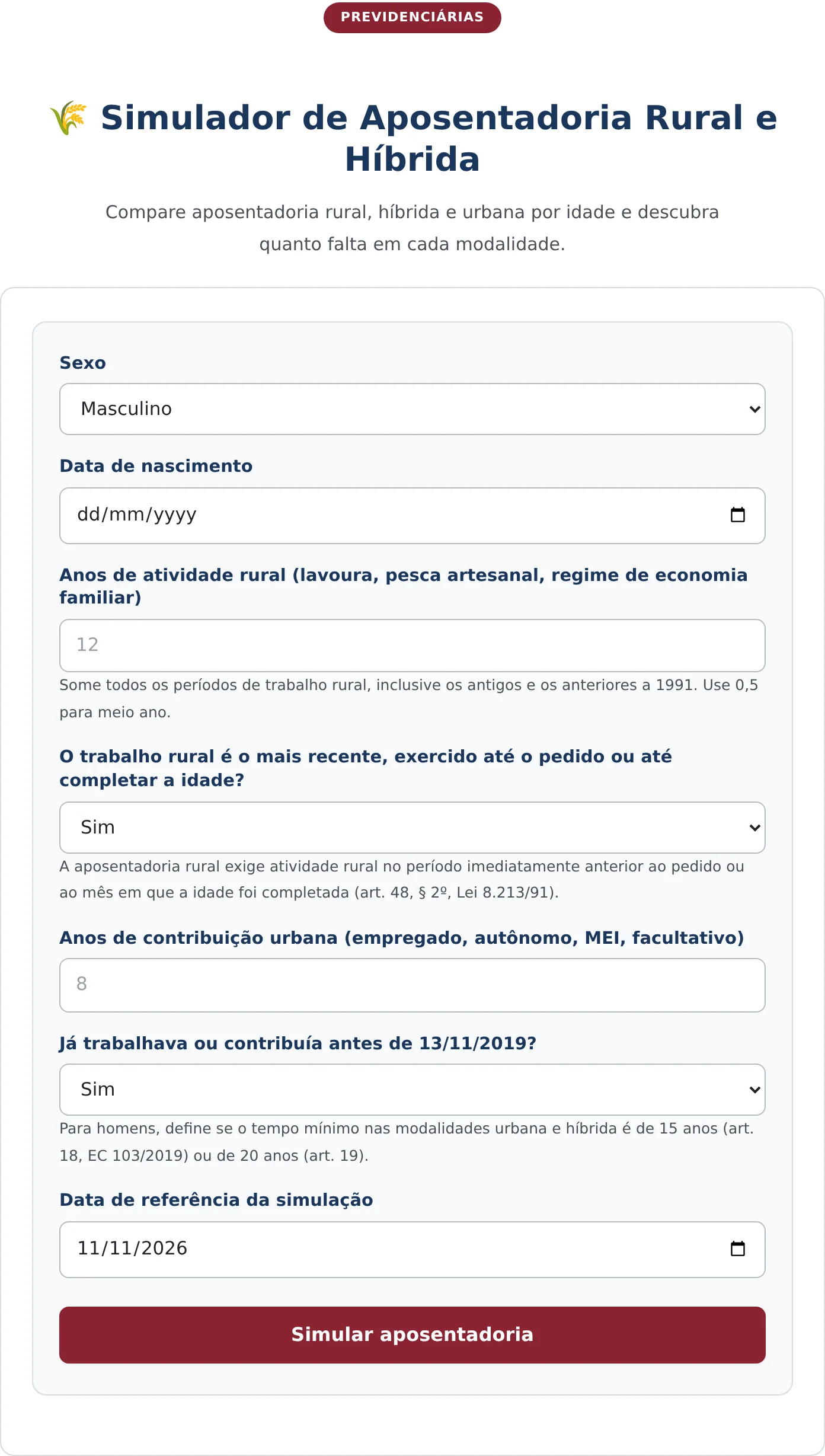
The screen has seven fields. The first two are sex and date of birth. The third asks for years of rural activity, with instructions to add all periods together, including older periods and those before 1991, and to use half a year as a fraction where applicable.
The fourth asks whether rural work was your most recent work, performed until the application or until you reached the required age, and it determines access to rural retirement.
The final three fields are years of urban contributions, enrollment before November 13, 2019, and the reference date for the simulation.
2. Enter the details of your work history
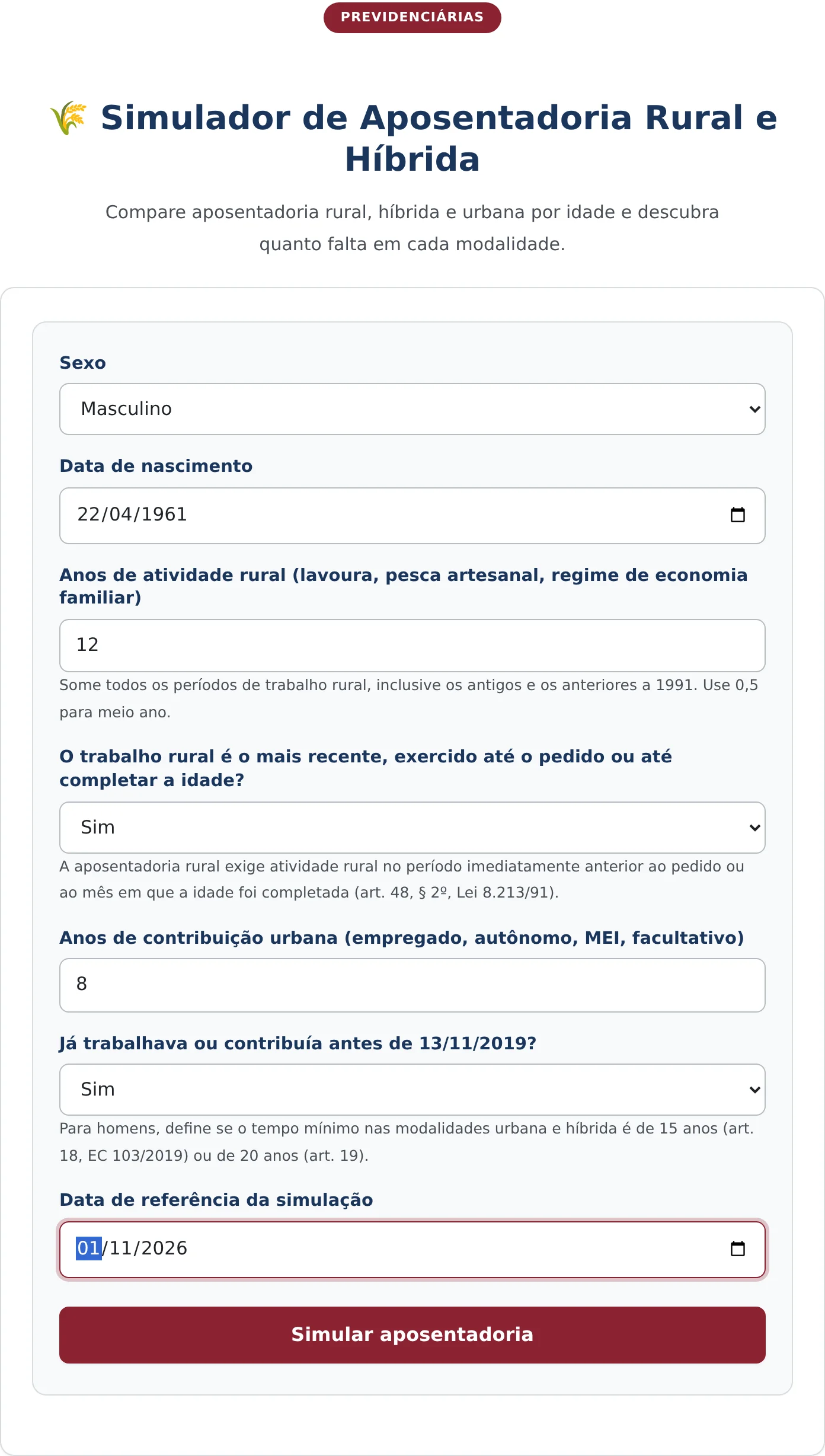
In the example, the person is a man born in April 1961, with twelve years of rural activity, rural work as his most recent work, eight years of urban contributions, enrollment before the reform, and a reference date in November 2026.
Separating rural and urban time is the most delicate part of completing the form. Rural time is often shown in old documents and depends on an início de prova material (initial documentary evidence); urban time comes from the social security statement.
3. Run the simulation and read the comparison
The simulation button opens a panel with the conclusion highlighted and, below it, one section for each benefit type, each showing the marked requirements, a projected date where applicable, and the formula used to calculate the amount.
How to read each section of the result
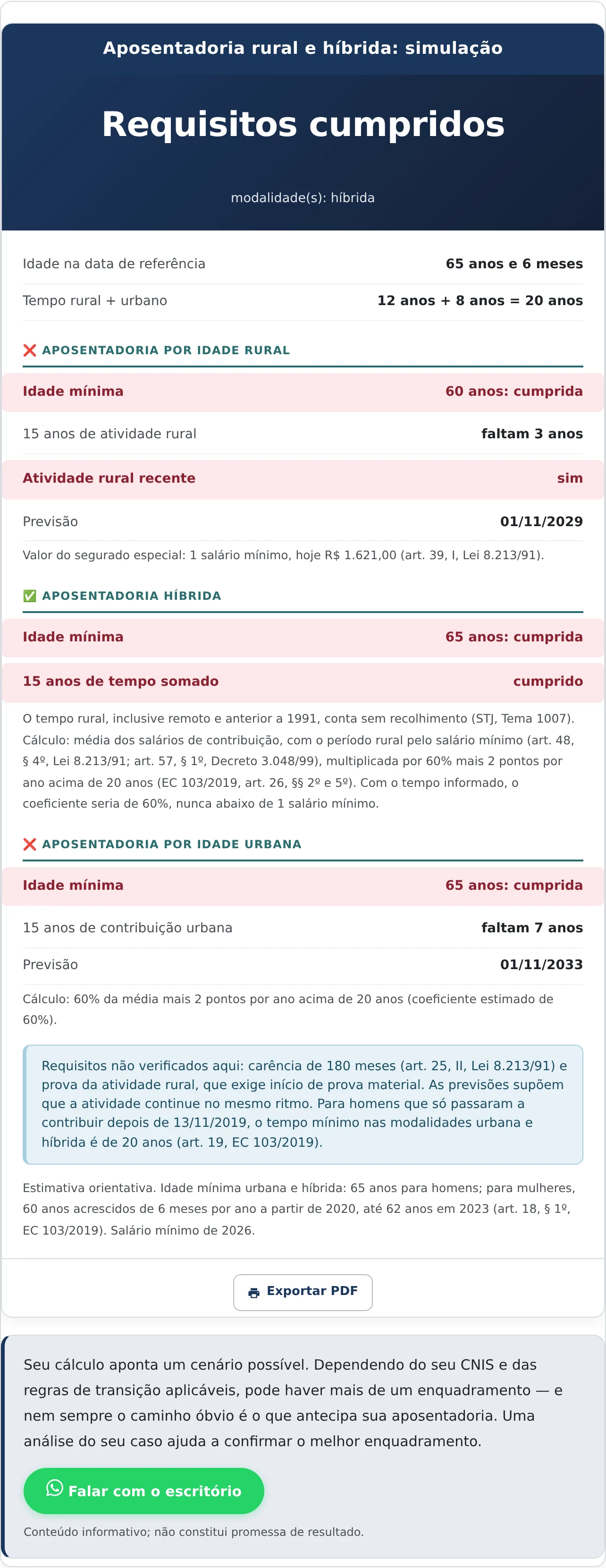
In the example, the conclusion indicates that the requirements for hybrid retirement have been met. The header summarizes the age of sixty-five years and six months on the reference date, along with the combined time: twelve years of rural work plus eight years of urban work equals twenty years.
The rural retirement section is marked as not met. The minimum age of sixty has been met and the rural activity is recent, but three years are still missing from the required fifteen years of farm work. The corresponding projected date is shown, and the amount would be one minimum wage.
The hybrid retirement section is marked as met. The minimum age of sixty-five has been met, as have the fifteen years of combined time. Just below, the tool notes the basis that makes this possible: rural time, including remote periods and periods before 1991, counts without contributions.
The calculation of the amount is then explained: the average of contribution wages, with the rural period considered at the minimum wage, multiplied by the coefficient of sixty percent plus two percentage points for each year above twenty years. With the reported time, the coefficient would be sixty percent, never less than one minimum wage.
The urban age-based retirement section completes the comparison and is marked as not met: the age requirement has been met, but seven years of urban contributions are still missing, with a projected date in 2033.
The difference between the projected dates is the tool’s most useful result. Hybrid retirement is available now; rural retirement would be available in 2029 and urban retirement in 2033.
Remote rural time and the evidence it requires
The issue that most often decides these cases is not the calculation, but the evidence.
Rural time under a family-economy regime does not generate contributions and therefore does not appear on the social security statement. It must be shown through an início de prova material, meaning documents from the relevant period that indicate the activity.
Documents that can serve this purpose include, among others, rural producer invoices, partnership or lease agreements, registration with a rural workers’ union, certificates identifying the person as a farm worker, children’s school records showing a rural address, and records of rural property in the family’s name.
Witness testimony alone is not enough, although witnesses are permitted and often necessary to extend the time period covered by the document that was found.
The self-declaration of rural activity, provided for in the social security authority’s own form, is part of this body of evidence, but it does not eliminate the need for the initial documentary evidence that must accompany it.
For this reason, the tool’s own result warns that it does not verify evidence of rural activity, nor the qualifying period required for urban retirement.
What the simulator does not do
The tool does not verify the qualifying period or assess evidence of rural time, limitations stated in the result itself.
It also does not calculate the average of contribution wages, so the amount is addressed through the applicable formula rather than through a calculation of the actual amount.
Nor does it address retirement based on contribution time or transition rules, matters covered by other tools in the collection.
Frequently Asked Questions
Does older rural time still count?
Yes, including periods before 1991 and periods worked decades ago, without the need for contributions, as established in a repetitive-appeals ruling by the Superior Court of Justice. What it requires is initial documentary evidence from the relevant period.
Do people who left rural work long ago lose their right?
They lose access to rural retirement, which requires farm work during the period immediately before the application or before reaching the required age. Rural time, however, remains valid for hybrid retirement, which combines rural and urban periods.
What is the difference between hybrid and rural retirement?
Rural retirement requires a lower age, fifteen years of farm work, and recent activity, and pays one minimum wage. Hybrid retirement uses the age requirement for urban retirement, combines rural and urban time, and calculates the amount based on the average of contribution wages, with the rural period considered at the minimum wage.
Receba novidades por e-mail
Cadastre-se gratuitamente para receber nossos novos artigos.
Seus dados estão protegidos conforme a LGPD.
Ficou com dúvidas? Fale com um advogado especialista.
📱 Falar pelo WhatsAppAs informações deste artigo são de caráter informativo e não substituem consulta jurídica individualizada. Cada caso possui particularidades que exigem análise específica.


