
Abusive Clause Checker: Tutorial
An abusive clause is void as a matter of law, not merely voidable upon request. The website’s checker identifies the item of art. 51 of the Consumer Protection Code violated in each situation and the corresponding consequence.
What the abusive clause checker addresses
Consumer contracts are generally adhesion contracts. The consumer does not negotiate their terms: they either accept them or do not enter into the contract. This imbalance led the legislature to establish content review, listing clauses that are void regardless of the adherent party’s consent.
The nullity here arises as a matter of law. It does not require judicial invalidation to exist, may be recognized by the court on its own initiative, and is not cured by the consumer’s signature. This framework is what distinguishes consumer-law review from the general civil-law framework.
The practical difficulty lies in identifying the applicable provision. The statutory list is extensive and uses open-ended concepts, such as excessive advantage and incompatibility with good faith, whose application depends on knowing how the courts have given them concrete meaning.
The website’s checker turns this list into a review guide, with checkboxes corresponding to the most common situations, and returns the applicable item and the consequence of each one.
When the tool helps in a specific case
Its most direct use is the critical review of a contract you have received, before signing it or when disputing a charge.
Other recurring situations include:
- supporting an administrative complaint against the supplier;
- organizing the initial complaint in an action to revise a contract;
- identifying the corresponding statutory item for each defect;
- checking the application of the Code to banking contracts;
- reviewing health-plan clauses for hospitalization limits.
The banking scenario deserves special attention. Financial institutions have argued that the Code would not apply to their transactions, a position superseded by established case law, and the corresponding checkbox exists to record that objection when it arises.
Nullity as a matter of law is not cured by a signature. A consumer who accepted an abusive clause may still challenge it.
This is the basis presented in the result for each selected situation.
Step-by-step guide with the tool’s screens
The checker is in the website’s tools section, among the civil and consumer-law tools, and works in your browser.
1. Open the tool and understand its structure
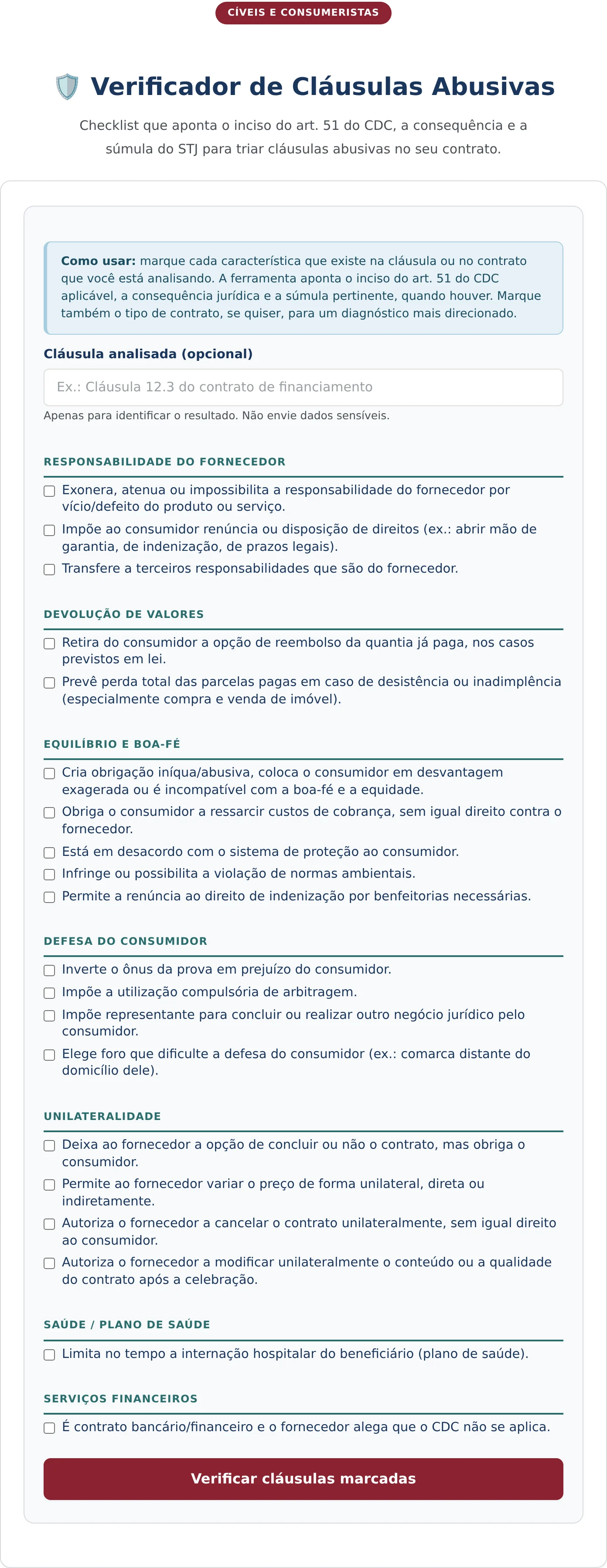
The screen opens with an optional field to identify the clause being analyzed, along with a warning not to enter sensitive data. The checklist itself appears below.
Each checklist item describes a potentially abusive situation in language close to the statutory text, making it easier to compare with the wording of the contract in hand. The checkboxes allow multiple selections.
2. Select the applicable situations
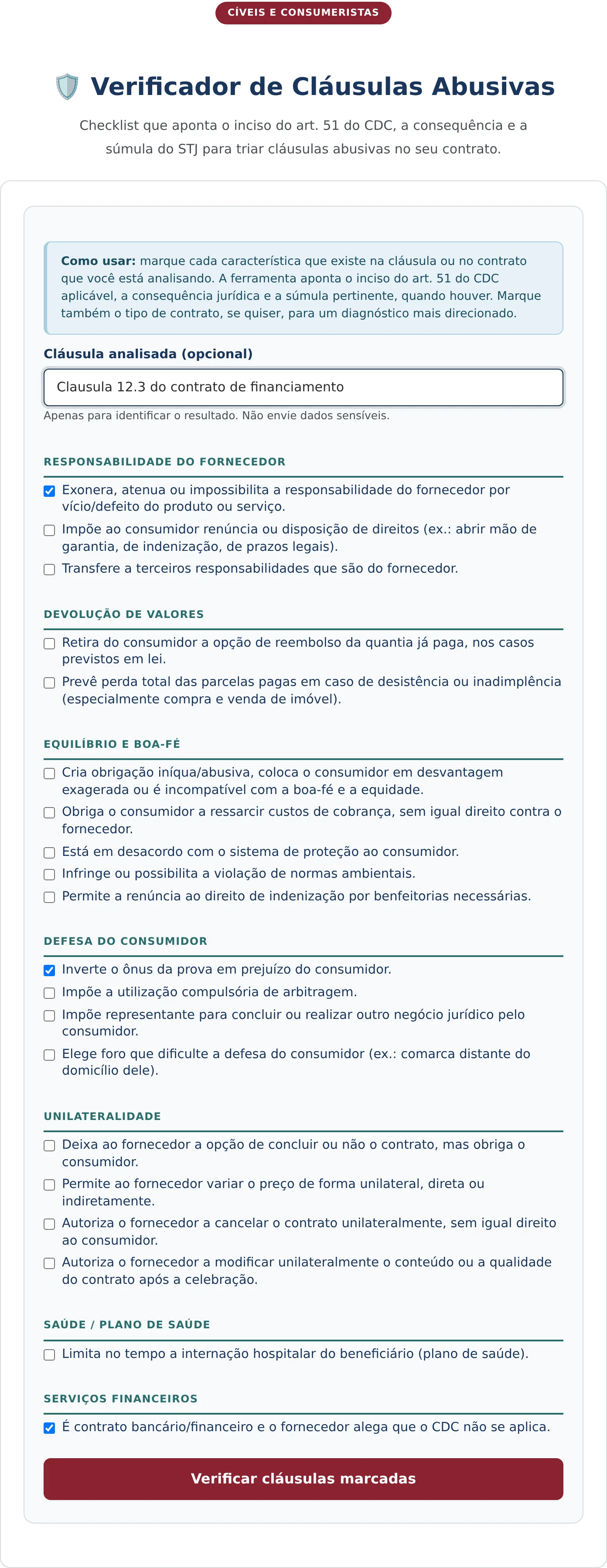
In the example, the clause being analyzed is identified by a fictional loan agreement number, and three situations are selected: the supplier’s exclusion of liability, reversal of the burden of proof to the consumer’s detriment, and the claim that the Code does not apply to a banking contract.
Multiple selections reflect the reality of adhesion contracts, in which defects are often cumulative. A clause may simultaneously limit liability and reverse the burden of proof.
3. Check and read the result
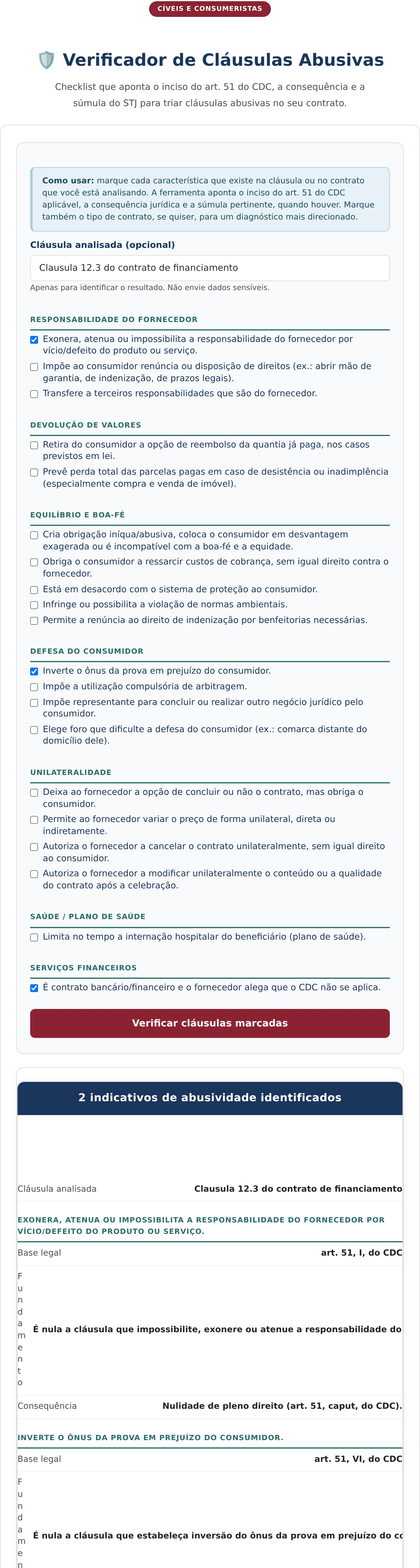
The check button opens a card showing the number of indicators found, the screening conclusion and, for each situation, the legal basis, rationale and consequence.
How to read each result section
In the example, the card reports two identified indicators of abusiveness and concludes that the clause is probably abusive, noting the advisory nature of the screening.
The first section addresses exclusion of liability. The legal basis is item I of art. 51, and the rationale restates the rule: a clause that prevents, excludes or mitigates the supplier’s liability for defects of any kind, or entails the waiver of consumer rights, is void.
The second section addresses reversal of the burden of proof to the consumer’s detriment, based on item VI of the same article. In both cases, the consequence is the nullity as a matter of law provided for in the caput.
This three-line structure for each situation, with legal basis, rationale and consequence, makes the result directly usable in a pleading or an administrative complaint.
The conclusion uses the phrase probably abusive, and that choice is correct: the screening identifies indications based on what was selected, while recognizing nullity depends on analyzing the full text of the clause and the contract’s context.
The consequences of recognizing nullity
Identifying an abusive clause is only the beginning. It is worth understanding the effects of recognizing it.
The first effect is that the clause is invalid without invalidating the entire contract. The system preserves the transaction and removes the defective clause, except where its absence would create an excessive burden for either party.
The second is the possibility of restitution. Amounts charged based on a void clause may be recovered, and double reimbursement is available when the improper charge results from conduct without a justifiable mistake.
The third is the possibility of revision. When a clause establishes a disproportionate obligation or becomes excessively burdensome because of a subsequent event, the law allows the contract to be modified or revised.
There is also administrative review. Consumer-protection agencies may issue a citation to the supplier for an abusive clause, and the administrative sanction does not depend on an individual court action.
These effects explain why reviewing a contract in advance has concrete value: it helps you decide whether to negotiate, file an administrative complaint or go to court.
It is worth noting what distinguishes an abusive clause from one that is merely unfavorable, because confusion between the two leads to unfounded claims.
By their nature, contracts contain clauses that favor one party and burden the other. Waiting periods, early-termination penalties and security requirements burden the consumer and are generally lawful, provided they are proportionate and clearly disclosed.
Abusiveness arises when a clause unjustifiably disrupts the balance, shifts to the consumer a risk inherent in the supplier’s business activity or removes a right guaranteed by law. The standard is not inconvenience, but disproportion.
This is why the duty to provide information is central. A clause that limits a right must be drafted prominently enough to allow immediate understanding, and the absence of that prominence alone compromises its effectiveness against the consumer.
What the tool does not do
The checker does not read the contract. The user selects the situations based on reading the text, and the classification depends on that reading.
It also does not cover every situation in the statutory list or the case-law developments specific to each sector, such as insurance, health plans and financial services, which have their own particularities.
Nor does it assess the contract as a whole. An isolated clause may appear abusive but cease to be so in light of consideration provided elsewhere in the instrument.
Frequently Asked Questions
Does signing the contract cure the abusive clause?
No. The nullity arises as a matter of law and does not depend on the consumer’s consent; it may be recognized even after the contract is signed. This is the main difference between the consumer-law framework and the general civil-law framework for nullities.
Does the Consumer Protection Code apply to banking contracts?
Yes. The argument that it does not apply was superseded by established case law, and financial institutions are subject to the consumer-law framework in transactions with end users, including with respect to the review of abusive clauses.
Does recognizing nullity invalidate the entire contract?
Generally, no. The void clause is removed and the remainder of the contract remains valid, except where its absence would make the transaction excessively burdensome for either party, in which case revision or termination is permitted.
Receba novidades por e-mail
Cadastre-se gratuitamente para receber nossos novos artigos.
Seus dados estão protegidos conforme a LGPD.
Ficou com dúvidas? Fale com um advogado especialista.
📱 Falar pelo WhatsAppAs informações deste artigo são de caráter informativo e não substituem consulta jurídica individualizada. Cada caso possui particularidades que exigem análise específica.


