
Federal Civil Servant Retirement: A Tutorial
Federal civil servants must meet four cumulative requirements, not two: age, contribution period, public-service period, and time in the permanent position. The website’s checker tests them all under each rule and shows what is still missing.
What the public-service retirement checker does
Federal civil servant retirement is often confused with retirement under the general system, but the differences are structural.
The first difference is the number of requirements. In addition to age and contribution period, the rules require a minimum period of public service and a minimum period in the permanent position from which retirement will be granted. A civil servant may have forty years of contributions and still be unable to retire because they lack sufficient time in their current position.
The second is the existence of transition rules specific to public service, distinct from those of the general system, created by the same constitutional amendment but with parameters specific to public service.
The third concerns full benefits and parity. Civil servants who entered service by a certain date may be entitled to a benefit equal to their final compensation and to adjustments linked to those granted to active employees, benefits that later rules do not provide.
The website’s checker takes seven pieces of information and tests each rule, requirement by requirement, indicating what has already been met and what is still missing.
When the tool helps in a specific case
Its most valuable use is career planning, especially for those considering changing positions and who may lose accrued time in a permanent position.
Other recurring situations include:
- identifying which transition rules apply to the civil servant;
- checking eligibility for full benefits and parity based on the date of entry;
- measuring what remains for each requirement separately;
- comparing the timing of eligibility under the available rules;
- assessing how the date of entry into public service affects the options.
The requirement-by-requirement view is the distinguishing feature. Knowing that three years remain is useful; knowing that only three years of age remain, with everything else met, leads to a different decision.
Changing permanent positions resets the time in the position, which is an independent requirement. This is the least-known trap in the public-service system.
The example in this tutorial presents the four requirements side by side, using fictional information selected for demonstration purposes.
Step by step through the tool’s screens
The checker is in the website’s tools area, among the social-security tools, and works in your browser.
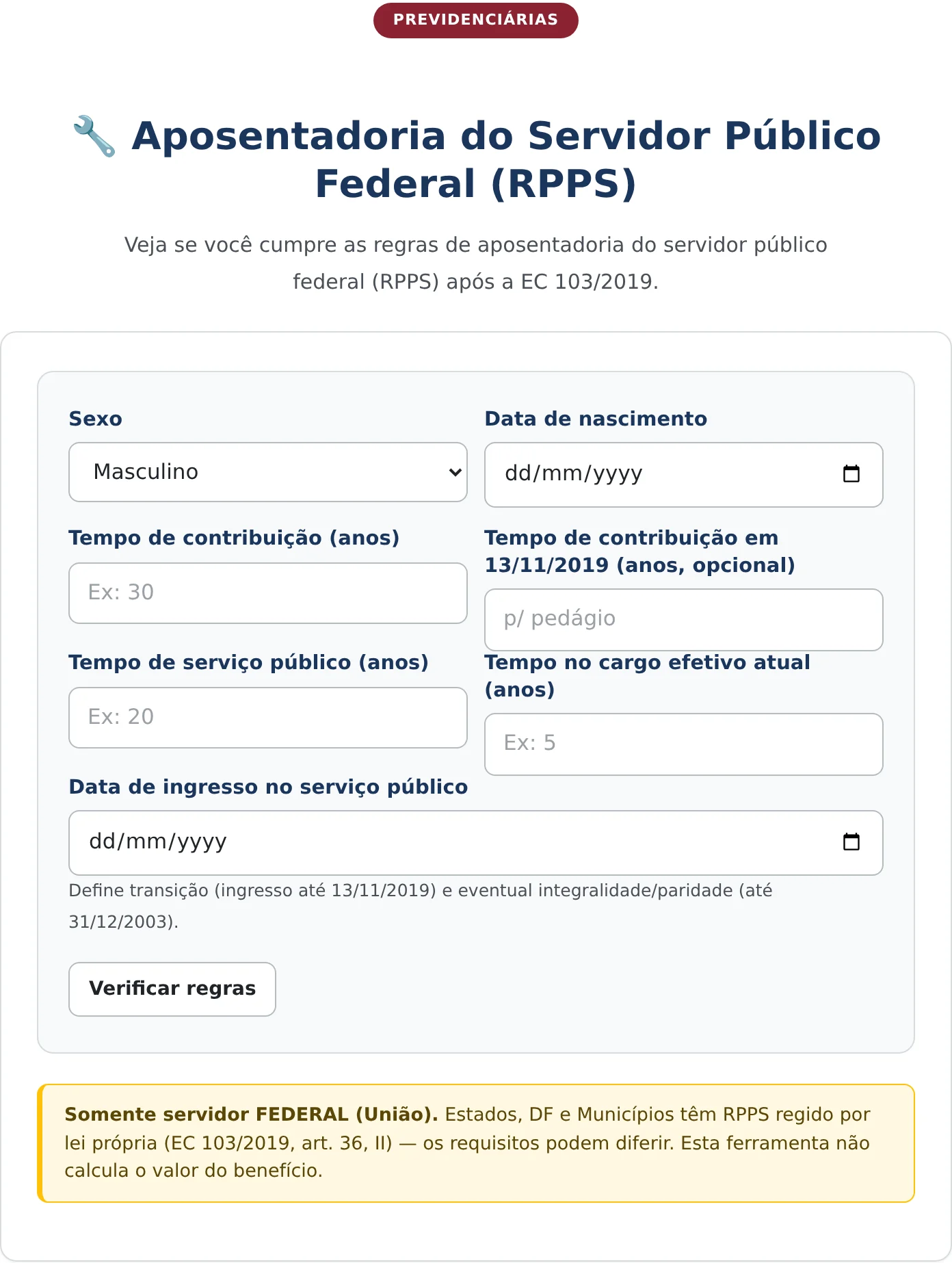
1. Open the tool and identify the fields
The screen contains seven fields. The first two are sex and date of birth. The next three capture total contribution period, the contribution period already accrued on the date of the reform, and public-service period.
The final two are time in the current permanent position and the date of entry into public service. This last field includes guidance explaining its importance: it determines access to transition rules and potential eligibility for full benefits and parity.
2. Enter your employment information
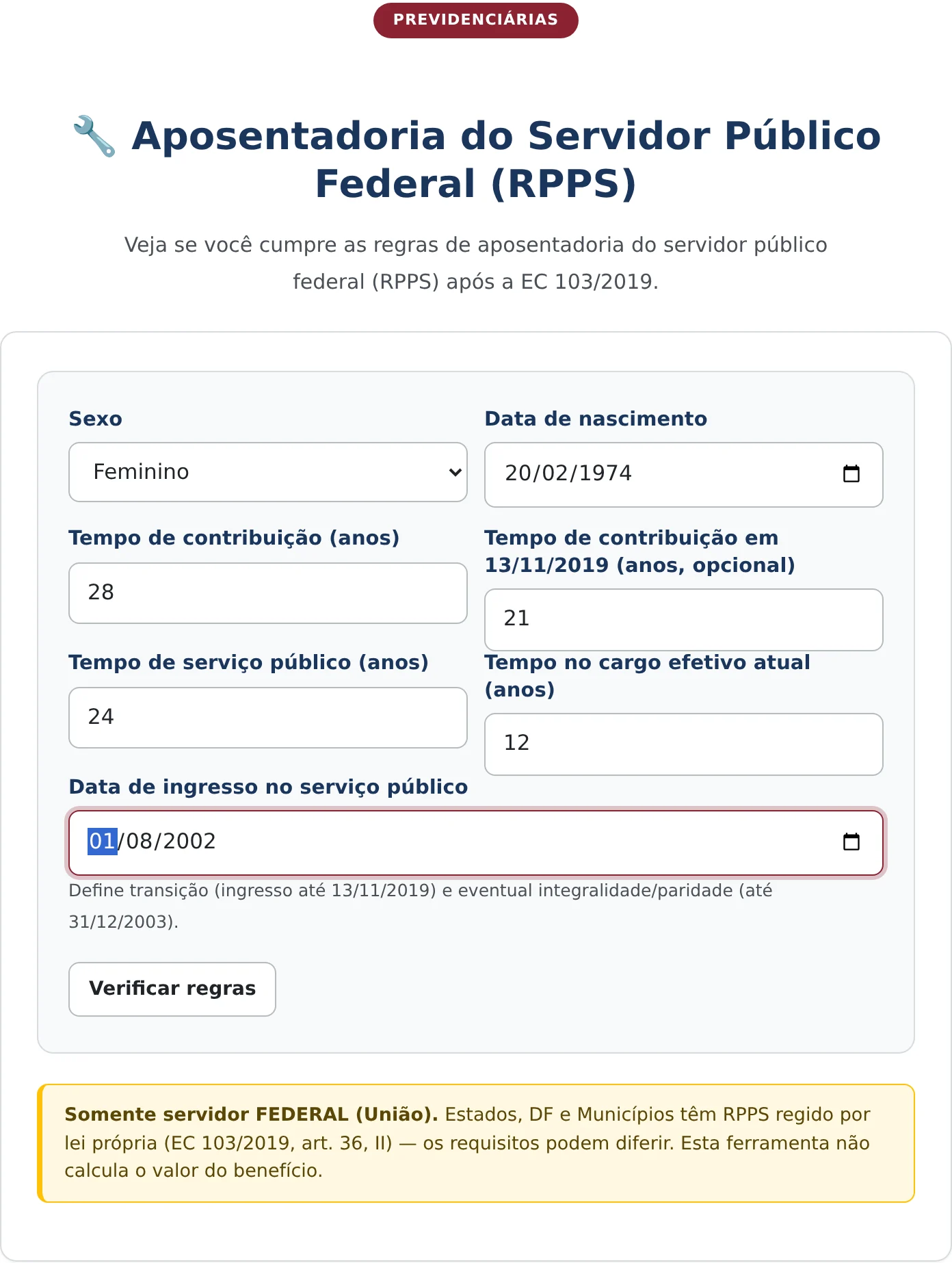
In the example, the civil servant was born in February 1974 and has 28 years of contributions, 21 of which had already accrued on the date of the reform, 24 years of public service, 12 years in the current permanent position, and entered public service in August 2002.
The distinction among contribution period, public-service period, and time in the position is essential and often leads to data-entry errors. Contribution period includes periods under the general system; public-service period counts only public-sector employment; time in the position counts only the current position.
3. Check the rules and read the result
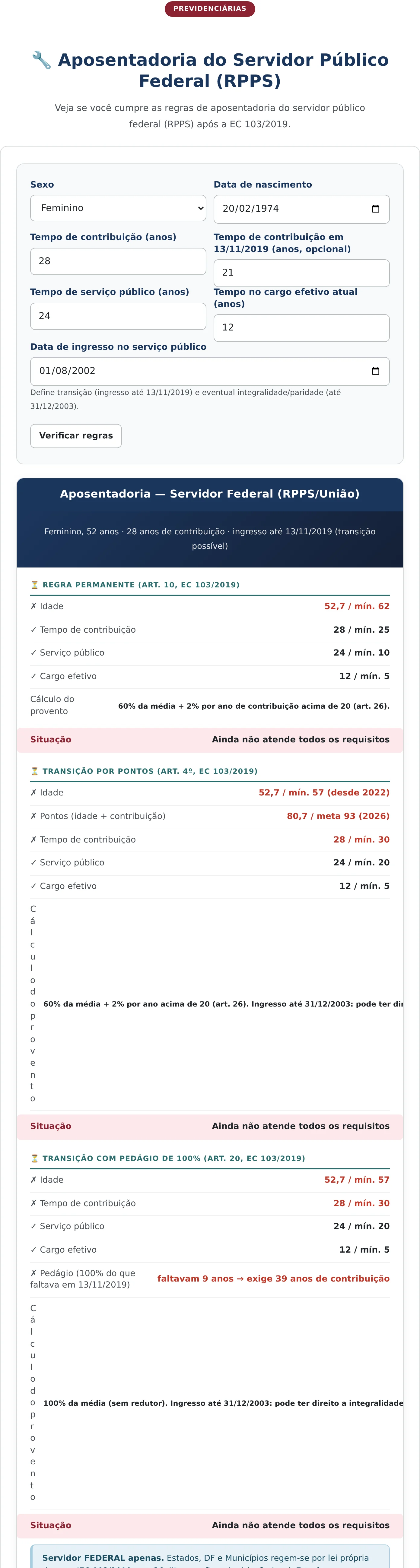
The “Check rules” button opens a card identifying the profile and then a section for each rule, with each requirement marked as met or unmet, along with the benefit calculation formula.
How to read each result section
In the example, the heading summarizes the profile: female, age 52, 28 years of contributions, and entry before the reform, with a possible transition rule.
The permanent-rule section shows four individually marked lines. An age of 52.7 does not meet the minimum of 62 and appears as unmet. A contribution period of 28 years exceeds the minimum of 25 and appears as met. Public service of 24 years exceeds the required 10 years, and 12 years in the position exceeds the required 5 years.
Below the requirements is the benefit formula: sixty percent of the average, plus two percent for each year of contributions above twenty. This information is as important as eligibility because it determines the amount.
The points-based transition-rule section repeats the structure with its own parameters: a minimum age of 57, a score of 93 in 2026, a minimum contribution period of 30 years, 20 years of public service, and 5 years in a permanent position.
In the example, three requirements under this rule have not yet been met, and the display lets you see exactly which ones. The section also notes entry by the end of 2003, which may ensure full benefits and parity.
Full benefits, parity, and the importance of the date of entry
This last point deserves further explanation because it is what most distinguishes civil servants from different generations.
Full benefits means that the benefit corresponds to the compensation of the permanent position, rather than to an average of contributions. Parity means that benefit adjustments track those granted to active civil servants.
These rights were progressively restricted by successive reforms and are now limited to those who entered public service by certain dates and meet the requirements of specific transition rules.
Those who entered later are subject to an average-based calculation, with a progressive coefficient and adjustments based on a price index, without any link to active employees’ compensation.
There is also the civil servant supplementary pension system, applicable to those who entered after its establishment. It limits the benefit under the public-service system to the ceiling of the general system and offers optional supplemental coverage.
The date of entry, therefore, is not merely registration information: it defines the entire legal framework for a civil servant’s retirement.
It is also worth noting the reciprocal crediting of service between systems, the legal mechanism that connects the public-service system to the general system.
Contribution time under the general system may be credited to the public-service system, and the reverse is also possible, through a contribution-time certificate issued by the originating system. Financial compensation between the systems occurs administratively, at no cost to the insured person.
However, crediting does not turn time under the general system into public-service time or time in a permanent position. It adds to the contribution period, which is only one of the four requirements, and this distinction is a recurring source of frustration in poorly conducted planning.
What the tool does not do
The checker addresses the federal public-service system. States and municipalities have public-service systems with different rules established by local legislation, and the result does not apply to them.
It also does not calculate special service time for civil servants or the crediting of time under the general system, procedures that require a certificate and their own administrative process.
And it does not calculate the benefit amount, limiting itself to identifying the formula applicable to each rule.
Frequently Asked Questions
What are the requirements for federal civil servant retirement?
There are four cumulative requirements: minimum age, contribution period, public-service period, and time in the permanent position from which retirement will be granted. The checker tests each one separately and indicates which have already been met.
Does changing positions harm retirement eligibility?
It can, because time in the permanent position is an independent requirement and starts over in the new position. Contribution time and public-service time are preserved, but the specific requirement to remain in the position must be met again.
Who is entitled to full benefits and parity?
Only civil servants who entered public service by the dates set out in the transition rules and who meet their specific requirements. Those who entered later have benefits calculated based on an average, with adjustments based on a price index.
Receba novidades por e-mail
Cadastre-se gratuitamente para receber nossos novos artigos.
Seus dados estão protegidos conforme a LGPD.
Ficou com dúvidas? Fale com um advogado especialista.
📱 Falar pelo WhatsAppAs informações deste artigo são de caráter informativo e não substituem consulta jurídica individualizada. Cada caso possui particularidades que exigem análise específica.


