
BPC Back-Pay Calculator: Tutorial
Back pay for an assistance benefit is not a simple multiplication: each installment is worth the minimum wage applicable to that month and is adjusted separately. The website calculator performs the month-by-month calculation and applies the statute of limitations.
What the back-pay calculator resolves
When a benefit is granted by court order with retroactive effect, the question arises of how much the past-due period is worth. The calculation seems straightforward, but it conceals four difficulties.
The first is that the amount of an assistance benefit corresponds to one minimum wage, and the minimum wage changes every year. An installment from 2021 is worth less than one from 2026, and the total must reflect the amount applicable to each month.
The second is adjustment. Each installment becomes due in a given month and must be adjusted from its due date through the calculation date, which means a different factor applies to each one.
The third is the five-year statute of limitations. For successive obligations, only installments that became due more than five years before the lawsuit was filed are time-barred, while the right to the benefit itself is preserved.
The fourth is the transition in the adjustment regime that occurred in December 2021, which changed the criterion applicable to judgments against the government.
The website calculator addresses all four issues and returns the total with a month-by-month breakdown.
When the tool helps in a specific case
Its most common use is to gauge the amount at issue, whether to decide on a settlement or to check the calculation submitted in the case file.
Other recurring situations include:
- estimating back pay for a benefit recognized administratively with retroactive effect;
- measuring the effect of the statute of limitations on the total amount owed;
- checking the number of installments included in a spreadsheet;
- assessing the impact of including the prorated thirteenth-month payment;
- calculating back pay for other benefits by entering the monthly benefit amount.
The option to enter a separate monthly benefit amount expands its use beyond assistance benefits, covering retirement benefits and allowances worth more than the minimum wage.
The five-year statute of limitations cuts off installments, not the right. The benefit remains payable; what is lost are the older installments.
That distinction is why the tool includes a lawsuit filing date field.
Step by step with the tool’s screens
The calculator is located in the website’s tools section, among the social security tools, and works in your browser.
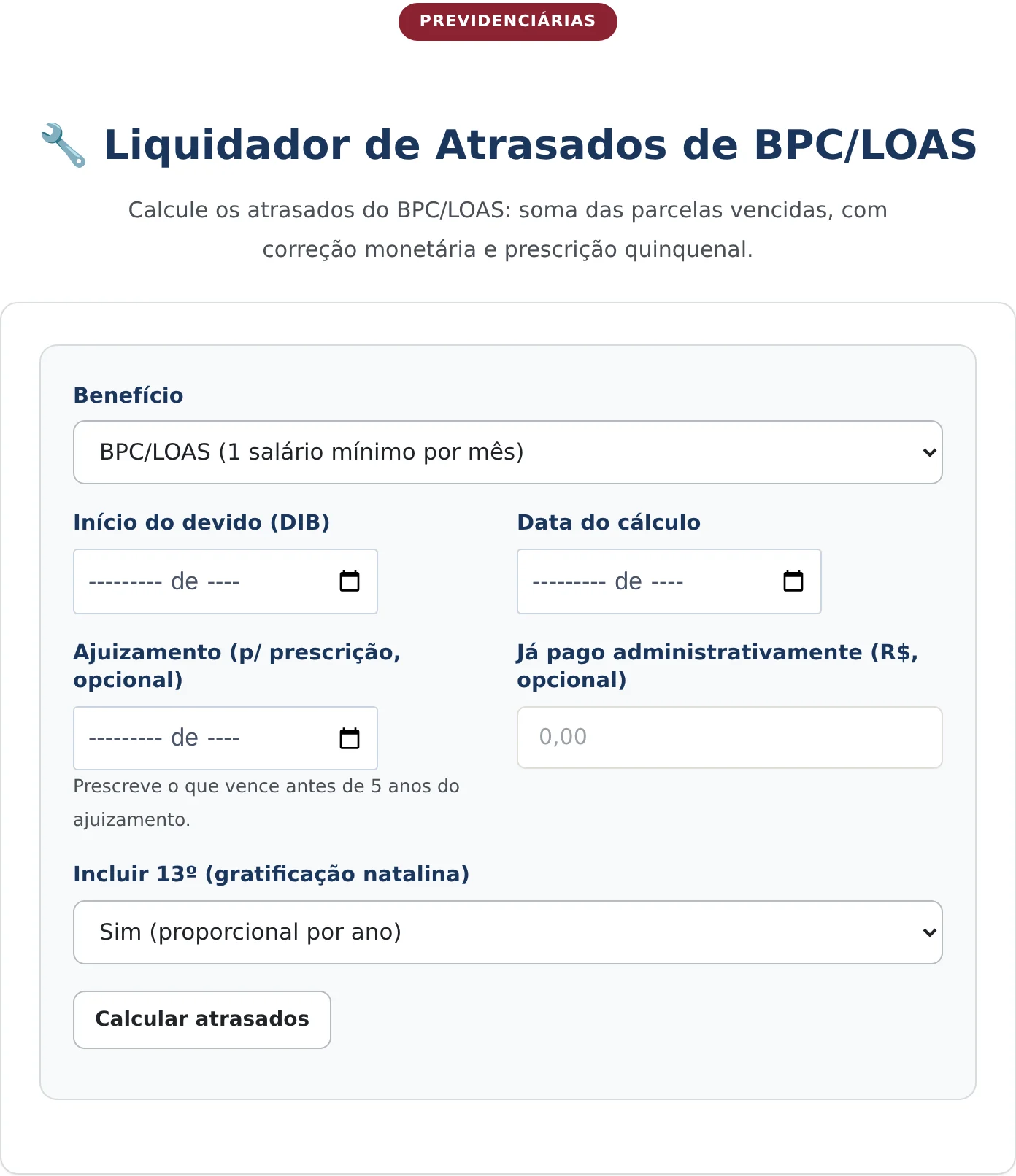
1. Open the tool and identify the fields
The screen contains seven fields. The first lets you choose between the assistance benefit, which is worth one minimum wage, and another benefit with an entered monthly amount.
The following fields accept the monthly amount when applicable, the start date of the amount owed, the calculation date, the lawsuit filing date for statute-of-limitations purposes, the amount already paid administratively, and the option to include the Christmas bonus.
The lawsuit filing date field is optional. Leaving it blank means the calculation will not apply a statute-of-limitations cutoff, which inflates the result for long periods.
2. Fill it in with the case information
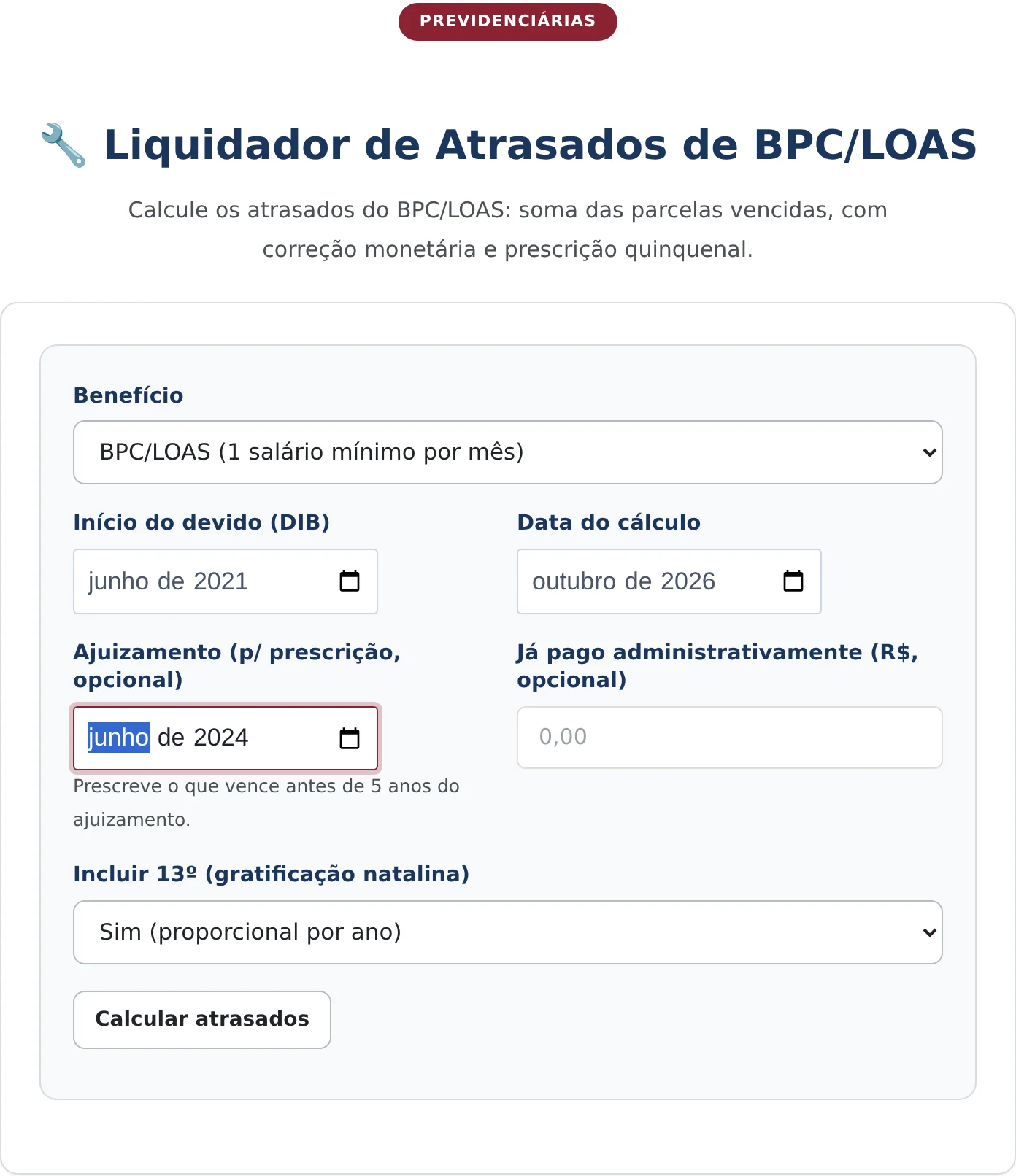
In the example, the benefit is an assistance benefit, the amount owed begins in June 2021, the calculation runs through October 2026, the lawsuit was filed in June 2024, there was no administrative payment, and the Christmas bonus is included.
Choosing the dates is the central decision. The start date of the amount owed usually coincides with the filing date of the denied administrative application, and the lawsuit filing date establishes the statute-of-limitations cutoff.
3. Calculate and read the result
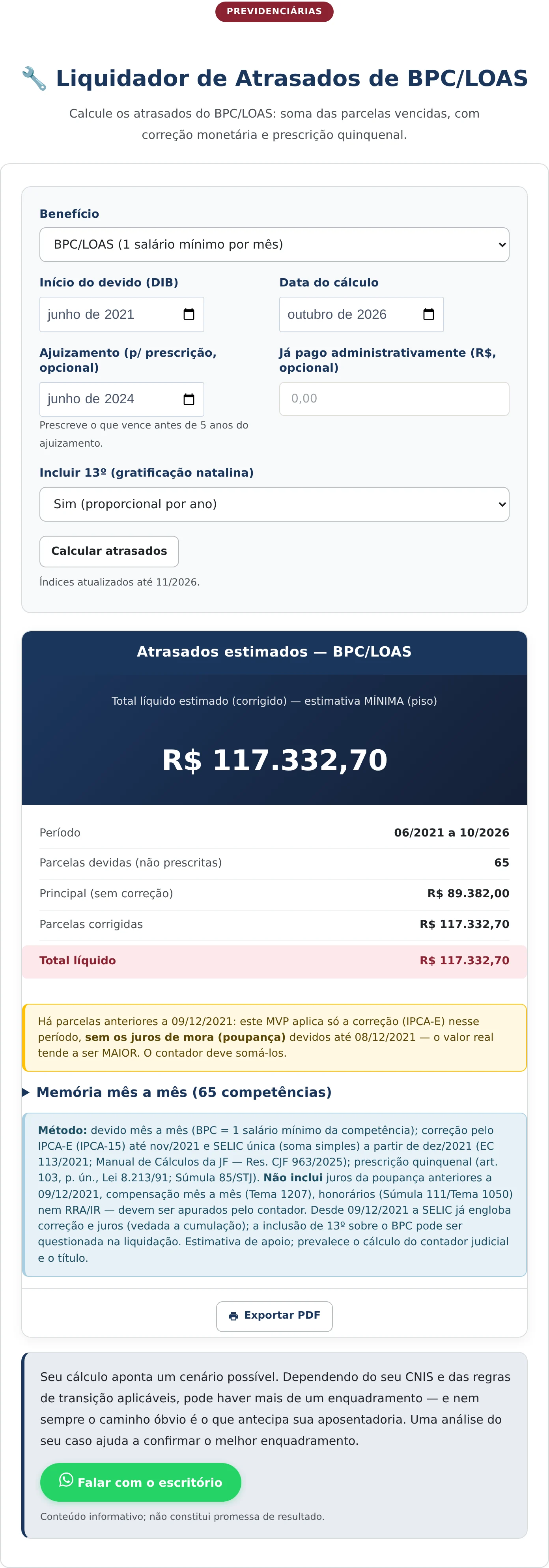
The “Calculate back pay” button opens a card showing the highlighted total, the period, the number of non-time-barred installments, the principal without adjustment, the adjusted amount, and the month-by-month breakdown.
How to read each line of the result
In the example, the estimated net total is R$ 117.332,70, expressly presented as a minimum estimate.
The information block shows the period from June 2021 through October 2026 and reports 65 non-time-barred installments due. That figure already includes the statute-of-limitations cutoff and the prorated Christmas bonus for each year.
The principal without adjustment is R$ 89.382,00, and the adjusted installments total R$ 117.332,70. The difference, nearly twenty-eight thousand reais, reflects monetary adjustment over five years.
The card includes a warning that deserves attention for its technical candor: there are installments from before the December 2021 regime change, and for that period the tool applies only adjustment, without the late-payment interest due until the transition. The actual amount therefore tends to be higher, and the court-appointed accountant must add it.
The month-by-month breakdown lists each month with the amount due and the factor applied. It is the tool for checking the calculation when it differs from the spreadsheet prepared by the accountant or the opposing party.
The footer states the full method: amount due month by month according to the minimum wage applicable to that month, adjustment by a price index through November 2021 and a single basic rate from December onward, accumulated by simple addition, and the five-year statute of limitations with its corresponding legal and case-law basis.
How the statute of limitations applies to back pay
The statute-of-limitations rule for social security and assistance benefits deserves further detail because it is often misunderstood.
The right to the benefit itself does not expire. Anyone who meets the requirements remains entitled to the benefit, no matter how much time has passed since the denial.
What expires are installments that became due more than five years earlier, counted backward from the filing of the lawsuit or the review request. This is known as the statute of limitations for installments, applicable to successive obligations.
The practical effect is straightforward: someone whose benefit was denied in 2015 and who files a lawsuit in 2026 is entitled to the benefit from 2015 onward, but receives only the installments from 2021 onward. The earlier ones are time-barred.
There is an important exception for persons who are absolutely incapable, against whom the statute of limitations does not run, fully preserving back pay in cases involving minors.
This mechanism explains why the lawsuit filing date field changes the result so much, and why delaying the filing of a lawsuit carries a measurable cost.
What the tool does not do
The calculator does not replace the court-appointed accountant’s calculation. It expressly states that limitation and identifies the interest portion it does not calculate for the period before the adjustment regime transition.
It also does not calculate attorney’s fees, court costs, or any deductions for amounts received on another basis, such as non-cumulative benefits received during the same period.
Nor does it determine the start date of the amount owed, which follows from the court decision or the administrative application, not from the user’s choice.
Frequently Asked Questions
Does the statute of limitations cause you to lose the right to the benefit?
No. For successive obligations, the statute of limitations reaches only installments that became due more than five years before the lawsuit was filed. The right to the benefit remains, and it is granted with payment of the non-time-barred installments.
Why is the result presented as a minimum estimate?
Because, during the period before unification under the basic rate, the tool applies only monetary adjustment, without the late-payment interest then due. The actual amount tends to be higher, and the screen itself recommends that the accountant add that portion.
Is the thirteenth-month payment included in the back-pay calculation?
Yes, proportionally for each year of the period when the option is selected in the form. The Christmas bonus is payable for social security benefits and is part of the recognized back-pay amount.
Receba novidades por e-mail
Cadastre-se gratuitamente para receber nossos novos artigos.
Seus dados estão protegidos conforme a LGPD.
Ficou com dúvidas? Fale com um advogado especialista.
📱 Falar pelo WhatsAppAs informações deste artigo são de caráter informativo e não substituem consulta jurídica individualizada. Cada caso possui particularidades que exigem análise específica.


