
Early Lease Termination Penalty: A Guide
The penalty for returning the property before the end of the lease is not charged in full: it is reduced in proportion to the time already completed. The calculator on this website makes this reduction by day and shows the calculation breakdown.
What the penalty calculator does
Fixed-term lease agreements often provide for a penalty for returning the property early, usually equivalent to three months’ rent. What many tenants do not realize is that this amount is rarely owed in full.
Brazil’s Tenancy Law requires the penalty to be reduced in proportion to the period already completed. A tenant who returns the property with two months remaining on a thirty-month lease does not pay the same penalty as one who returns it in the third month.
This proportional reduction applies automatically and does not depend on a contractual provision. It follows from the law, and a clause seeking to exclude it has no intended effect.
There are also circumstances in which the penalty is waived entirely. If the tenant’s employer transfers the tenant to work in another location and the tenant gives written notice thirty days in advance, the penalty does not apply at all.
The website tool takes eleven pieces of information and returns the proportional penalty along with a complete calculation breakdown.
When the tool helps in a specific case
Its most common use is checking the amount charged by the real estate agency or landlord when the keys are returned.
Other recurring situations include:
- planning the move-out date by comparing the cost across different months;
- determining whether the work-transfer waiver applies;
- checking the effect of thirty days’ prior notice;
- calculating the penalty when it is set as a fixed amount rather than in months’ rent;
- confirming that there is no penalty under an open-ended lease.
This last point answers many questions. A lease already extended for an open-ended term does not result in a penalty for early return: thirty days’ prior notice is all that is required.
The full penalty is almost never owed. The proportional reduction follows from the law and requires no provision in the lease.
The example in this guide shows that reduction in figures, using fictional data selected for demonstration purposes.
Step by step through the tool screens
The calculator is in the website’s tools section, among the civil and consumer-law tools, and works in your browser.
1. Open the tool and identify the fields
The screen includes eleven fields, displayed as applicable. The first is the type of lease, which distinguishes fixed-term from open-ended leases and already indicates the result in the latter case.
Next come the monthly rent amount, how the lease sets the penalty, whether as a number of months’ rent or a fixed amount, and the relevant parameter. Then come the lease start date, the term in months, and the date the keys are returned.
The final three address waiver and reduction circumstances: employer transfer, written notice thirty days in advance, and prior notice to the landlord.

2. Enter the lease information
In the example, the lease is for a fixed term, the rent is R$ 2.000,00, the penalty is set at three months’ rent, the lease began in February 2025 with a thirty-month term, the property was returned in October 2026, there was no employer transfer, and written prior notice was given.
The start and move-out dates are the most sensitive information because the proportion is calculated by day, not by whole months. A difference of just a few days changes the result.

3. Calculate and read the breakdown
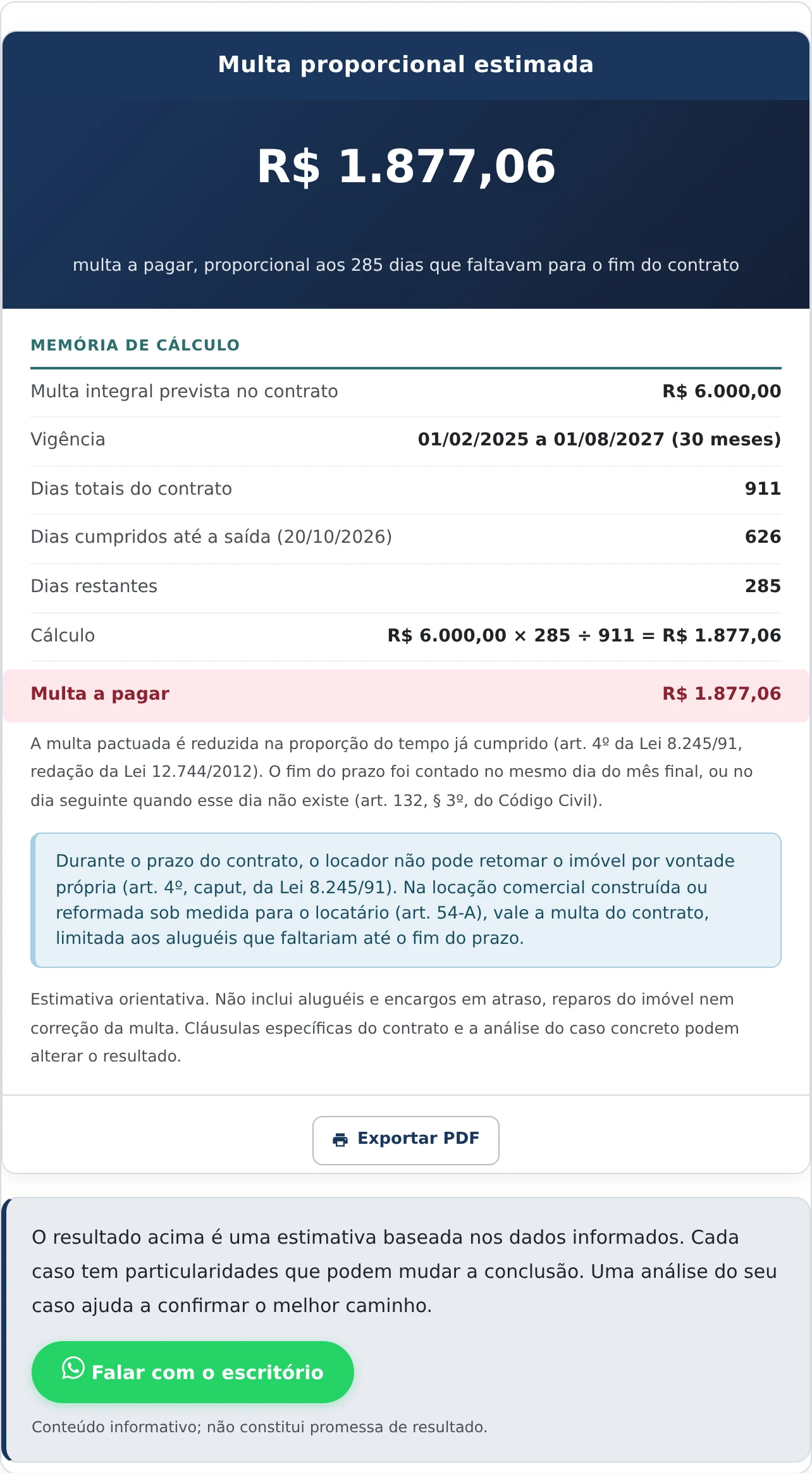
The “Calculate penalty” button opens the card showing the proportional penalty prominently, the complete calculation breakdown, and the applicable legal notes.
How to read each line of the result
In the example, the proportional penalty is R$ 1.877,06, described as proportional to the 285 days remaining until the end of the lease.
The calculation breakdown presents the result in six lines. The full penalty provided in the lease is R$ 6.000,00, equivalent to three months’ rent of R$ 2.000,00.
The lease runs from February 2025 to August 2027, totaling thirty months, which corresponds to 911 days. Of those, 626 had elapsed by the move-out date, leaving 285.
The formula is stated explicitly: the full penalty multiplied by the remaining days and divided by the total days. The result is the penalty owed.
This transparency is what makes the result useful in a negotiation. When the real estate agency charges the full amount, the breakdown lets you demonstrate the reduction line by line, with the legal basis alongside it.
The card also records two relevant notes: the rule for counting the end of the term, which follows the Civil Code, and the observation that, during the lease term, the landlord may not take back the property simply by choice.
Waiver circumstances and prior notice
It is worth detailing the situations that eliminate or reduce the penalty because they are not well known.
The transfer waiver requires two cumulative requirements: the tenant must be transferred by the employer to provide services in another location, and the tenant must give the landlord written notice at least thirty days in advance. If either is missing, the waiver does not apply.
Thirty days’ prior notice is an independent obligation. Its absence does not make the full penalty payable, but it allows the landlord to charge one additional month of rent as compensation.
Under a lease already extended for an open-ended term, there is no penalty for early return because there is no remaining term to fulfill. Only thirty days’ prior notice remains required.
There is also the nonresidential lease of a property built or renovated for the tenant, which allows a compensation clause subject to its own rules, distinct from the ordinary penalty.
These distinctions explain why the form asks about transfer, notice, and prior notice: each answer can substantially change the amount owed.
One methodological point completes the use of the tool: the difference between an early termination penalty and a late-payment penalty.
The penalty addressed here is compensatory and results from ending the lease term early. A late-payment penalty is different: it applies to rent paid late and is usually set as a percentage of the overdue amount, plus interest and monetary adjustment.
Both may apply at the same time. A tenant who returns the property before the end of the term and leaves rent unpaid is liable for the proportional penalty and, separately, for late-payment charges on the unpaid amount.
There is also the issue of improvements. Necessary improvements made by the tenant are generally compensable, unless there is a waiver clause, and that settlement is separate from the penalty, forming part of the final accounting upon return of the property.
What the calculator does not do
The tool does not read the lease. The penalty amount and the term must be taken from the relevant clause, and where the lease has no penalty clause, the amount is set by the court.
It also does not calculate outstanding charges, such as overdue rent, utility bills, and repairs for damage to the property, which are separate charges.
Nor does it address the return of the security deposit or the final accounting, which follow the terms of the lease.
Frequently Asked Questions
Is the penalty always three months’ rent?
Three months’ rent is common market practice, but the lease terms govern. Whatever amount is agreed upon, it is reduced in proportion to the time already completed, as required by law regardless of any contractual provision.
Is there a penalty under an open-ended lease?
No. Without a term to fulfill, there can be no early return. The tenant need only notify the landlord thirty days in advance, and failure to give that notice allows the landlord to charge one month’s rent as compensation.
When is the penalty waived entirely?
When the tenant is transferred by the employer to provide services in another location and gives the landlord written notice at least thirty days in advance. Both requirements are cumulative, and the absence of either one leaves the proportional penalty in place.
Receba novidades por e-mail
Cadastre-se gratuitamente para receber nossos novos artigos.
Seus dados estão protegidos conforme a LGPD.
Ficou com dúvidas? Fale com um advogado especialista.
📱 Falar pelo WhatsAppAs informações deste artigo são de caráter informativo e não substituem consulta jurídica individualizada. Cada caso possui particularidades que exigem análise específica.


