
Statute of Limitations and Prescription at the INSS: A Guide
You have ten years to review the amount of an awarded benefit; there is no deadline to challenge a denied benefit. The website’s checker distinguishes between the two scenarios and calculates what can still be claimed.
What the statute of limitations checker does
Two distinct legal concepts limit disputes over social security benefits, and confusing them leads to incorrect conclusions in either direction.
The statute of limitations applies to the right to review the benefit award decision. The period is ten years, counted from the first day of the month following receipt of the first payment. Once that period expires, the decision becomes unchangeable.
Prescription applies to the installments. It does not extinguish the right; it only prevents recovery of amounts due more than five years before the claim. It is the legal concept that applies alongside a review that is still possible.
There is a third situation that is not subject to the statute of limitations: a denied, canceled, or terminated benefit. Because there was no benefit award decision to review, the ten-year period does not apply, although older installments remain subject to prescription.
The website’s checker takes five pieces of information and returns the status of each deadline, with the exact dates.
When the tool helps in a specific case
Its most important use is screening whether a review is viable before starting one, a step that avoids work on a right that has already expired.
Other recurring situations include:
- calculating the final day to request a review of an awarded benefit;
- checking how many installments are not yet time-barred;
- distinguishing a review of an amount from a challenge to a denied benefit;
- assessing the effect of the filing date on the differences owed;
- identifying issues not addressed in the award decision, which follow their own rules.
The last situation deserves emphasis. When the review is based on an issue that was not even addressed in the benefit award decision, the statute of limitations may be counted differently, and the form includes a specific option for it.
A denied benefit has no statute-of-limitations deadline. What becomes time-barred are the installments, not the right to challenge the denial.
This distinction saves claims that appeared lost and avoids others that already were.
Step-by-step guide to the tool’s screens
The checker is located in the website’s tools section, among the social security tools, and works in your browser.
1. Open the tool and identify the fields
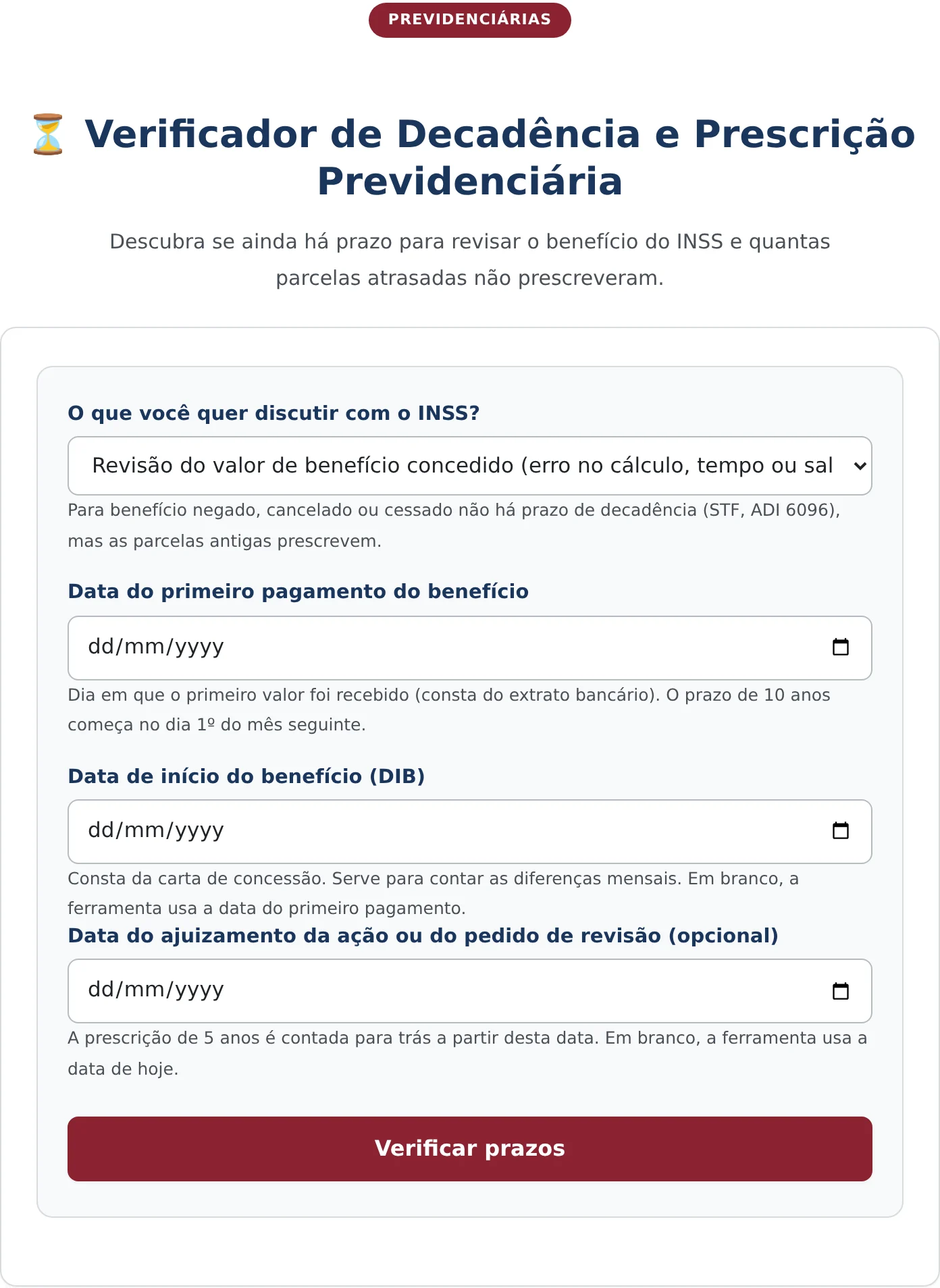
The screen has five fields. The first defines what you intend to challenge, with three options: review of the amount of an awarded benefit, review based on an issue not addressed, and denied, canceled, or terminated benefit.
The remaining fields take the date of the first payment, the benefit start date, the date of the denied request or termination, and the filing date or the date of the review request.
The guidance for the first-payment field is precise and avoids the most common mistake: it is the day on which the first amount was actually received, and the ten-year period begins on the first day of the following month.
2. Fill in the benefit information
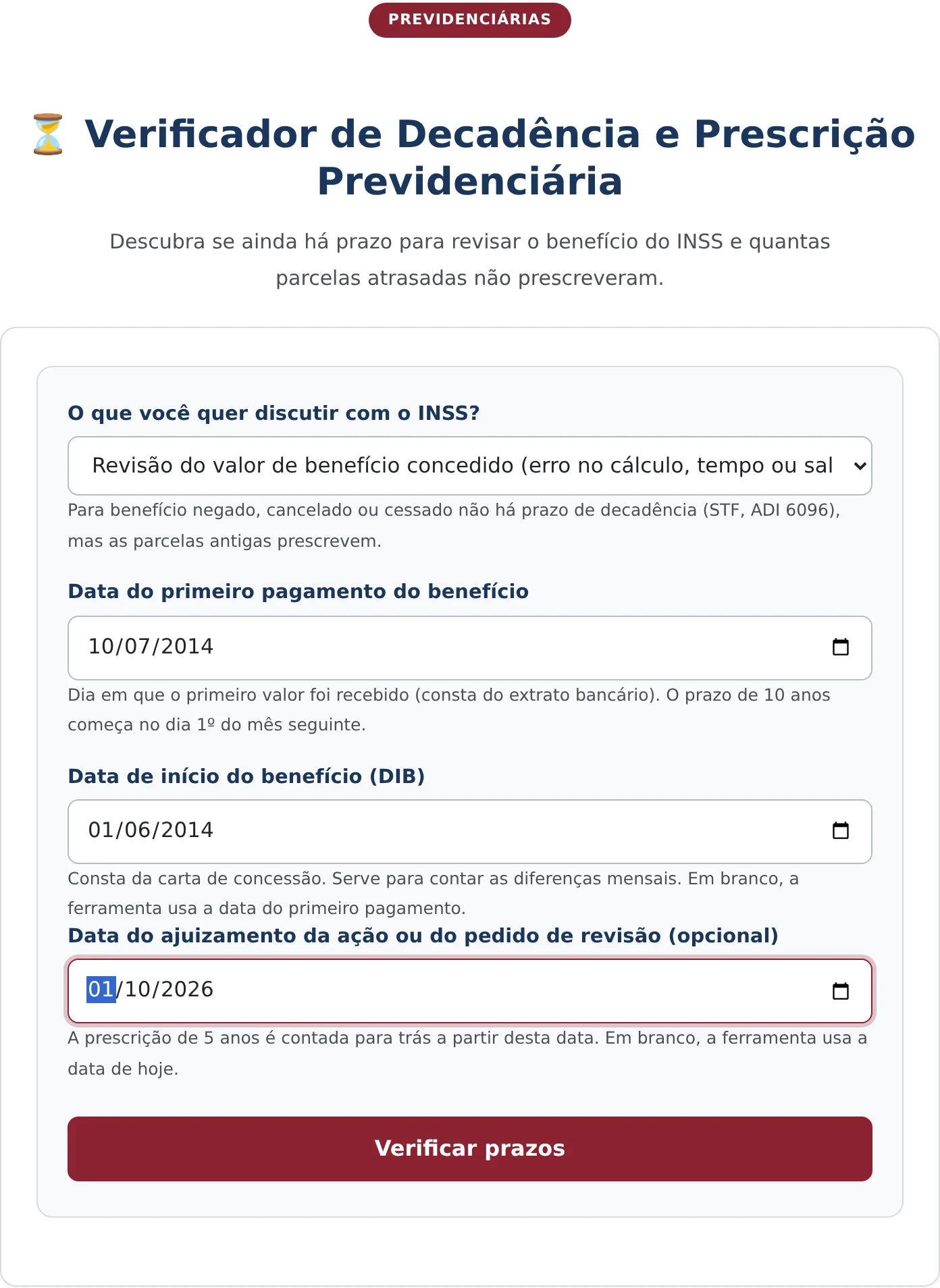
In the example, the goal is to review the amount of an awarded benefit, the first payment was made in July 2014, the benefit began in June 2014, and filing is expected in October 2026.
The date of the first payment is usually available from the bank statement. When it is not known precisely, the benefit start date can serve as an approximation, subject to the caveat that the result will be less accurate.
3. Check and read the result
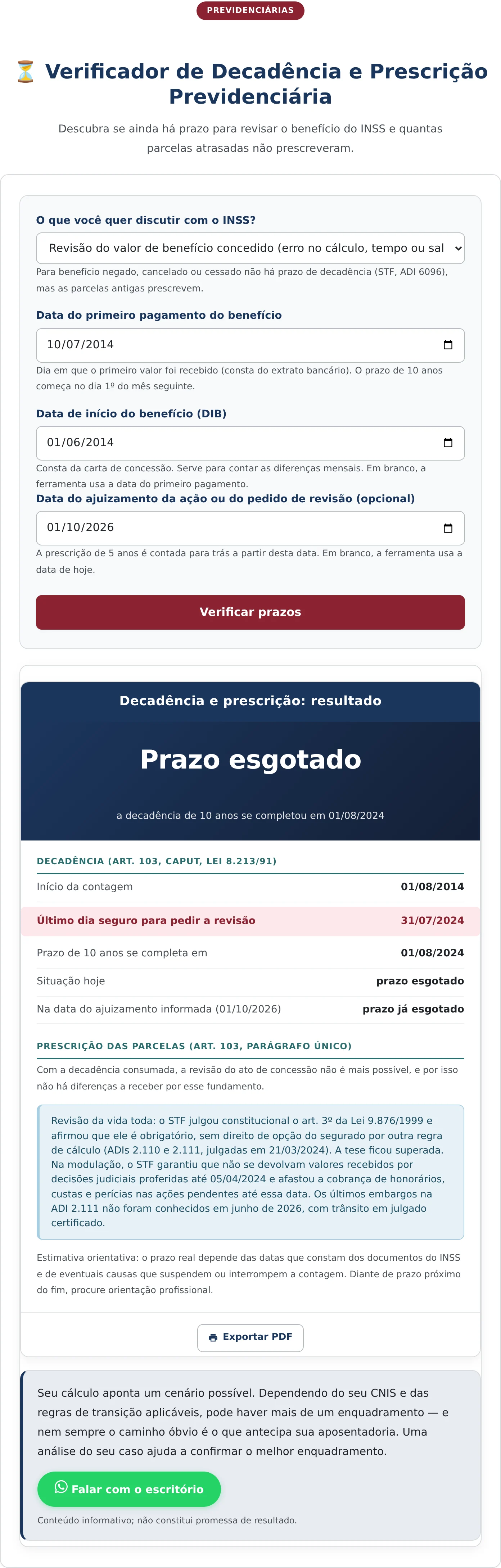
The “Check deadlines” button opens the card showing the status, the statute-of-limitations section with the exact dates, and the installment-prescription section.
How to read each line of the result
In the example, the result states that the deadline has expired, with the statute of limitations being completed in August 2024.
The statute-of-limitations section has four lines. The start of the counting period appears as August 2014, confirming the rule that it begins on the first day of the month following the first payment. The last safe day to request a review is the end of July 2024.
The next line records the exact date on which the ten-year period was completed, and the last two compare that date with the current situation and the filing date provided.
This dual comparison is useful because it allows you to test scenarios: by entering different filing dates, you can see exactly when the right expired.
The prescription section provides the resulting conclusion. Once the statute of limitations has run, review of the benefit award decision is no longer possible, and therefore no differences can be recovered on that basis.
The card also records the established understanding regarding the argument that sought to change the benefit-calculation rule, with the corresponding ruling identified, information relevant to anyone considering that approach.
Statute of limitations, prescription, and arguments that may still be available
It is worth organizing what remains once the statute of limitations has run, because not everything is lost.
The statute of limitations applies to review of the benefit award decision, that is, disputes over the criteria used to calculate the benefit at that time. It does not apply to issues arising after the award.
Adjustments applied over time, for example, are independent acts and may be challenged regardless of the statute of limitations on the original decision. The same applies to improper deductions and payment errors.
A dispute over a benefit that was never awarded is likewise not subject to the statute of limitations. Someone whose request was denied in 2010 and who did not appeal may challenge it today, receiving only the installments from the last five years.
There is also the situation of an issue not addressed in the benefit award decision, in which the counting of the statute of limitations may be challenged because there was no administrative decision on that specific point.
These distinctions explain why the first field on the form is the most important: it defines which deadline regime will apply.
There is one methodological warning for anyone using the tool to screen a body of cases.
The date of the first payment, which starts the counting period, is not always easy to obtain. For older benefits, the first credit may appear only on the bank statement from that time, a document the insured person rarely keeps.
Without that information, the benefit start date serves as an approximation, but with a bias: it precedes the first payment, making the calculation more conservative and potentially indicating that the statute of limitations has run when there was still time.
In close cases, therefore, obtaining the statement or payment history is no longer a detail but a condition for reaching a reliable conclusion.
What the tool does not do
The checker does not analyze the merits of the review. It addresses deadlines, and whether there was an error in the original calculation depends on reviewing the benefit award letter and statement.
It also does not consider specific grounds for suspension or interruption, such as the processing of an administrative appeal, which may alter the calculation in individual cases.
And it does not calculate the amount of the differences, a task handled by the case-calculation tool, which determines each installment with adjustments.
Frequently Asked Questions
What is the deadline for reviewing the amount of a benefit?
Ten years, counted from the first day of the month following receipt of the first payment. Once this period expires, the benefit award decision becomes unchangeable, and the criteria used in the original calculation can no longer be challenged.
Is a denied benefit also subject to a statute-of-limitations deadline?
No. Because there was no benefit award decision to review, the ten-year period does not apply to challenging the denial. What is lost, through prescription, are the installments due more than five years before the claim.
Does the statute of limitations prevent challenges to benefit adjustments?
No. Adjustments are subsequent and independent acts in relation to the benefit award decision, and may be challenged even after the statute of limitations on the original review has run, subject to prescription of the installments.
Receba novidades por e-mail
Cadastre-se gratuitamente para receber nossos novos artigos.
Seus dados estão protegidos conforme a LGPD.
Ficou com dúvidas? Fale com um advogado especialista.
📱 Falar pelo WhatsAppAs informações deste artigo são de caráter informativo e não substituem consulta jurídica individualizada. Cada caso possui particularidades que exigem análise específica.


