
Nonpecuniary Damages Calculator: A Guide to the Two-Step Method
The two-step method of the STJ (Brazil’s Superior Court of Justice) first sets a base amount according to the type of harm and then adjusts it based on the circumstances. The website’s calculator reproduces both steps and provides a reference range.
What the nonpecuniary damages calculator does
Determining nonpecuniary damages has always faced criticism for its unpredictability. Widely different amounts awarded in similar situations have fueled the perception of arbitrariness and, consequently, made it harder to guide those seeking compensation.
The two-step method was the response to this problem. In the first step, a base amount is set according to the legally protected interest harmed, based on precedents from analogous cases. In the second, that amount is adjusted for the particular circumstances of the case.
This structure makes the determination auditable. Rather than being an unexplained number, it becomes a result supported by a calculation record, in which each adjustment can be discussed separately.
The website’s tool follows this logic: it takes the nature of the harm and seven circumstances, then provides a range with a record of each adjustment applied.
When the tool helps in a specific case
Its most important use is to calibrate expectations before making a claim, a stage at which excess often undermines the credibility of the request.
Other recurring situations include:
- structuring the basis for the amount requested in the initial complaint;
- evaluating a settlement offer against an objective reference point;
- measuring the weight of each circumstance in the final result;
- comparing different types of harm;
- preparing an appellate argument concerning the amount awarded.
The tool states clearly that the range is illustrative and is not the amount of the lawsuit. This limitation is essential because damages are determined by the court and take into account elements no calculator can capture.
A disproportionate claim weakens the entire complaint. A well-supported range is worth more than a high number without justification.
The example in this guide walks through both steps of the method, using hypothetical parameters selected for demonstration purposes.
Step by step through the tool’s screens
The calculator is located in the website’s tools section, among the civil and consumer-law tools, and works in your browser.
1. Open the tool and identify the fields
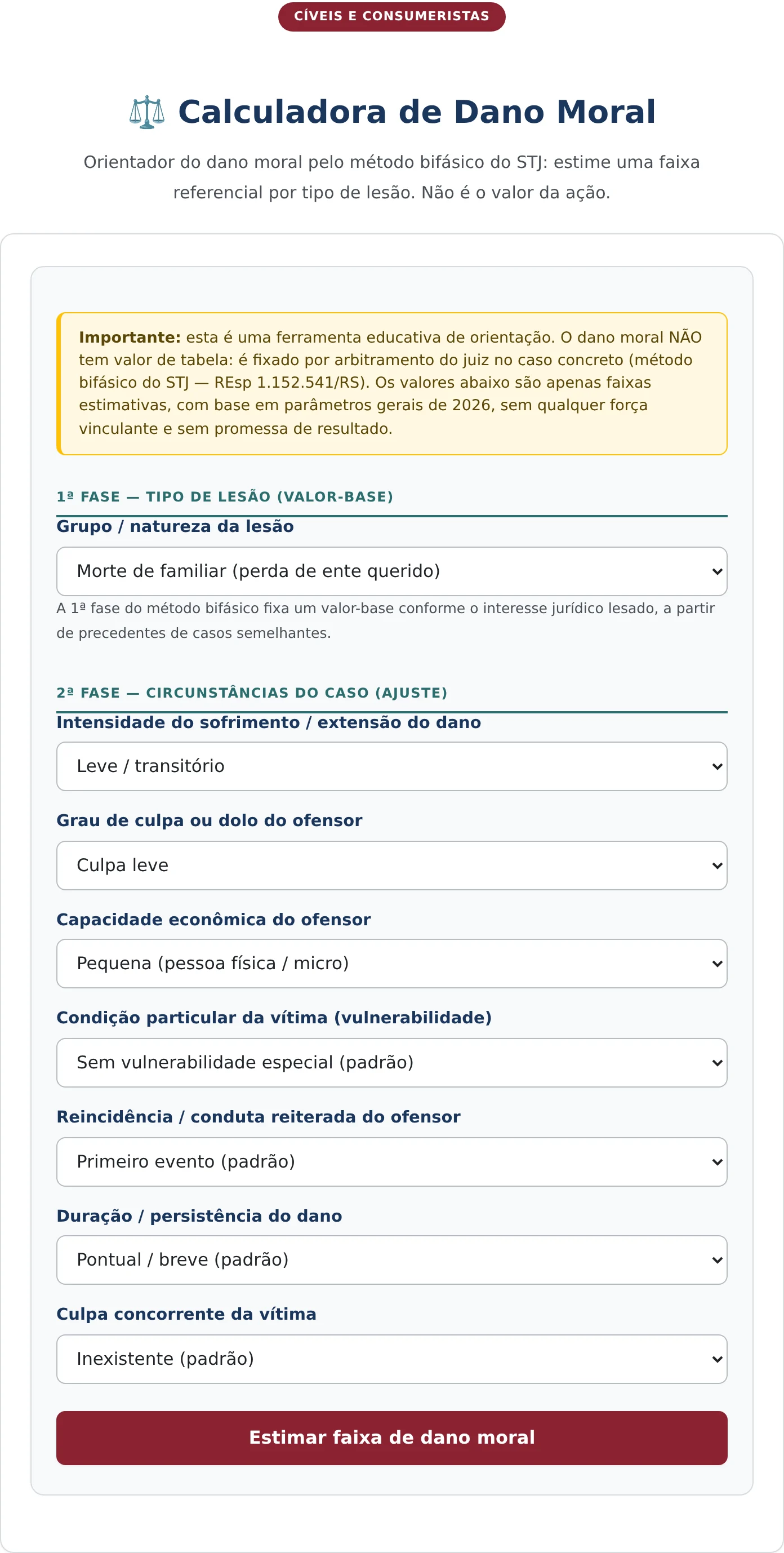
The screen contains eight selectors. The first defines the group or nature of the harm, with eight options ranging from the death of a family member to banking abuse, including medical malpractice, harm to reputation, and wrongful listing in a delinquent-debtor registry.
The next seven correspond to the circumstances considered in the second step: intensity of suffering, degree of fault, the wrongdoer’s financial capacity, the victim’s vulnerability, repeat misconduct, duration of the harm, and comparative fault.
Each option shows its corresponding percentage adjustment, making the tool’s operation transparent from the moment you complete the fields.
2. Describe the case
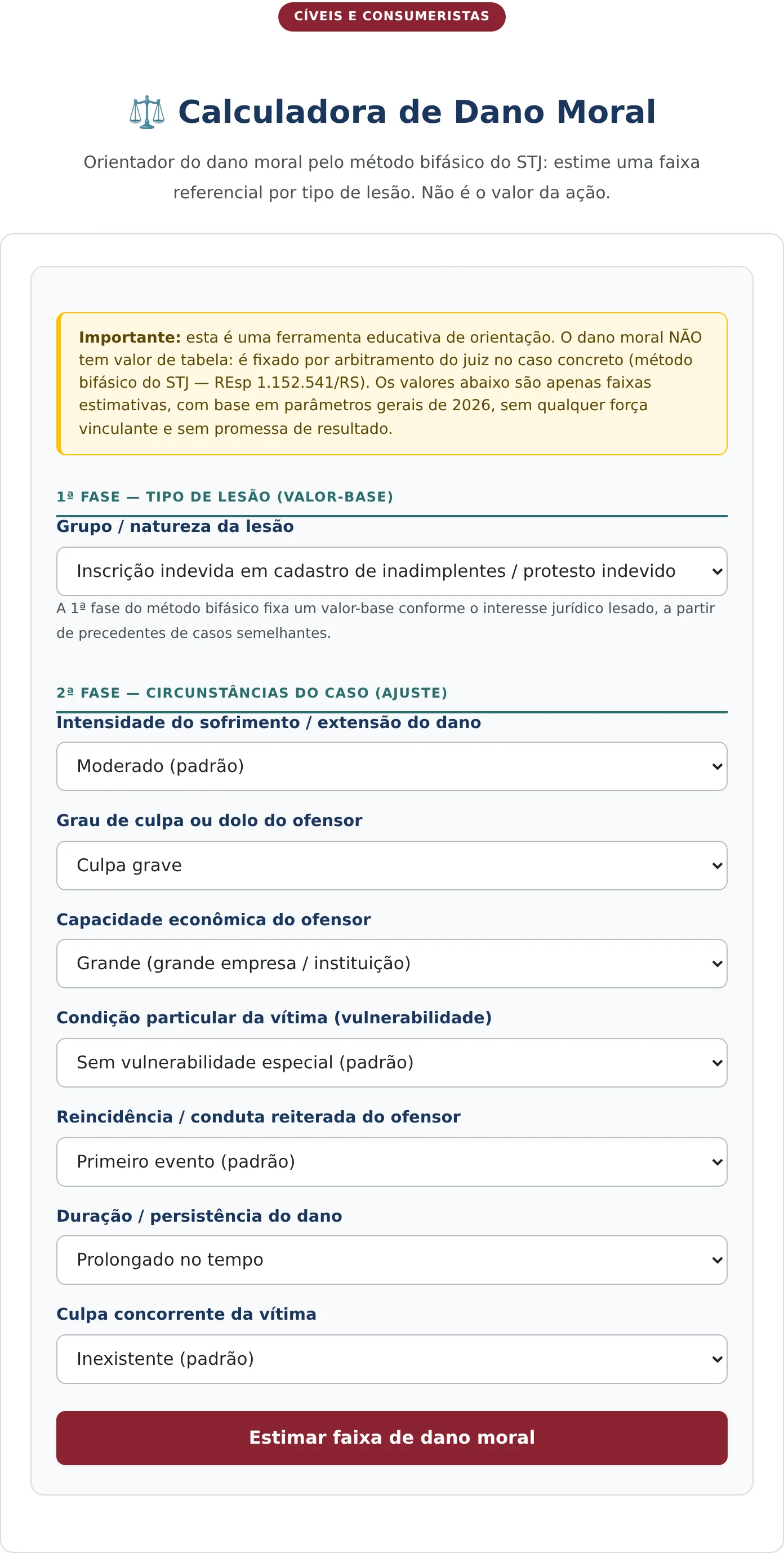
In the example, the nature of the harm is wrongful listing in a delinquent-debtor registry. The intensity of suffering is moderate, the degree of fault is serious, the wrongdoer has substantial financial capacity, the victim has no special vulnerability, this is a first occurrence, the harm was prolonged over time, and there is no comparative fault.
In practice, completing the fields is an exercise in characterizing the facts. Each selector requires you to take a position on an element that the complaint will have to establish.
3. Estimate and read the range
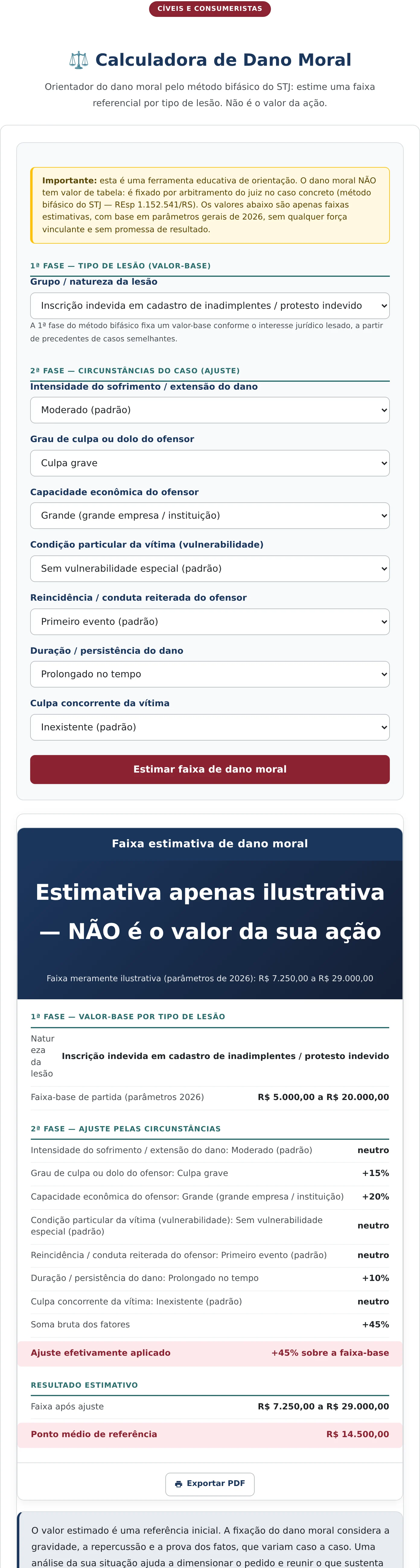
The estimate button opens a card showing the highlighted range, the first step with the base amount, the second step with each adjustment itemized, and the final result.
How to read each part of the result
In the example, the estimated range runs from R$ 7.250,00 to R$ 29.000,00, preceded by a notice that it is an illustrative estimate and not the amount of the lawsuit.
The first step identifies the nature of the harm and the starting base range, which in this case runs from R$ 5.000,00 to R$ 20.000,00. This interval reflects the parameters adopted for that type of legally protected interest harmed.
The second step lists each circumstance and its effect. Moderate intensity is neutral. Serious fault adds fifteen percent. Substantial financial capacity adds twenty percent. The absence of vulnerability is neutral. A first occurrence is neutral. Prolonged harm adds ten percent. The absence of comparative fault is neutral.
The combined adjustments are what shift the base range to the final range. The itemized record makes it possible to discuss each adjustment separately, which is precisely what the two-step method is intended to enable.
Note that the final range preserves the breadth of the base range. The method does not provide a single number, but rather an interval, because the final determination is made by the judge.
The circumstances that carry the most weight and why
Among the seven circumstances, three deserve comment because they are the most frequently disputed.
The wrongdoer’s financial capacity serves a deterrent purpose. The same harm caused by a small business and by a large institution does not have the same deterrent effect when the amount is identical, and the adjustment reflects that asymmetry.
Repeat misconduct works in the same direction. Repeated conduct indicates that the amount previously set did not fulfill its educational purpose and justifies an increase.
The victim’s comparative fault works in the opposite direction, reducing the amount. When the conduct of the injured party contributed to the result, compensation is reduced proportionately.
There is also the duration of the harm, which distinguishes an isolated event from a situation that continues over time. A wrongful listing maintained for years despite complaints differs from one corrected within days.
These distinctions are not rhetorical: they correspond to facts that must be alleged and proven, and the tool also serves as a roadmap for what the evidence must establish.
Before considering the amount, there is a question worth noting: when is nonpecuniary harm presumed, and when must it be proven?
In certain situations, the injury arises from the fact itself and does not require specific proof. Wrongful listing in a delinquent-debtor registry is the classic example, and the same reasoning applies to the death of a close family member and serious harm to reputation.
In others, the harm must be proven. A simple breach of contract, without repercussions beyond inconvenience, tends not to be compensable, and this is the boundary Brazilian case law has developed to avoid trivializing the doctrine.
The distinction matters for the evidentiary strategy and also for the amount. Presumed harm requires proof of the fact; harm that must be proven requires proof of the injury, which expands the evidentiary effort and influences the very intensity of suffering reported in the second step of the method.
What the calculator does not do
The tool does not determine damages. The amount is set by the judge, who considers elements that cannot be captured in a form, such as the concrete repercussions of the event and the evidence presented.
Nor does it research precedents for the specific case. The base range reflects general parameters by type of harm, and specific cases may differ because of relevant particularities.
And it does not assess whether nonpecuniary harm exists in the first place, which in some situations is presumed and in others requires proof of the injury.
Frequently Asked Questions
What is the two-step method?
It is the method for determining damages adopted by the STJ that, in the first step, sets a base amount according to the legally protected interest harmed and, in the second, adjusts it based on the circumstances of the specific case, making the result demonstrable.
Is the estimated range the amount I will receive?
No. The tool expressly warns that it is an illustrative estimate. The final amount is determined by the judge, who considers the evidence presented and elements that do not fit within a parameter form.
Why does the wrongdoer’s financial capacity increase the amount?
Because the determination serves a deterrent function in addition to a compensatory one. An amount that has a meaningful impact on a small business may be irrelevant to a large institution, and the adjustment seeks to preserve the educational effect of the judgment.
Receba novidades por e-mail
Cadastre-se gratuitamente para receber nossos novos artigos.
Seus dados estão protegidos conforme a LGPD.
Ficou com dúvidas? Fale com um advogado especialista.
📱 Falar pelo WhatsAppAs informações deste artigo são de caráter informativo e não substituem consulta jurídica individualizada. Cada caso possui particularidades que exigem análise específica.


