
Simple and Compound Interest Calculator: Tutorial
Twelve months at 1% per month yield 12% under simple interest and 12.68% under compound interest. The site’s interest calculator shows the two side by side and explains which standard the civil law now uses.
What the interest calculator does
The difference between simple and compound interest is well known in theory and underestimated in practice. Under simple interest, interest always accrues on the original principal. Under compound interest, it accrues on the principal plus the interest already accumulated, which makes the balance grow at an accelerating pace.
Over short periods, the difference looks irrelevant. Over long periods, it dominates the result. That is why the choice between the two methods is usually the central point in disputes over debts, financing, and settlement calculations.
There is also a legal question. Brazil’s civil legislation sets the standard for statutory default interest, and that standard changed substantially in August 2024. Anyone calculating a civil debt needs to know which rule applies to the period in dispute.
The tool on the site calculates both methods, presents a comparison, and includes a mode for statutory default interest under the rule in force before the change.
When the tool helps in a real case
The most common use is to estimate the cost of a debt or the return on an investment over a given period.
Other recurring situations:
- checking how interest is applied in a spreadsheet;
- comparing installment proposals with different rates;
- measuring the effect of the term on the total interest paid;
- calculating statutory default interest for periods before August 2024;
- showing, in numbers, the effect of compounding.
The comparison option is the most instructive, because it puts both methods on the same screen and makes the difference measurable in reais, not just in percentages.
The same rate of 1% per month produces 12% per year under simple interest and 12.68% under compound interest. It is the length of the term that turns this difference into money.
The example in this tutorial uses exactly that scenario, with fictitious figures chosen for the demonstration.
Step by step, with screenshots of the tool
The calculator is in the site’s tools section, among the civil law and consumer law tools, and it runs in your browser.
1. Open the tool and identify the fields
The screen has five elements. The first three are the initial principal, the interest rate as a percentage, and the period. The fourth selects the type of calculation: comparison, simple interest only, or compound interest only.
The fifth is a checkbox for statutory default interest before August 30, 2024, which applies a rate of 1% per month under simple interest, the usual reference for that period.
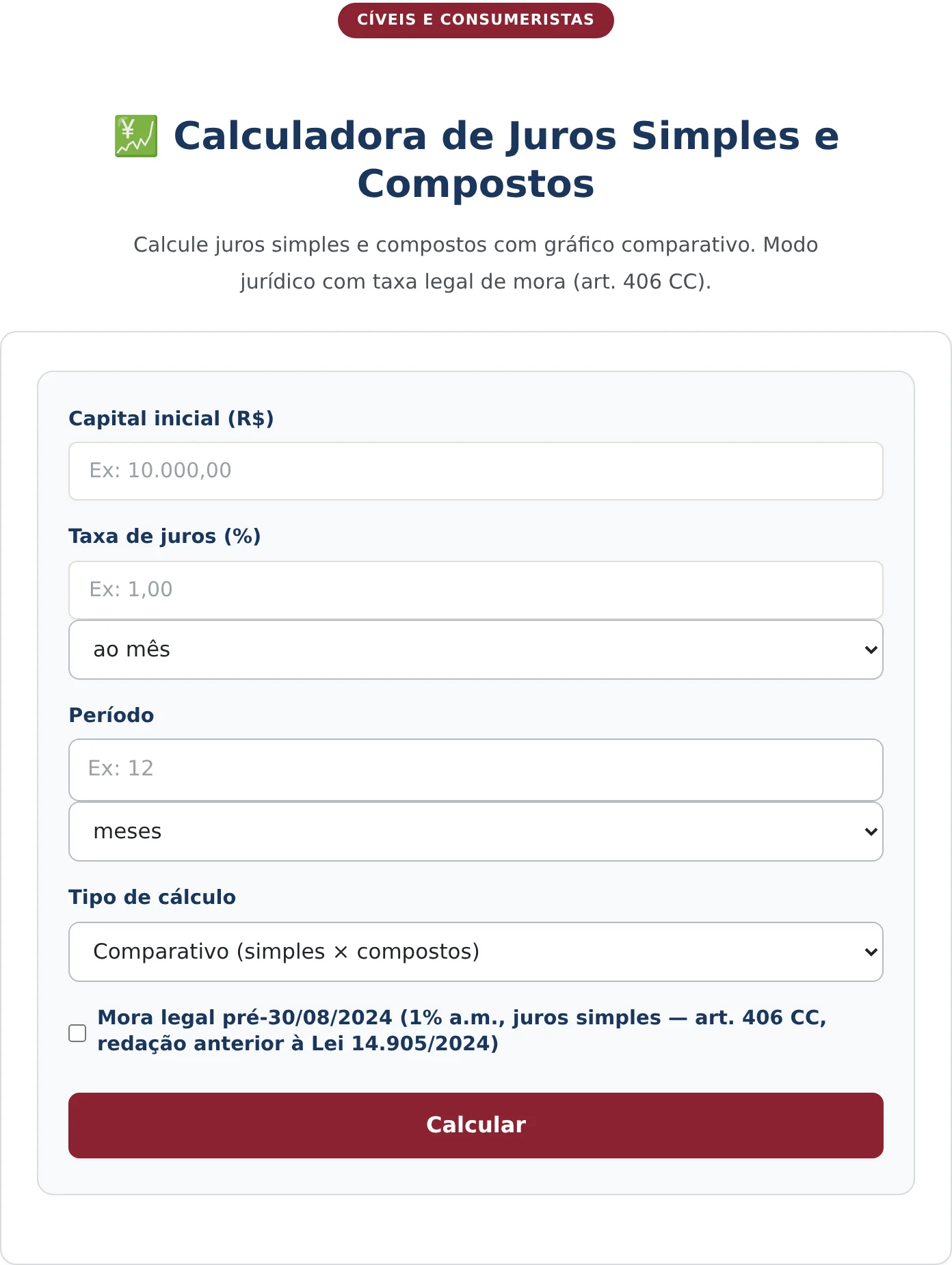
2. Fill in the calculation data
In the example, the initial principal is R$ 10.000,00, the rate is 1.00% per month, the period is 12 months, and the selected type is the comparison between simple and compound interest.
The rate and the period must use the same unit of time: a monthly rate with a period in months, or an annual rate with a period in years. Mixing the units is the most frequent data-entry mistake, and it produces results far from what you expect.

3. Calculate and read the comparison
The calculate button opens a card showing both final amounts prominently, a block for each method with its formula, the comparison, and a chart of how the balance evolves.

How to read each line of the result
In the example, the final amount is R$ 11.200,00 under simple interest and R$ 11.268,25 under compound interest.
The simple interest block shows the formula applied and the data: principal of R$ 10.000,00, a rate of 1% per month (equivalent to 12% per year), a period of 12 months, a final amount of R$ 11.200,00, and total interest of R$ 1.200,00.
The compound interest block repeats the structure with the exponential formula. The equivalent annual rate rises to 12.68%, the final amount reaches R$ 11.268,25, and total interest reaches R$ 1.268,25. The gap between the equivalent annual rates is compounding in its purest form.
The comparison quantifies the effect: a difference of R$ 68,25, or 5.69% more interest under compound interest. Over twelve months the number looks modest; the same exercise over ten years changes the order of magnitude entirely.
The evolution chart shows the two curves. The simple interest curve is a straight line; the compound interest curve rises steeply. It is the visual explanation of why, over long terms, the choice between the two methods becomes decisive.
The 2024 change in statutory interest
The footer of the result carries the tool’s most important legal information. Effective August 30, 2024, the legislation changed the statutory interest standard set out in the Civil Code.
Civil statutory interest now equals the economy’s benchmark rate minus the official inflation index, calculated and published monthly by the monetary authority, under simple interest.
This design has a consequence stated expressly in the law itself: if the result of the subtraction is negative, the rate is treated as zero. There is no negative statutory interest.
For earlier periods, the simplified reference is the rate of 1% per month, which the tool offers in the dedicated checkbox. The footer candidly warns that the standard actually applicable to that period may vary depending on the court decision, since part of the case law applied the benchmark rate even before the reform.
One educational use of the tool deserves mention. If you repeat the same calculation with longer and longer terms, the difference between the two methods stops being marginal and comes to dominate the result: at twelve months it is just over five percent of the interest, and over long terms it comfortably exceeds the initial principal itself.
This numerical demonstration tends to be more persuasive than the theoretical explanation, both in a conversation with a client and in a technical legal filing. The evolution chart, which separates the straight line from the curve, makes visible the point at which compounding starts to weigh heavily.
What the calculator does not do
The tool does not apply inflation adjustment. Interest and inflation adjustment are separate components, and the site maintains its own calculators for index-based updating.
It also does not calculate the statutory rate month by month for the period after August 2024, which depends on the official monthly publication. The legal mode available covers the reference rule in force before the change.
And it does not assess rate limits in consumer relationships, a matter that depends on the type of contract, the institution involved, and an analysis of any abusiveness in the specific case.
Frequently Asked Questions
What is the practical difference between simple and compound interest?
Under simple interest, interest always accrues on the original principal. Under compound interest, it accrues on the principal plus the interest already accumulated. In the example of twelve months at 1% per month, the difference is R$ 68,25, and it grows at an accelerating pace as the term gets longer.
What is the statutory interest rate in civil matters today?
Since August 30, 2024, it equals the economy’s benchmark rate minus the official inflation index, calculated monthly, under simple interest. When the result is negative, the law treats the rate as zero.
Can the 1% per month rate still be used?
It is the simplified reference for periods before August 30, 2024, and the tool offers that mode in its own checkbox. For those earlier periods, however, the standard actually applied may vary depending on the decision issued in the case.
Receba novidades por e-mail
Cadastre-se gratuitamente para receber nossos novos artigos.
Seus dados estão protegidos conforme a LGPD.
Ficou com dúvidas? Fale com um advogado especialista.
📱 Falar pelo WhatsAppAs informações deste artigo são de caráter informativo e não substituem consulta jurídica individualizada. Cada caso possui particularidades que exigem análise específica.


