
Succession Readiness Checker: Tutorial
Probate must be opened within two months, and the inheritance transfer tax has its own deadline calculated from the date of death. The website checker compares these deadlines with the appropriate procedure and the risks involved in succession.
What the succession readiness checker addresses
Succession begins with a race against deadlines that few people know about. The Code of Civil Procedure sets a two-month period to open probate, counted from the date of death, and state law establishes its own deadline for payment of the inheritance transfer tax.
Missing these deadlines does not prevent succession from proceeding, but it makes it more expensive. The tax penalty applies to the tax itself and accumulates with interest, so delay turns a predictable cost into a growing one.
There is also the choice of procedure. Extrajudicial probate, through a public deed, is faster and less expensive, but requires agreement among legally capable heirs and the absence of a will. Summary probate follows a simplified procedure, with its own requirements regarding value or agreement. Full judicial probate is the residual option.
The website checker receives five pieces of information and returns a report with deadlines, the recommended procedure, an estimated tax amount, and identified risks.
When the tool helps in a specific case
Its most important use is screening soon after the death, when prompt decisions prevent costs that cannot be recovered.
Other recurring situations include:
- checking how much time remains to open probate without a penalty;
- identifying the appropriate procedure based on the composition of the estate;
- estimating the inheritance transfer tax due;
- assessing the possibility of an exemption for a single low-value residential property;
- identifying whether lifetime gifts must be brought into account.
The issue of bringing gifts into account is the least remembered and the one that generates the most litigation. Gifts made by the deceased to descendants or the spouse are presumed to be an advance on the inheritance and must be included in the distribution, unless expressly waived.
The penalty for opening probate late applies to the tax, not to the estate. Delay costs a percentage, not a fixed amount.
This is why the report begins with deadlines, before any other information.
Step by step through the tool screens
The checker is located in the website’s tools section, among the succession tools, and works in your browser.
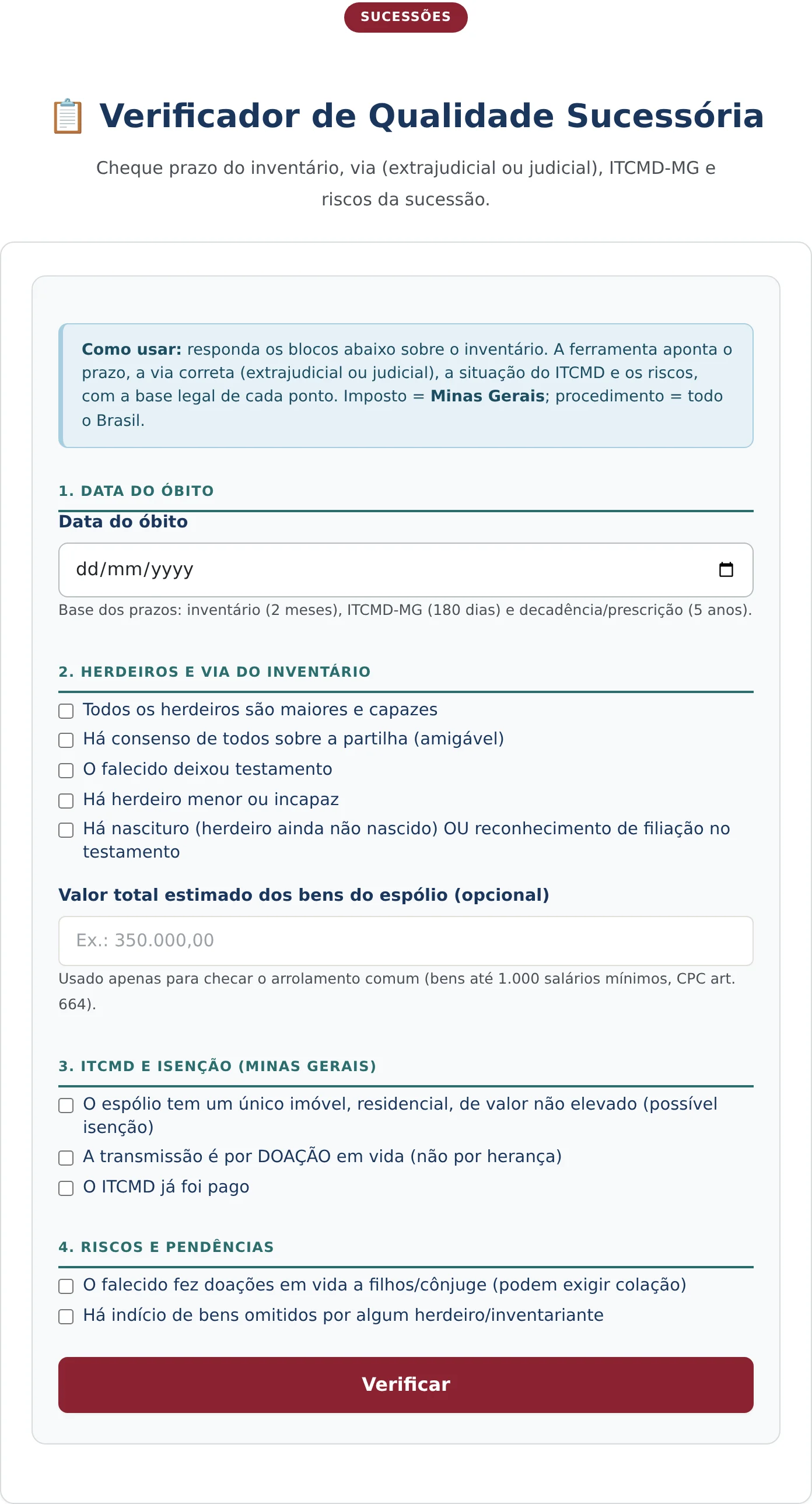
1. Open the tool and identify the fields
The screen contains five fields. The first is the date of death, which serves as the basis for all calculated deadlines. The second is a box confirming whether all heirs are adults and legally capable.
The third takes the estimated total value of the assets, used to determine whether summary probate is available. The fourth identifies whether there is a single low-value residential property, which may qualify for an exemption. The fifth records lifetime gifts.
2. Fill in the succession information
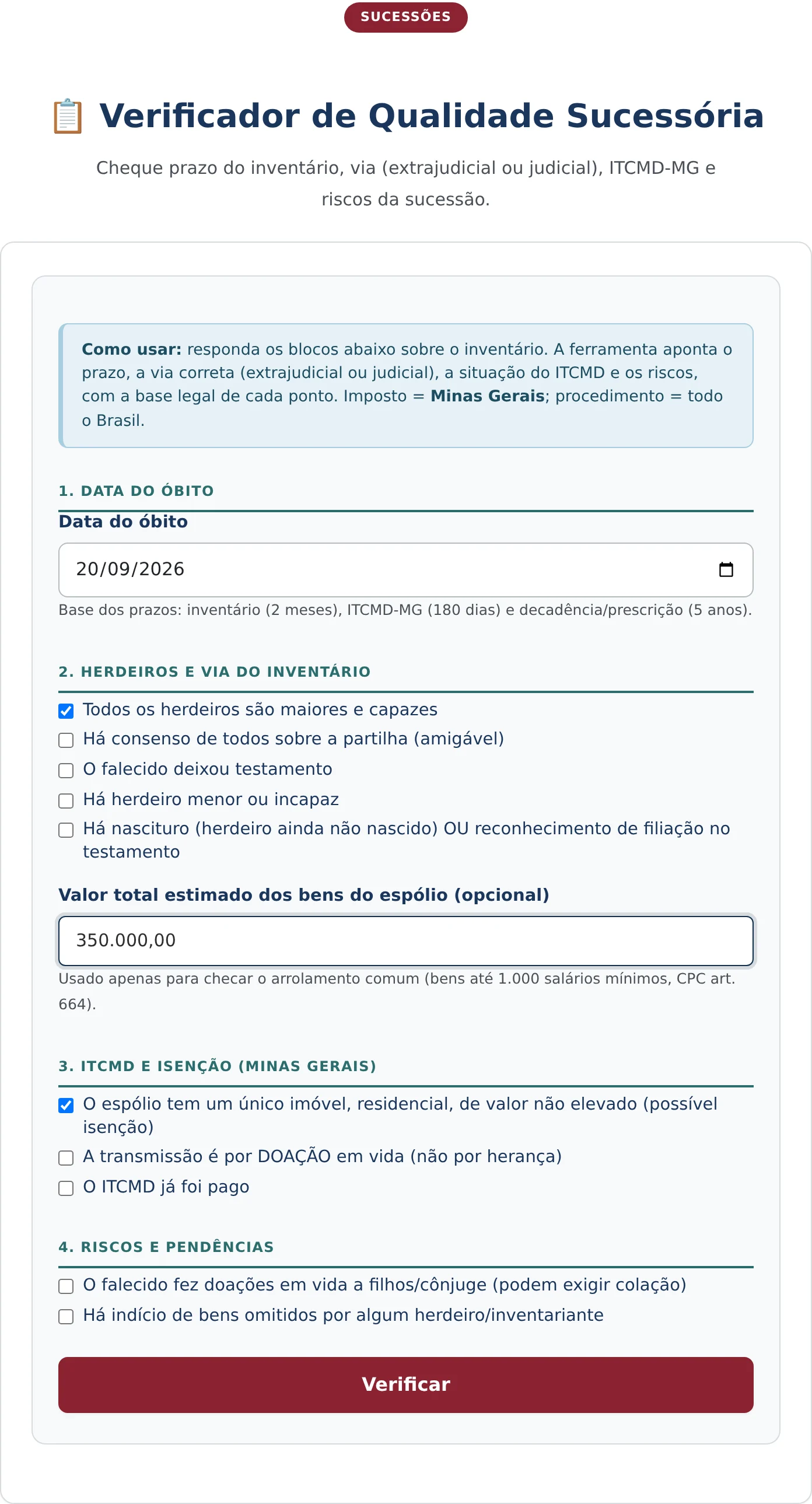
In the example, the death occurred in September 2026, all heirs are adults and legally capable, the estate is estimated at R$ 350.000,00, there is a single low-value residential property, and there were no lifetime gifts.
The box concerning the heirs’ legal capacity is decisive for the procedure. The presence of an incapacitated heir rules out extrajudicial probate and requires the intervention of the Public Prosecutor’s Office in the judicial proceeding.
3. Check and read the report
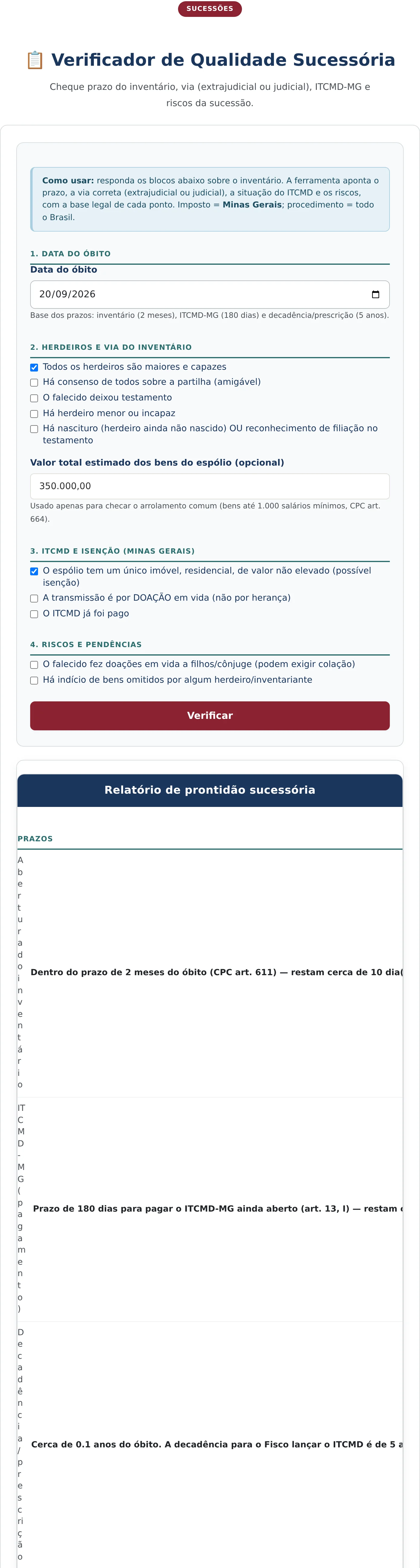
The “Check” button opens the succession readiness report, with sections on deadlines, the recommended procedure, tax, and identified risks.
How to read each section of the report
In the example, the deadlines section begins with opening probate, stating that it is still within the two-month period and indicating how many days remain.
Next comes the inheritance transfer tax deadline, indicating the one-hundred-and-eighty-day payment period and the days remaining, along with a warning that timely payment avoids the late-payment penalty.
The third item addresses lapse and prescription, stating the time elapsed since the death and noting that the tax authority has five years to assess the tax.
The recommended procedure section is the most straightforward. In the example, it indicates ordinary summary probate, explaining that the reported assets do not exceed the limit of one thousand minimum wages and that this procedure allows even an incapacitated heir or the absence of full agreement.
The tax section states the applicable rate under the state law loaded into the tool, identifying the legal provision. This information varies among states, and the report states which law it refers to.
The report header expressly records this limitation: the procedure addressed is nationwide, while the tax portion corresponds to the law of a specific state.
The three probate procedures and what distinguishes them
It is worth detailing the procedures because the choice determines timing, cost, and complexity.
Extrajudicial probate is completed through a public deed at a notary office. It requires adult and legally capable heirs, agreement on the distribution, no will, and assistance from a lawyer. It is the fastest option and can be completed in weeks when the documentation is complete.
Summary probate is a simplified judicial proceeding. It has two forms: the summary form, for legally capable heirs who agree, and the ordinary form, available when the value of the assets does not exceed the legal limit and allowing even incapacitated heirs.
Full judicial probate is the ordinary procedure, applicable when there is litigation among heirs, a will to be carried out, or other circumstances that rule out simplified procedures. It is the slowest and most expensive option.
Under any procedure, the inheritance transfer tax must be paid, and payment is a condition for completion. The choice of procedure affects the time involved, not the tax obligation.
There is also the possibility of partial distribution or a judicial authorization for specific situations, such as withdrawing small amounts, which do not require the full procedure.
One further point that the report flags and is often underestimated concerns the estate’s debts.
The estate is liable for debts left by the deceased, and distribution reaches only what remains after creditors have been paid. An heir is not liable with personal assets because liability is limited to the value of the inheritance, but a distribution made without considering liabilities may be undone.
For this reason, the proper sequence is to identify the assets, determine the liabilities, pay the debts, and distribute the remainder. Reversing this order by distributing assets before determining debts often leads to later litigation between heirs and creditors.
What the tool does not do
The checker does not review documents or identify heirs. The order of inheritance and any testamentary provisions require a specific analysis.
It also does not calculate the distribution, an operation handled by another tool in the collection, or determine the estate’s debts, which come before division among heirs.
And the tax portion corresponds to the law of a specific state, as stated in the report. In successions governed by another state’s law, the rate and exemptions must be checked under the applicable law.
Frequently Asked Questions
What is the deadline to open probate?
Two months from the date of death, pursuant to the Code of Civil Procedure. Missing the deadline does not prevent probate from being opened later, but it subjects the estate to the penalty provided under the state inheritance transfer tax law, which applies to the tax itself.
When can probate be completed at a notary office?
When all heirs are adults and legally capable, there is agreement on the distribution, and no will exists, always with assistance from a lawyer. The presence of an incapacitated heir or litigation rules out the extrajudicial procedure and requires judicial proceedings.
What does bringing gifts into account mean?
It is the obligation to include in the distribution assets given by the deceased during life to descendants or the spouse, because those gifts are presumed to be an advance on the inheritance. A waiver requires an express declaration by the donor, and omission is a frequent cause of litigation.
Receba novidades por e-mail
Cadastre-se gratuitamente para receber nossos novos artigos.
Seus dados estão protegidos conforme a LGPD.
Ficou com dúvidas? Fale com um advogado especialista.
📱 Falar pelo WhatsAppAs informações deste artigo são de caráter informativo e não substituem consulta jurídica individualizada. Cada caso possui particularidades que exigem análise específica.


