
Types of INSS (Brazil’s National Social Security Institute) Benefits: Lookup Guide
The code shown on the benefit award letter defines the type of benefit, the required qualifying period, and the calculation coefficient. The website’s benefit-type lookup includes 63 codes, along with the requirements for each one.
What the benefit-type lookup provides
Every social security benefit has a numerical code that identifies it. It appears on the benefit award letter, the payment statement, and administrative systems, and it is the code used to handle the benefit internally.
This code is not merely a bureaucratic reference. It indicates the benefit type, which defines its legal framework: whether the benefit is a social security, occupational injury, or social assistance benefit, the required qualifying period, the calculation coefficient, and whether it is still granted or has been discontinued.
The distinction between social security and occupational injury benefits, for example, has important consequences: occupational injury benefits ensure job security after medical clearance and are subject to their own qualifying-period rules.
There is also a historical issue. Many codes correspond to discontinued benefits, which are no longer granted but continue to be paid to those already receiving them. Analyzing an older benefit requires knowing which rule governed it.
The website’s lookup brings this information together in a searchable database, with filters by group and status.
When the tool helps in a specific case
Its most common use is identifying the benefit type from the code shown in an insured person’s document.
Other recurring situations include:
- checking the qualifying period required for a particular benefit;
- confirming the applicable calculation coefficient;
- distinguishing a social security benefit from an occupational injury benefit;
- identifying whether a benefit is still granted or has been discontinued;
- mapping the benefit types within a group, such as pensions or allowances.
The distinction between active and discontinued benefits is especially useful when analyzing an older benefit, because it guides research into the legislation in force when the benefit was granted.
A discontinued benefit continues to be paid to those already receiving it. No longer being granted is not the same as no longer existing.
The tool identifies this status for each benefit type, avoiding the hasty conclusion that an older benefit is irregular.
Step-by-step guide to the tool’s screens
The lookup is located in the website’s tools section, among the social security tools, and works in your browser.
1. Open the tool and understand the screen
The screen includes a search field, two filter selectors, and two buttons. The search field accepts the code, such as a benefit-type number, or part of the benefit’s name.
The first selector filters by group, with options ranging from old-age retirement benefits to the federal government’s social security obligations. The second filters by status, allowing you to view only active or only discontinued benefits.
Below the controls, a counter shows how many benefit types are displayed and how many exist in total, including how many are active.

2. Search by name or code
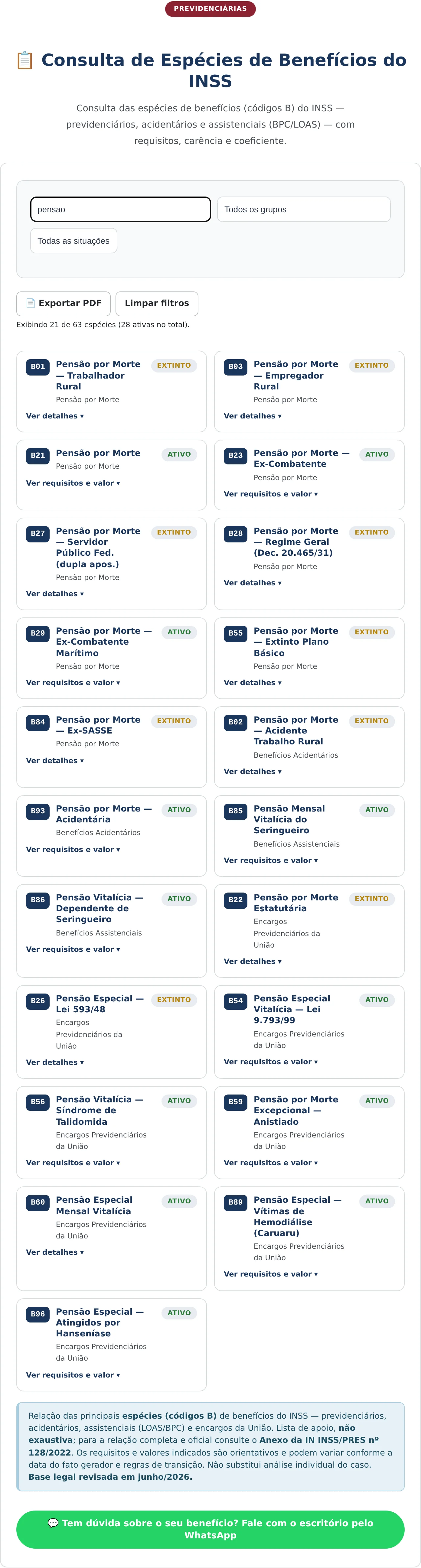
The search filters the list according to the text entered, without requiring you to click a button. In the example, searching for a term related to pensions narrows the list to the corresponding benefit types.
This is the typical use for someone with the document in hand: enter the code shown on the benefit award letter and immediately find the benefit type, along with its requirements.
3. Filter by group
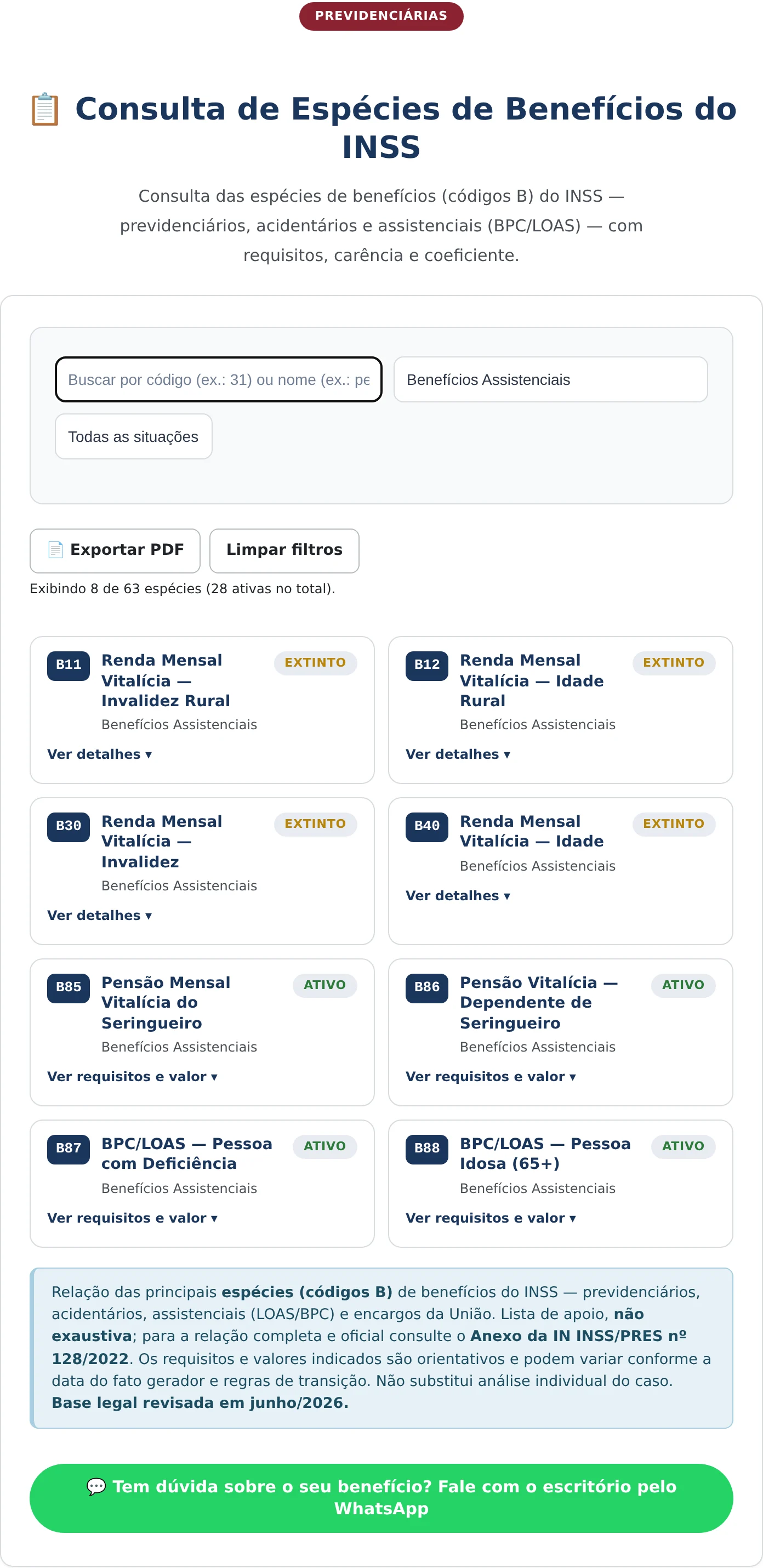
The group filter lets you view all benefit types within the same family. In the example, the social assistance benefits group narrows the list to benefit types of that nature, including discontinued ones.
How to read each item in the listing
Each benefit type appears with its code highlighted, the benefit’s name, the group it belongs to, and its status, active or discontinued.
The details button expands the item and displays the requirements. For active benefits, the expanded view shows the requirements and amount; for discontinued benefits, it shows the historical context and the rule that governed them.
The counter at the top serves as a guide. It shows how many benefit types the filter returned and how many exist in total, giving you a sense of the full universe and avoiding the impression that the displayed list is complete.
The inclusion of discontinued benefit types in the database is intentional. Benefits such as lifetime monthly income benefits, replaced by the current social assistance benefit, continue to be paid to long-standing beneficiaries, and analyzing these cases requires knowing the original rule.
Exporting to a document lets you take the filtered list beyond the screen, which is useful when preparing a legal opinion or a filing that addresses several benefit types.
Why the code matters when analyzing a case
It is worth examining the practical consequences of correctly identifying the benefit type.
The first is the qualifying period. Benefits have different requirements for a minimum number of contributions, and some waive it, as is the case with benefits resulting from an accident and certain illnesses listed by law.
The second is the coefficient. The percentage applied to the benefit base salary varies according to the benefit type and applicable rule, and it determines the initial monthly benefit amount.
The third is concurrent receipt. Some benefit types cannot be received together, and correct identification is the first step in assessing the lawfulness of existing or intended concurrent receipt.
The fourth is the occupational injury nature of the benefit. Occupational injury benefits ensure job security for twelve months after termination, and converting an ordinary benefit into an occupational injury benefit is a frequent issue, with significant employment-law effects.
The fifth is the statute of limitations and statute of repose, whose starting points may vary depending on whether the issue is the grant or review of the benefit type granted.
One point about reading the benefit award letter completes the picture, because that is where the code appears with the greatest consequences.
In addition to the benefit type, the letter includes the benefit start date, the initial monthly benefit amount, the benefit base salary used, and the coefficient applied. These four elements make it possible to reconstruct the calculation and identify any error.
The letter is also where you can verify whether the benefit was granted under the correct type. For example, granting an ordinary benefit in a situation that would qualify as an occupational injury benefit deprives the insured person of job security and changes the qualifying-period rules, and correcting that classification is an independent claim.
For that reason, the benefit-type lookup is usually the first step in analyzing a benefit that has already been granted: before discussing the amount, confirm its nature.
What the tool does not do
The lookup does not analyze a specific case. It provides the general requirements for each benefit type, while eligibility depends on the insured person’s contribution history and circumstances.
It also does not calculate the benefit amount, an operation that depends on the average of contribution salaries and the applicable rule, addressed by other tools in the collection.
Nor does it replace the benefit award letter, the official document that states the benefit type actually granted, the start date, and the calculation parameters used.
Frequently Asked Questions
Where can I find my benefit type code?
It appears on the benefit award letter and payment statement, usually preceded by the letter that identifies the benefit type. Enter this number in the tool’s search field to find the corresponding requirements.
Has a benefit marked as discontinued stopped being paid?
No. Discontinued means that the benefit type is no longer granted to new beneficiaries, but those already receiving it continue to do so under the rule in force when it was granted. The designation helps guide research into the applicable legislation.
What is the difference between a social security benefit and an occupational injury benefit?
An occupational injury benefit results from a workplace accident or occupational disease and is governed by its own rules, including waiver of the qualifying period and job security for twelve months after termination. The benefit type indicated by the code makes this distinction possible.
Receba novidades por e-mail
Cadastre-se gratuitamente para receber nossos novos artigos.
Seus dados estão protegidos conforme a LGPD.
Ficou com dúvidas? Fale com um advogado especialista.
📱 Falar pelo WhatsAppAs informações deste artigo são de caráter informativo e não substituem consulta jurídica individualizada. Cada caso possui particularidades que exigem análise específica.


