
Insured Status Checker: Tutorial
Stopping contributions does not end your Social Security coverage the next day: there is a grace period that can last from 6 to 36 months. The website’s checker calculates that period and shows the exact date your coverage ends.
What the insured status checker does
Insured status is the condition that guarantees entitlement to benefits under the General Social Security System. While you have it, you are covered for temporary disability benefits, maternity benefits, incarceration benefits, and survivor’s pensions. Once it is lost, coverage ends, even if you have accumulated years of contributions.
The law does not end coverage on the date of the last contribution. It provides for a grace period, which generally lasts 12 months for most insured persons and 6 months for voluntary contributors. This period may be extended twice, reaching up to 36 months in certain situations.
The first 12-month extension requires more than 120 contributions without an interruption that results in loss of insured status. The second, also 12 months, requires proof of involuntary unemployment, which may be established through registration with the relevant agency, receipt of unemployment insurance, or another accepted means.
The website’s checker brings these variables together in six fields and returns the exact date coverage ends, along with a breakdown of the period.
When the tool helps in a specific case
Its most important use comes before applying for a benefit. Knowing whether insured status still exists determines whether the application has a chance of succeeding or whether another path is needed.
Other common situations include:
- planning a return to contributions before coverage expires;
- assessing the risk of stopping contributions for a few months;
- checking coverage on the date of an accident or illness;
- verifying the status of someone who received a benefit and later stopped contributing;
- understanding how the reason for leaving employment affects the period.
One detail in completing the form changes everything. Anyone who received a benefit after their last contribution must enter the date the benefit ended, rather than the date of the last contribution, because the period during which the benefit is received preserves insured status without a time limit.
The grace period can reach 36 months, but the extension for involuntary unemployment depends on proof, not a declaration.
In practice, this evidentiary requirement is what separates a 24-month period from a 12-month period.
Step-by-step guide using the tool’s screens
The checker is located in the website’s tools section, among the Social Security tools, and works entirely in your browser.
1. Open the tool and identify the fields
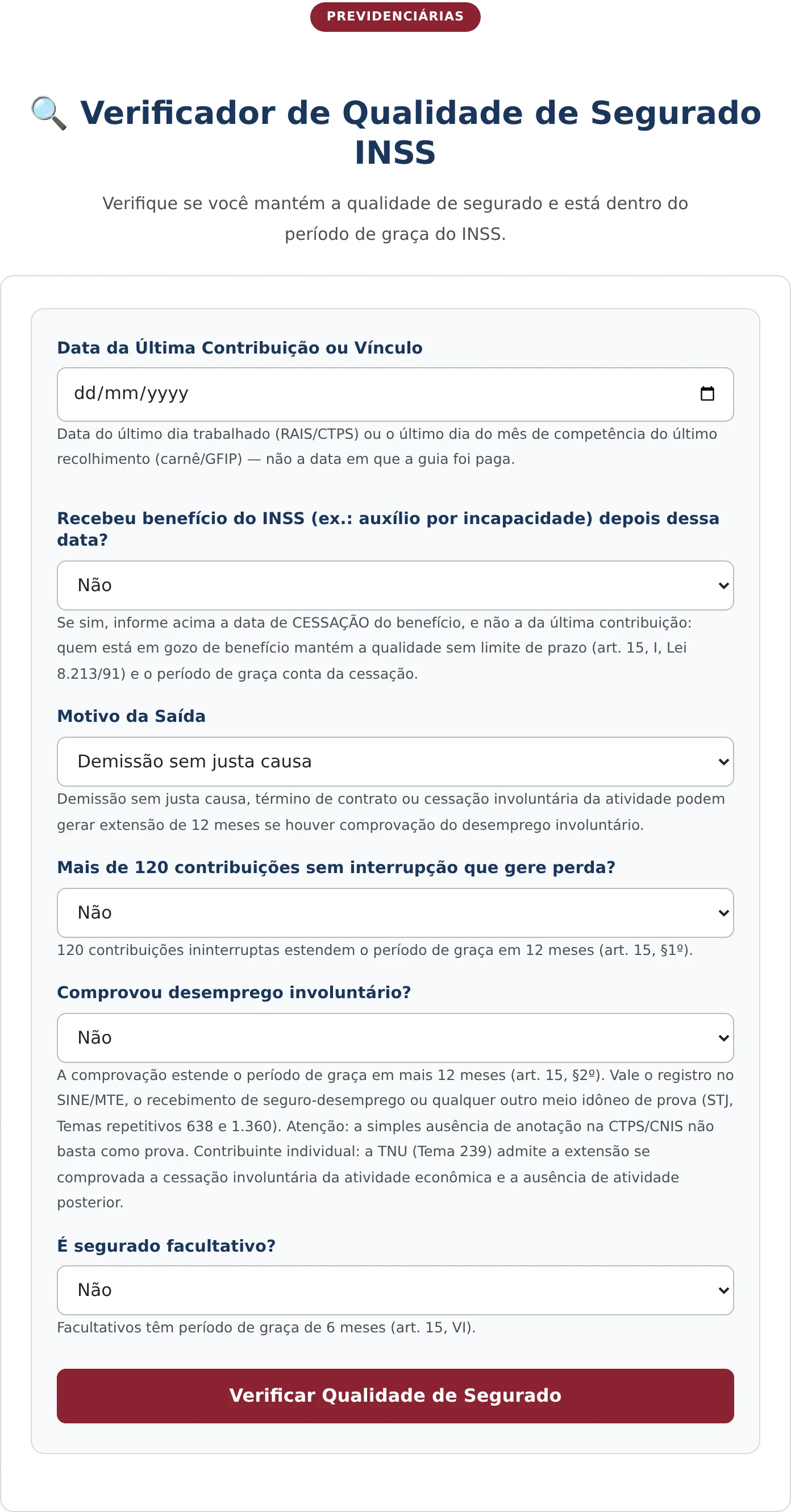
The screen contains six fields. The first is the date of your last contribution or employment relationship. The next five describe the situation: whether you received a benefit after that date, the reason for leaving employment, whether you have more than 120 uninterrupted contributions, whether involuntary unemployment was proven, and whether you are a voluntary contributor.
The supporting text for the first date is the most technical part of the screen and prevents the most common mistake: you must enter the last day worked, in the case of registered employment, or the last day of the contribution month, in the case of an individual contribution, rather than the date the payment slip was paid.
2. Complete the fields with the facts of the situation
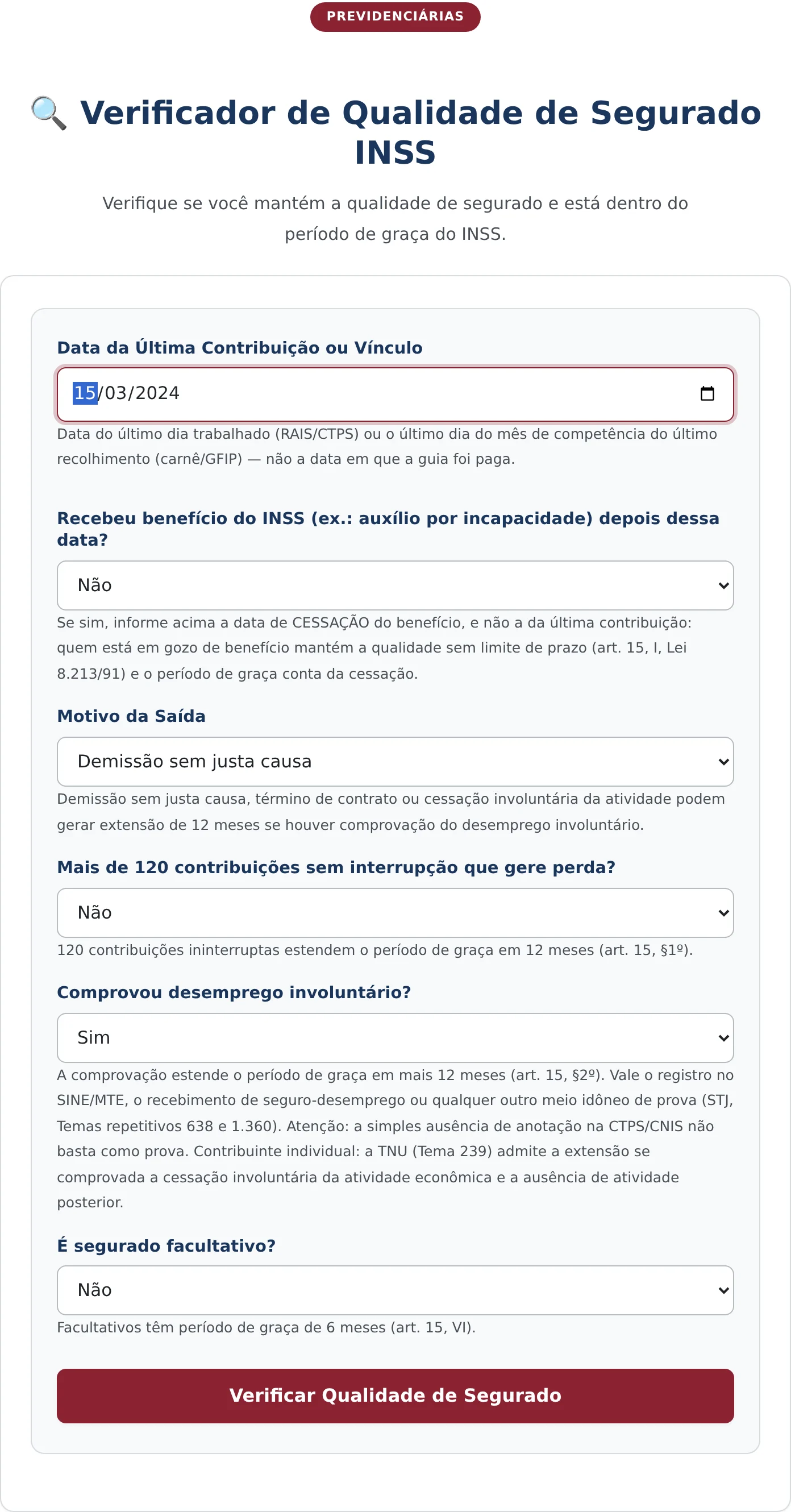
In the example, the last contribution was on March 15, 2024, no benefit was received after that date, the employment ended through dismissal without cause, there are not 120 uninterrupted contributions, involuntary unemployment was proven, and the insured person is not a voluntary contributor.
The selected combination is intentionally common: a dismissed worker who registered as unemployed and did not resume contributions. It produces the extended 24-month period and shows how proof of unemployment doubles the basic coverage period.
3. Check and read the result
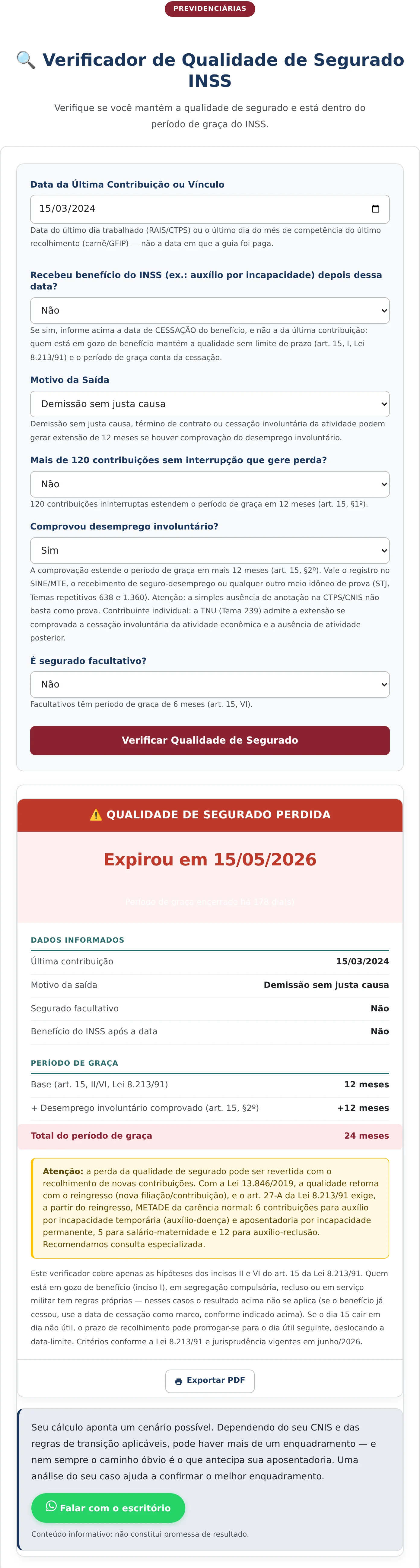
The “Check Insured Status” button opens a card showing the status prominently, the information entered, the breakdown of the grace period, and the applicable guidance.
How to read each line of the result
In the example, the result indicates loss of insured status, with coverage expiring on May 15, 2026. The tool states how many days ago the period ended, which shows the time dimension of the issue.
The information-entered section repeats the selections made in the form, allowing you to check whether any field was marked by mistake. It is a simple and useful feature, because most unexpected results come from how the form was completed, not from the calculation.
The breakdown of the grace period is the central part. It shows the 12-month base period, plus 12 months for proof of involuntary unemployment, for a total of 24 months counted from the last contribution. Each line identifies the corresponding legal provision, allowing you to check the legal basis.
The card ends with the information most important to anyone who has lost coverage: insured status can be regained through new contributions. Since the 2019 legislative amendment, insured status returns upon reentry, but from that point onward the law requires half of the normal qualifying period for certain benefits: 6 contributions for temporary disability benefits and permanent disability retirement, 5 for maternity benefits, and 12 for incarceration benefits.
There is also an important limitation on scope. The checker covers the situations set out in items II and VI of art. 15 of Law 8.213/91. Those receiving benefits, in compulsory isolation, incarcerated, or in military service are subject to their own rules, and the result does not apply directly in those cases.
A clarification about the method helps you use the result properly. Insured status is assessed on the date of the event giving rise to the benefit, not on the date of the application. For temporary disability benefits, the relevant date is when the disability began; for survivor’s pensions, the date of death; and for maternity benefits, the date of birth or adoption.
This distinction resolves many cases that may seem lost. Someone may have lost insured status before applying and still be entitled to the benefit because coverage existed on the date of the event. The checker provides the exact date the grace period ended, and the event must be compared against that date.
What the tool does not do
The checker does not access the Social Security registry. It works with the date entered by the user, and the accuracy of the result depends on the accuracy of that information, which must be checked against the official statement.
It also does not calculate the qualifying period or contribution time. Insured status and the qualifying period are separate requirements: you may have insured status without having met the qualifying period, and the reverse can also occur. The website has separate tools for calculating contribution time.
Finally, the checker does not analyze denied benefits. When a benefit is denied because of loss of insured status, the issue often involves proof of an unregistered employment relationship or undocumented unemployment, which requires an examination of the documents in the case.
Frequently Asked Questions
How long does the grace period last?
The base period is 12 months for most insured persons and 6 months for voluntary contributors. It increases by 12 months for more than 120 contributions without an interruption that causes loss of insured status, and by another 12 months with proof of involuntary unemployment, potentially reaching 36 months.
How is involuntary unemployment proven?
It may be proven through registration with the relevant agency, receipt of unemployment insurance, or another reliable means demonstrating the situation. The mere absence of an entry in the work booklet, by itself, is generally not accepted as sufficient proof.
If insured status is lost, is prior contribution time lost as well?
No. Time already contributed remains credited and continues to count toward retirement. What is lost is coverage for benefits that require insured status on the date of the event, and it returns upon reentry, subject to the reduced qualifying period required from that point onward.
Receba novidades por e-mail
Cadastre-se gratuitamente para receber nossos novos artigos.
Seus dados estão protegidos conforme a LGPD.
Ficou com dúvidas? Fale com um advogado especialista.
📱 Falar pelo WhatsAppAs informações deste artigo são de caráter informativo e não substituem consulta jurídica individualizada. Cada caso possui particularidades que exigem análise específica.


