
Minimum Wage and INSS (Brazil’s National Social Security Institute) Ceiling Table: A Guide
Reviewing an older benefit requires knowing the ceiling and minimum wage in effect that year, as well as the legal instrument that established them. The website’s historical table lists both amounts from 1994 onward, with the relevant legal instrument alongside each one.
What the historical table provides
Two figures determine nearly every social security calculation: the minimum wage, which is the floor for income-replacement benefits, and the general social security system ceiling, which limits both the contribution salary and the benefit amount.
These amounts change every year under their own legal instruments, and in some years they changed more than once. There were two minimum wage amounts in 2020, and again in 2023, meaning that the correct answer depends on the month, not just the year.
There is also the legal instrument. In a technical filing, stating the amount is not enough: you must identify the decree or ordinance that established it. Looking up that reference case by case takes time disproportionate to its importance.
The website’s table addresses all three needs on one screen, with searches by year, amount, or legal instrument, as well as document export.
When the tool helps in a specific case
Its most common use is reviewing benefits granted in prior years, when you need to determine whether the payment complied with the minimum and maximum amounts in effect at the time.
Other recurring situations include:
- checking whether a contribution salary exceeded that year’s ceiling;
- locating the legal instrument that established a given amount for citation in a filing;
- reviewing adjustments applied to minimum-value benefits;
- building a timeline of amounts for an arrears calculation;
- confirming the amount in effect on a specific date in the past.
Searching by amount is a less obvious but highly useful feature. When you have the number but do not know the year, entering the amount immediately identifies the corresponding reference period.
In some years, there were two different minimum wages. Giving an answer based on the year without checking the month produces the wrong amount.
The table addresses this particularity by displaying one row for each effective-date milestone, rather than one row per year.
Step by step through the tool’s screens
The table is in the website’s tools section, among the social security tools, and works in your browser.
1. Open the tool and identify the screen
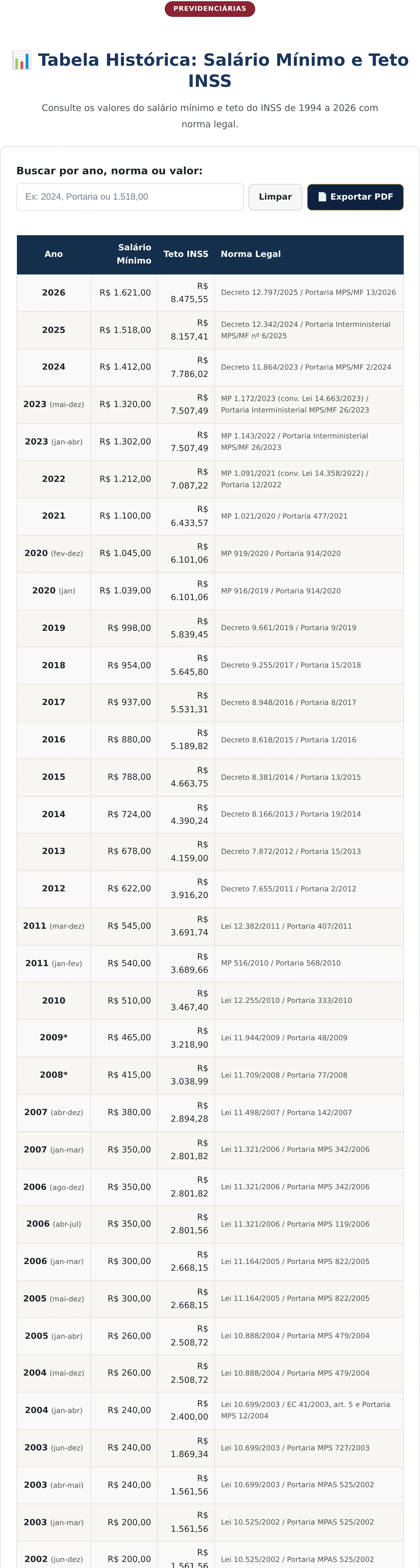
The screen displays a search field, a button to clear the filter, and an export button. Below is the complete table, arranged from the most recent year to the oldest.
Each row has four columns: year or effective period, minimum wage, general social security system ceiling, and legal instrument. The legal instrument column generally includes two references because the minimum wage is established by decree and the ceiling by an interministerial ordinance.
2. Filter by year
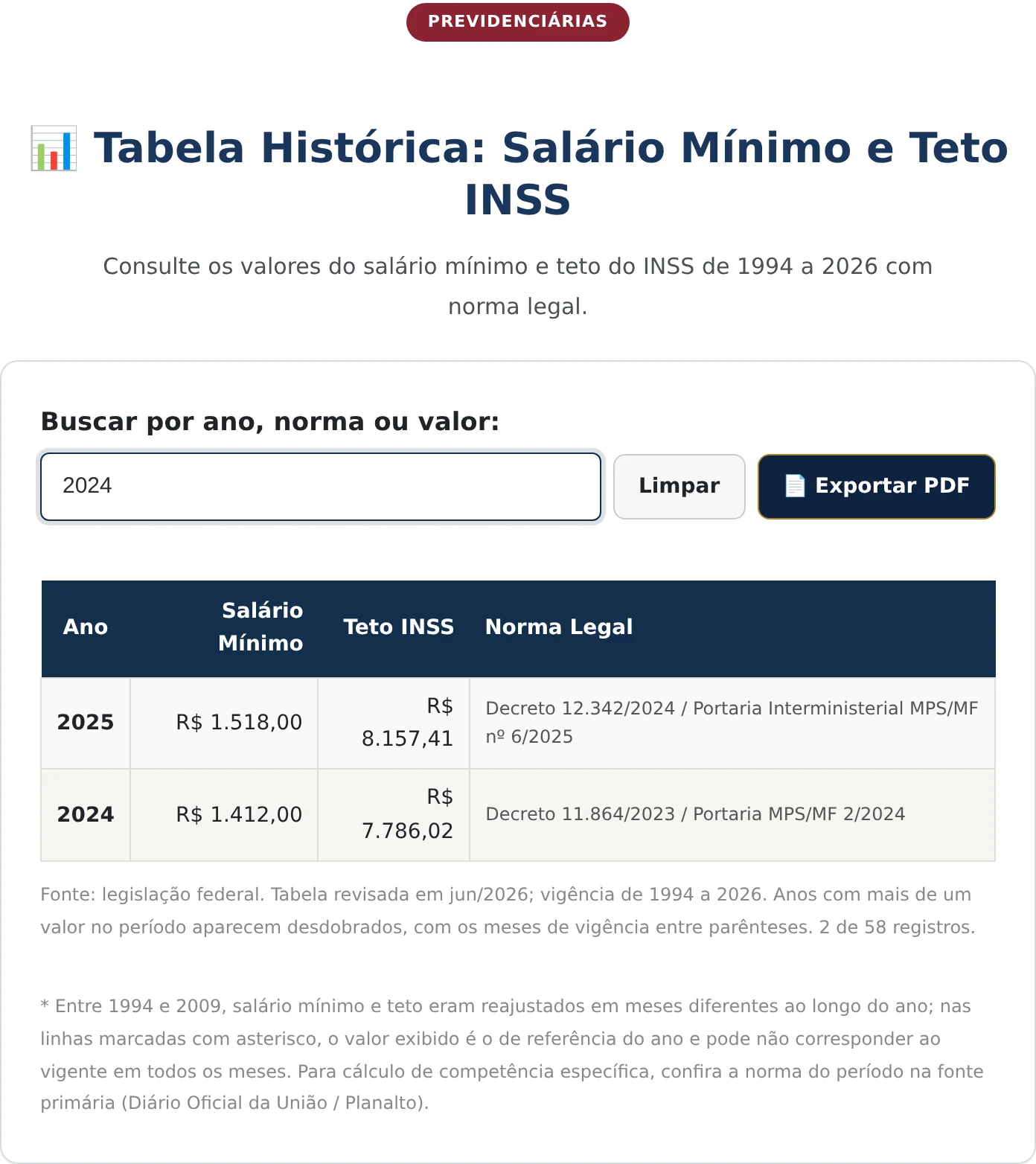
The search field filters the table according to the text you enter, without requiring you to click a button. In the example, searching for a specific year narrows the list to the rows for that period.
The filter works across all columns, which is why searches by amount also work. Entering part of a number identifies the row in which it appears, whether as the minimum wage or the ceiling.
3. Search by legal instrument
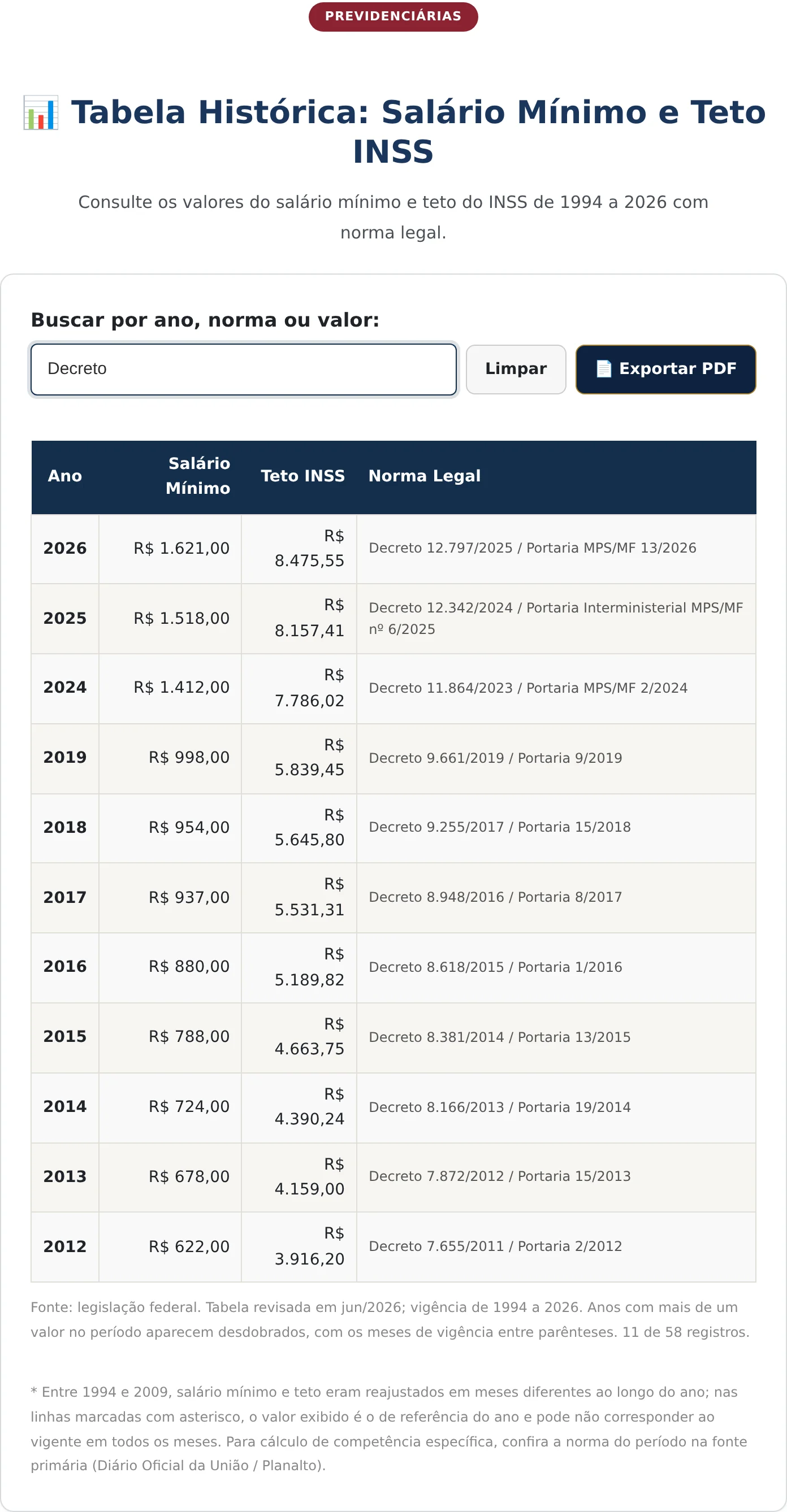
Searching by legal instrument is the third way to use the tool. By entering the type of legal act, the table displays all rows whose legal reference contains that term.
How to read each column in the table
The first column identifies the year or effective period. When it shows months in parentheses, it means there was more than one amount that year, and the row corresponds to one of those milestones.
The second column shows the national minimum wage. It is the floor for benefits that replace employment income, by constitutional mandate, and it is also the reference for the income limit in public assistance benefits.
The third column shows the general social security system ceiling. It serves two purposes: it limits the contribution salary, so no insured person contributes on an amount above it, and it limits the benefit amount. In 2026, the amounts in effect are R$ 1.621,00 for the minimum wage and R$ 8.475,55 for the ceiling.
The fourth column lists the legal instruments. The inclusion of both references, the decree and the ordinance, makes precise citation in a technical filing possible without the need for additional research.
The descending order supports the most common use, which is checking recent amounts, while the search function allows you to check older periods without scrolling.
Why the ceiling matters more than it may seem
The ceiling is often viewed as a detail affecting people who earn a great deal, but it is not.
It defines the limit on an employee’s contribution. Anyone who earns above the ceiling contributes only up to that amount, causing the effective rate to decrease as salary rises, and that is what often leads people to seek supplemental retirement plans.
It also limits the benefit amount, including survivor’s pensions and incapacity benefits. In arrears calculations, applying the ceiling for each reference period is indispensable because a benefit cannot exceed the limit in effect during the corresponding month.
It also affects benefit reviews. Review theories that seek to include contribution salaries in the average must take into account the ceiling in effect for each reference period, or they will produce an unenforceable result.
That is why a reliable historical table, with the legal instrument alongside each amount, is a working tool, not merely an occasional reference.
One recurring use of the table warrants explanation because it involves a common misunderstanding: benefit adjustments.
Benefits equal to one minimum wage are adjusted according to changes in the minimum wage itself and therefore follow the table directly. Benefits above the minimum follow a separate index, applied to the benefit amount rather than to the ceiling.
This explains why a benefit granted at the ceiling is no longer at the ceiling in later years. The ceiling and the benefit are adjusted under criteria that do not always coincide, and the accumulated gap over decades is the subject of well-known benefit review theories.
The table makes it possible to see this gap by simply comparing the evolution of the ceiling with that of the benefit under review. It is a simple analytical use and highly revealing when the difference is shown side by side.
What the tool does not do
The table does not perform calculations. It provides the amounts and legal instruments, while benefit, contribution, or arrears calculations depend on other tools in the collection.
It also does not provide the annual adjustment indexes for benefits above the minimum, which follow their own index and do not track changes in the minimum wage.
And reviewing the official act remains necessary when the amount is disputed. The reference shown in the table allows you to locate the legal instrument precisely, but the published wording prevails.
Frequently Asked Questions
Why do some years have two rows in the table?
Because there was more than one minimum wage amount that year, with different effective-date milestones. The table includes one row for each milestone, so you must consider the month, not just the year, to arrive at the correct amount.
What is the legal instrument column for?
It allows precise citation in a technical filing or administrative application. It identifies the decree that established the minimum wage and the interministerial ordinance that established the ceiling, avoiding additional research in official sources.
Does the ceiling limit the contribution or the benefit?
It limits both. No insured person contributes on an amount above the ceiling, and no benefit under the general social security system may exceed it. In arrears calculations, the ceiling in effect for each reference period applies, not just the one in effect in the year of the application.
Receba novidades por e-mail
Cadastre-se gratuitamente para receber nossos novos artigos.
Seus dados estão protegidos conforme a LGPD.
Ficou com dúvidas? Fale com um advogado especialista.
📱 Falar pelo WhatsAppAs informações deste artigo são de caráter informativo e não substituem consulta jurídica individualizada. Cada caso possui particularidades que exigem análise específica.


