
Attorney Fee Calculator: Tutorial
In cases involving the Public Treasury, prevailing-party attorney fees do not follow a single percentage: they are subject to tiered brackets measured in minimum wages. The website calculator applies these brackets and provides the range.
What the attorney fee calculator does
The 2015 Code of Civil Procedure profoundly changed the rules governing prevailing-party attorney fees. Under the general rule, the percentage is set between ten and twenty percent of the amount awarded, the economic benefit obtained or, if it cannot be measured, the updated amount in controversy.
When the Public Treasury is a party, the rules are different. The percentage follows tiered brackets, defined in minimum wages, and each bracket has its own range. The higher the award, the lower the percentage applicable to the portion exceeding the previous bracket.
This tiered system is technically similar to the progressive income tax table and has the same effect: the effective percentage falls below the nominal percentage of the bracket reached.
There is also a distinction between contractual fees and prevailing-party fees. The former arise from the agreement between attorney and client; the latter are set by the judge and belong to the attorney in their own right.
The website tool addresses both situations and applies the brackets when the Public Treasury is a party.
When the tool helps in a specific case
Its most common use is to estimate prevailing-party fees before deciding whether to appeal or accept a settlement offer.
Other recurring situations include:
- estimating the fee range in a case against a public entity;
- checking whether the amount set in the judgment complies with the statutory brackets;
- understanding the mathematical operation of the tiered system;
- comparing the effect of different award amounts;
- estimating the prevailing-party fee risk for the litigating party.
In the amount field itself, the tool states that the simulation is for educational purposes and does not constitute an estimate or fee proposal, which properly defines its use.
In cases involving the Public Treasury, the percentage decreases as the amount rises. The bracket reached does not apply to the entire award.
The example in this tutorial shows the initial bracket in operation, using fictional amounts selected for demonstration purposes.
Step by step through the tool screens
The calculator is in the website’s tools section, among the civil procedure tools, and runs in the browser.
1. Open the tool and identify the fields
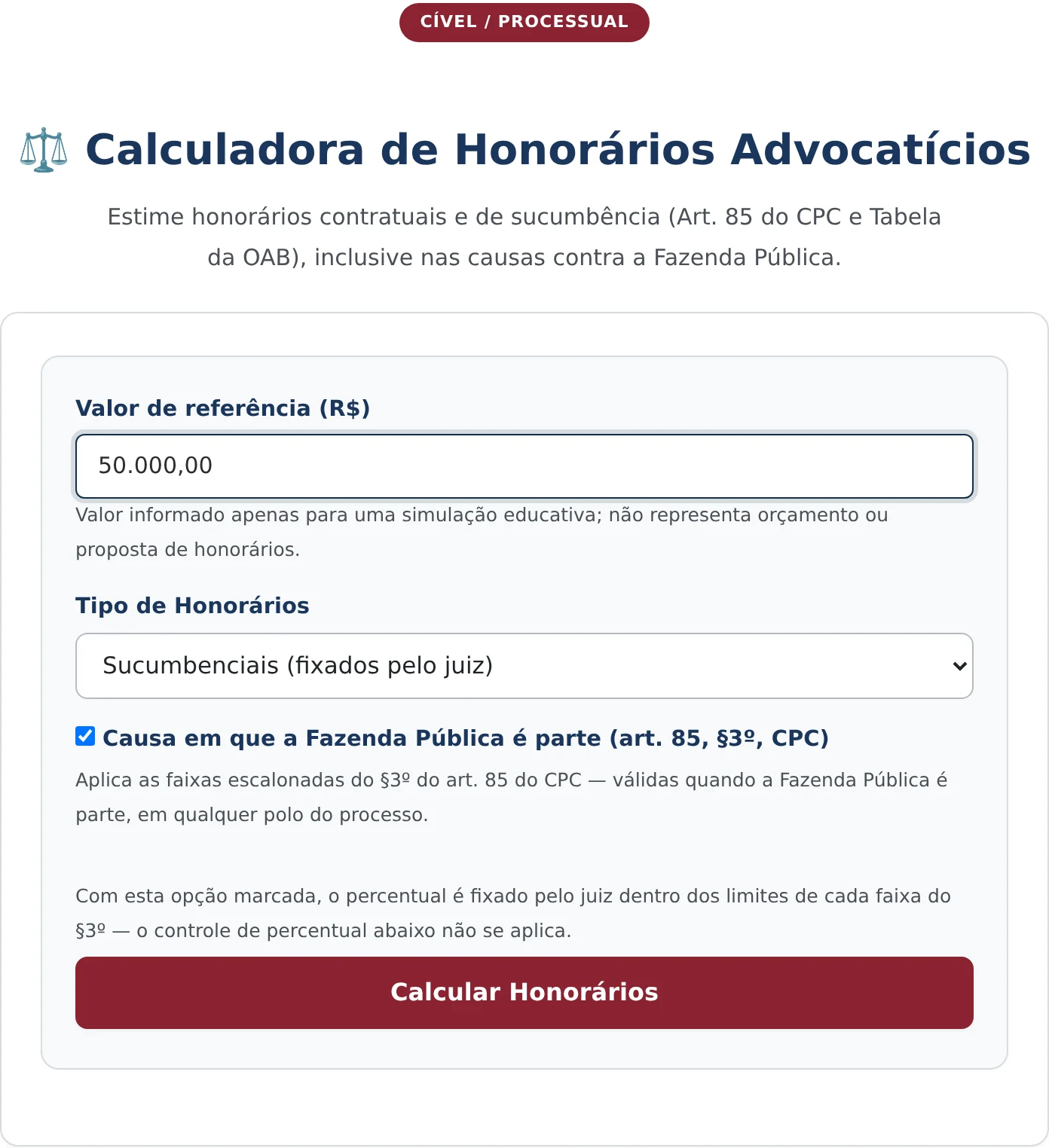
The screen contains four elements. The first is the reference amount, along with a note about the educational purpose of the simulation. The second lets you choose between contractual fees and prevailing-party fees.
The third is a checkbox that identifies cases in which the Public Treasury is a party, activating the tiered brackets. The fourth is a percentage slider, used when the percentage is freely set.

2. Enter the case details
In the example, the reference amount is R$ 50.000,00, the selected type is prevailing-party fees, and the checkbox indicating a case involving the Public Treasury is checked.
Checking the box changes the calculation logic. Without it, the general range of ten to twenty percent applies. With it, the tiered brackets measured in minimum wages come into play.
3. Calculate and read the result
The “Calculate Attorney Fees” button opens the card displaying the highlighted range, the calculation basis, the conversion into minimum wages, the brackets applied, and the legal basis.

How to read each line of the result
In the example, the attorney fee range is R$ 5.000,00 to R$ 10.000,00, corresponding to the ten to twenty percent range applicable to the first bracket.
The calculation basis section shows the award of R$ 50.000,00 and, immediately below, the conversion into minimum wages: 30,85 wages, calculated based on the 2026 amount of R$ 1.621,00.
This conversion is at the heart of the calculation. The Code’s brackets are expressed in minimum wages, not reais, which means they shift with each annual adjustment.
The card includes a crucial technical note on this point: the brackets were calculated using the 2026 minimum wage, but the Code requires use of the wage in effect on the date of the liquid judgment or the liquidation decision. In older cases, therefore, the reference may be different.
The bracket section shows the one applied in the case, which is the first, with a range of ten to twenty percent for awards of up to two hundred minimum wages. The result states the minimum and maximum, and the legal basis identifies the statutory provision.
Why the tiered system exists and how it works
The tiered brackets were created to prevent disproportionate fees in high-value awards against the government.
The logic is simple: the first bracket, up to two hundred minimum wages, allows for ten to twenty percent. The following brackets progressively reduce the range, and each applies only to the portion of the award corresponding to it.
The effect is cumulative. In an award that crosses three brackets, the fees are the sum of the amounts for each bracket, not the application of the final bracket’s percentage to the total. Anyone who calculates using the second method arrives at an amount far below what is due.
There is also a timing rule. When the judgment is unliquidated, the percentage is set only during liquidation, and the minimum wage at that time defines the brackets.
This explains why the estimate must state the minimum wage used, as the tool does. Without this information, the result cannot be reproduced.
It is important to clearly distinguish the two types of fees because they coexist in the same proceeding and belong to different holders.
Contractual fees arise from the agreement between attorney and client. Their amount is freely negotiated, subject to the local bar association’s fee schedule as a minimum reference, and payment is the client’s own obligation, regardless of the outcome of the case.
Prevailing-party fees are set by the judge in the judgment and constitute the attorney’s independent right, with a subsistence character. They are neither the same as nor a replacement for contractual fees, and they are paid by the losing party.
This independence has important practical effects. The prevailing-party fee award cannot be settled by the client without the attorney’s consent, and it may be enforced separately in the same case file.
What the calculator does not do
The tool does not set attorney fees. Fees are set by the judge, who considers the degree of care, the place where the service was provided, the nature and importance of the case, the work performed, and the time required.
It also does not address appellate fees, added at the appellate level, or situations of mutual prevailing-party liability, in which the allocation is proportional to each party’s degree of loss.
And with respect to contractual fees, it does not replace the agreement or the applicable fee schedule. The simulation is intended to explain the mathematical operation, not to price legal services.
Frequently Asked Questions
Why do attorney fees against the Public Treasury follow brackets?
Because the Code of Civil Procedure created a specific system for these cases, with tiered percentages measured in minimum wages. The purpose was to avoid disproportionate amounts in high-value awards against the government.
Which minimum wage defines the brackets?
The one in effect on the date of the liquid judgment or the liquidation decision, as the Code itself provides. The tool calculates using the current year’s amount and states that assumption, so older cases require adjustment of the reference.
Does the bracket percentage apply to the entire award?
No. Each bracket applies only to the corresponding portion of the award, and the total is the sum of those portions. Applying the final bracket’s percentage to the full amount produces an amount below what is due.
Receba novidades por e-mail
Cadastre-se gratuitamente para receber nossos novos artigos.
Seus dados estão protegidos conforme a LGPD.
Ficou com dúvidas? Fale com um advogado especialista.
📱 Falar pelo WhatsAppAs informações deste artigo são de caráter informativo e não substituem consulta jurídica individualizada. Cada caso possui particularidades que exigem análise específica.


