
FGTS Calculator: Step-by-Step Guide
The Severance Indemnity Fund balance is not merely the sum of deposits: it includes returns, a termination penalty, and withdrawal rules that vary depending on the type of termination. The website calculator separates each component.
What the FGTS (Brazil’s Severance Indemnity Fund) calculator does
The monthly deposit of 8% of your compensation is the simple part of the calculation. What can be confusing is what comes next: the returns credited to the linked account, the termination penalty, and, above all, the right to withdraw the funds.
The right to withdraw is the variable that most changes the outcome. In a termination without cause, the employee withdraws the full balance and receives the 40% penalty. If you resign, you cannot withdraw the balance or receive a penalty. In a termination by mutual agreement, you withdraw part of the balance and receive a reduced penalty.
There is also the birthday withdrawal option, which changes everything. Those who opt in cannot withdraw the balance upon termination: they receive only the termination penalty, while the balance remains in the account and is available only during the annual birthday withdrawal period.
The website tool takes four pieces of information and provides the estimated balance, returns, penalty, and the total amount actually available for withdrawal under the selected type of termination.
When the tool helps in a specific case
Its most common use is estimating the linked-account balance before a termination, so you can plan for the transition period.
Other recurring situations include:
- comparing how each type of termination affects withdrawal;
- assessing the consequences of opting into the birthday withdrawal option;
- checking the termination penalty stated in the termination document;
- estimating the balance for use in real estate financing;
- checking the monthly deposit due on a particular salary.
Comparing the different types of termination is especially helpful before accepting a termination by mutual agreement, because the difference in withdrawal amount often exceeds what is gained when negotiating the notice period.
Those who opt into the birthday withdrawal option cannot withdraw the balance upon termination. They receive only the penalty, and the rest remains unavailable until the annual withdrawal period.
This consequence is the least-known aspect of opting in, and it appears as a separate line in the tool’s result.
Step by step through the tool’s screens
The calculator is located in the website’s tools section, among the labor-law tools, and works in your browser.
1. Open the tool and identify the fields
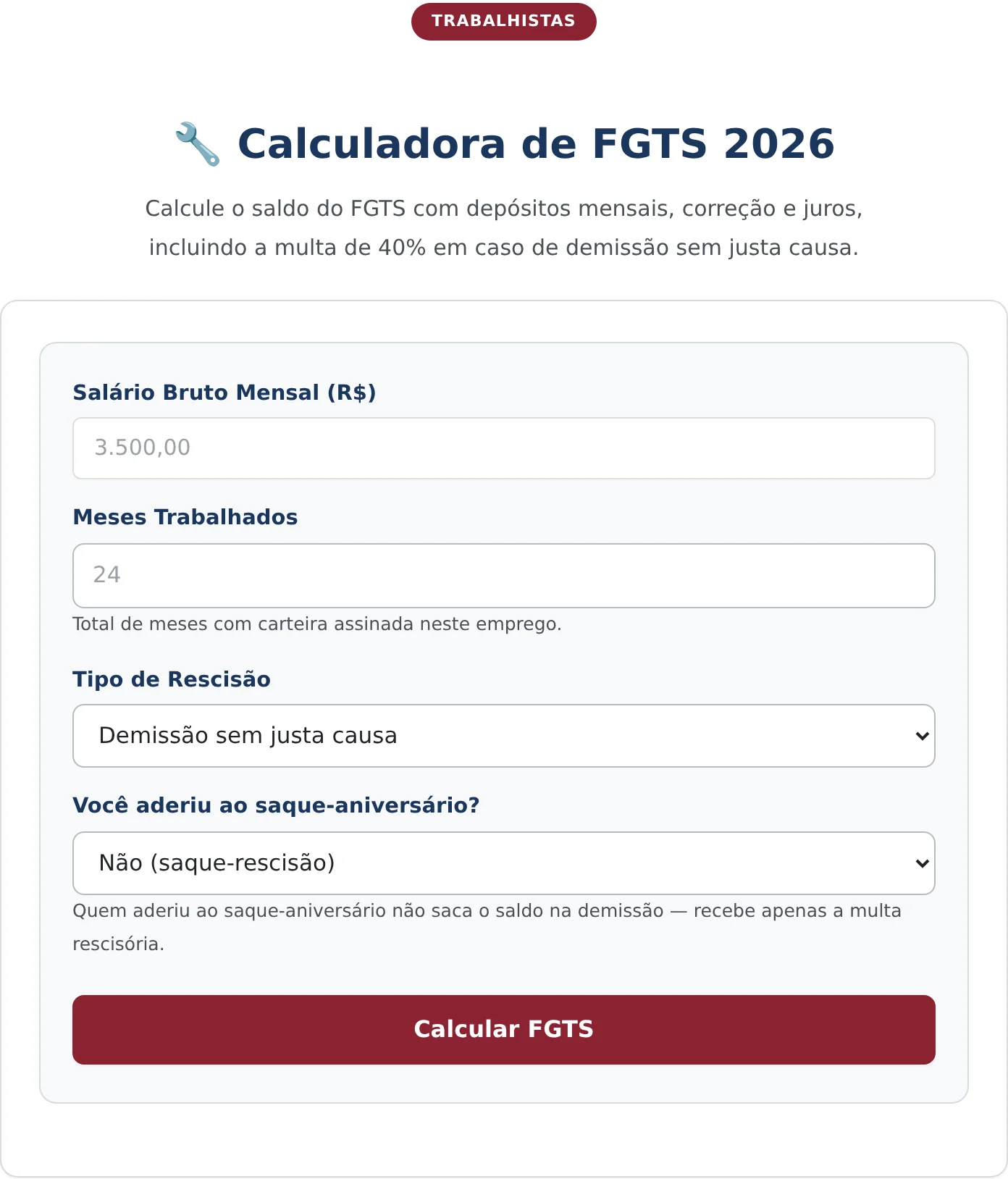
The screen has four fields. The first is your gross monthly salary. The second is the number of months worked during the employment relationship. The third is the type of termination, with four options.
The fourth field asks whether you opted into the birthday withdrawal option and includes guidance explaining its importance: those who opt in cannot withdraw the balance upon termination and receive only the termination penalty.
2. Fill in the employment information
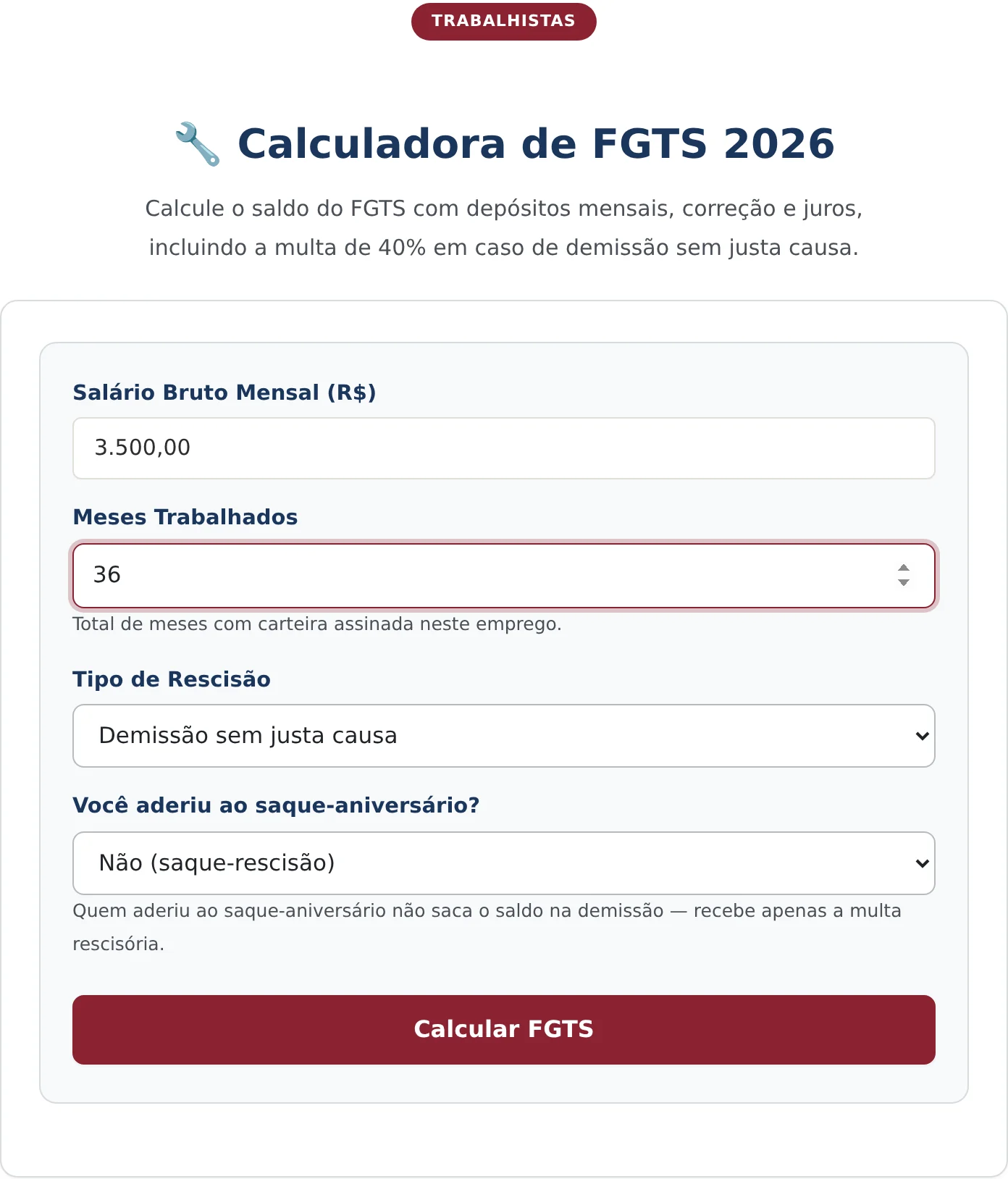
In the example, the gross salary is R$ 3.500,00, 36 months were worked, the type of termination is without cause, and there was no opt-in to the birthday withdrawal option.
It is worth repeating the calculation using different types of termination. The difference between termination without cause and resignation, with the other information unchanged, directly shows what is at stake in deciding who ends the contract.
3. Calculate and read the result
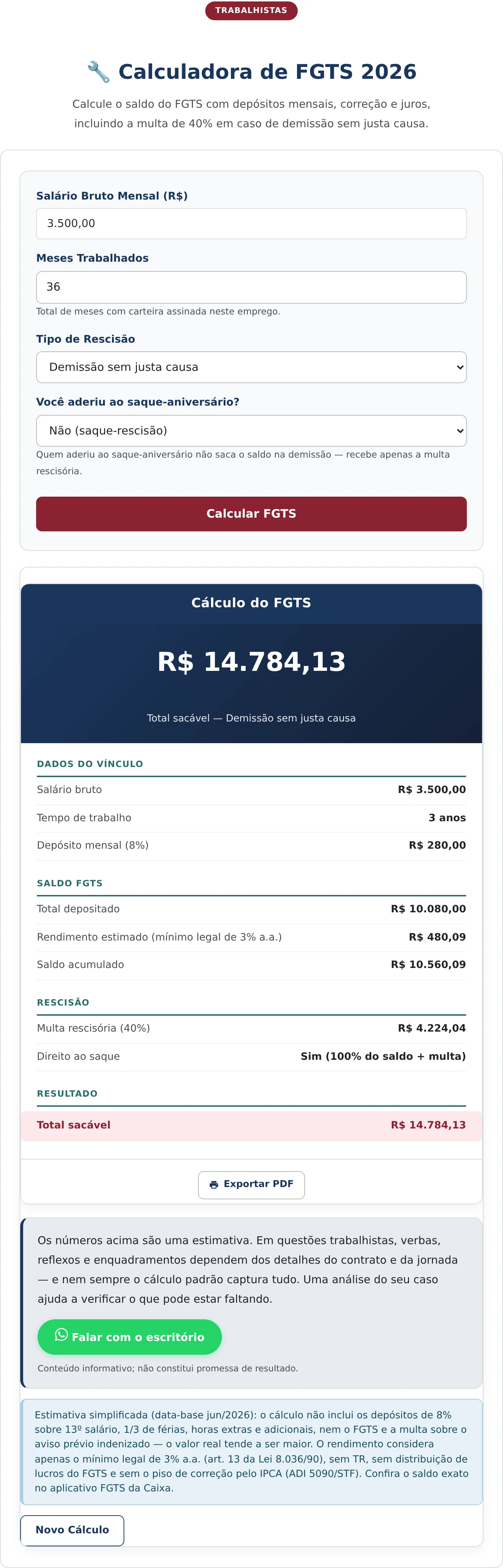
The “Calculate FGTS” button opens a card highlighting the total available for withdrawal, along with the employment information, balance breakdown, termination section, and result.
How to read each line of the result
In the example, the total available for withdrawal is R$ 14.784,13. The employment information confirms the monthly deposit of R$ 280,00, equivalent to 8% of the R$ 3.500,00 salary.
The balance section breaks down the calculation into three lines. The total deposited is R$ 10.080,00, resulting from 36 monthly deposits. Estimated returns are R$ 480,09, and the accumulated balance reaches R$ 10.560,09.
The returns line includes relevant technical information stated in the footer: the estimate considers only the legal minimum return of 3% per year, without the reference rate and without any distribution of the fund’s results. It is therefore a conservative estimate.
The termination section shows the 40% penalty on the accumulated balance, equivalent to R$ 4.224,04, and confirms the right to withdraw the full amount under the selected type of termination. The result adds the balance and penalty to determine the total available for withdrawal.
The footer also lists the amounts not included in the estimate: 8% deposits on the 13th-month salary, the one-third vacation bonus, overtime and additional compensation, as well as the deposit and penalty on pay in lieu of notice. The actual amount therefore tends to be higher than the estimate.
What changes under each type of termination
Selecting the type of termination in the form is not a formality: it changes the result entirely.
In a termination without cause, the employee withdraws the full balance and receives the 40% penalty, which is deposited into the linked account and withdrawn with the remaining funds. This is the most favorable situation.
If you resign, there is no withdrawal of the balance or penalty. The deposits remain in the account and may be withdrawn only in the situations provided by law, such as purchasing property, retirement, or serious illnesses specified by law.
In a termination by mutual agreement, the penalty falls to 20% and withdrawal is limited to 80% of the balance. This type of termination may benefit both parties in certain circumstances, but it costs the employee a significant portion of the fund.
In a termination for cause, there is no penalty or withdrawal of the balance, a situation equivalent to resignation with respect to the Severance Indemnity Fund.
One aspect of the fund is often overlooked, and the tool’s conservative estimate helps make it visible: returns. By law, the linked account earns three percent per year plus the reference rate, a level that has historically been lower than inflation during several periods.
The practical consequence is that the fund tends to lose purchasing power over long contracts, which explains why the balance accumulated over twenty years is often lower than what the inflation-adjusted sum of the deposits would indicate. Distribution of the fund’s results, when it occurs, partially mitigates this effect, but it is neither guaranteed nor predictable.
This information matters when deciding whether to opt into the birthday withdrawal option. Leaving the balance held in a low-return account has a cost, and the comparison must consider both the loss of withdrawal upon termination and the actual return during the period.
What the calculator does not do
The tool does not access the linked account. The balance is estimated based on the salary and time period provided, and the official amount is available through the fund administrator’s channels.
It also does not account for periods with different salaries, leaves of absence, or prior contracts with a remaining balance, all of which change the account’s actual composition.
Nor does it calculate the fund contributions due on unpaid amounts under judicial dispute, a matter that depends on recognition of the underlying amounts.
Frequently Asked Questions
Does someone who resigns receive the 40% penalty?
No. The termination penalty is due in a termination without cause and, at the reduced rate of 20%, in a termination by mutual agreement. There is no penalty for resignation or termination for cause, and the balance remains in the linked account.
What changes with the birthday withdrawal option upon termination?
Those who opt in cannot withdraw the balance when they are terminated: they receive only the termination penalty. The balance remains in the account and may be withdrawn only during the annual birthday-month withdrawal period, which often surprises those who opted in without considering this consequence.
Is the amount estimated by the calculator the account’s actual amount?
It is a conservative estimate. The calculation uses only the legal minimum return and does not include deposits on the 13th-month salary, the one-third vacation bonus, overtime, and pay in lieu of notice, so the actual balance tends to be higher than the amount shown.
Receba novidades por e-mail
Cadastre-se gratuitamente para receber nossos novos artigos.
Seus dados estão protegidos conforme a LGPD.
Ficou com dúvidas? Fale com um advogado especialista.
📱 Falar pelo WhatsAppAs informações deste artigo são de caráter informativo e não substituem consulta jurídica individualizada. Cada caso possui particularidades que exigem análise específica.


