
ITBI (Brazilian Municipal Real Estate Transfer Tax) and ITCMD (Brazilian State Inheritance and Gift Tax) Calculator: Step-by-Step Guide
The tax on a purchase is municipal, while the tax on an inheritance is state-level, with different rates and tax bases. The website calculator addresses both and displays the ruling that established the tax base for transfers for consideration.
What the ITBI and ITCMD calculator does
Two taxes apply to asset transfers, and they are often confused. The tax on transfers of real property is municipal and applies to transfers for consideration, typically a purchase and sale. The tax on inheritance and gift transfers is state-level and applies to inheritances and gifts.
The difference is not limited to which level of government has authority. The rates follow different laws, the tax bases are determined differently, and exemptions vary from one municipality to another and from one state to another.
For the municipal tax, the tax base was the subject of a long-standing dispute. Many municipalities used their own reference value, higher than the transaction value, which increased the tax. In a precedential ruling under Brazil’s repetitive-appeals procedure, the Superior Tribunal de Justiça established that the tax base is the transaction value actually declared by the taxpayer, which is presumed to be accurate.
The website tool takes four pieces of information and returns an estimated tax amount, identifying the rate applied and the relevant precedent.
When the tool helps in a specific case
Its most common use is to estimate the cost of a real estate purchase before the transaction closes.
Other recurring situations include:
- estimating the state tax due in probate proceedings;
- determining the tax cost of a lifetime gift;
- comparing the tax among different municipalities or states;
- checking the amount assessed by the municipality on a payment form;
- assessing whether it is feasible to challenge the tax base used.
This last use became more relevant after the tax-base ruling was established. When the payment form is issued using a reference value higher than the value stated in the deed, there are grounds for a challenge, and the tool makes it possible to measure the difference.
The tax base for the municipal tax is the declared transaction value, which is presumed to be accurate. A municipality’s unilateral reference value does not automatically prevail.
The tool’s result expressly notes this precedent, which is useful when speaking with the registry office or city hall.
Step by step through the tool’s screens
The calculator is located in the website’s tools section, among the tax tools, and works in your browser.
1. Open the tool and identify the fields
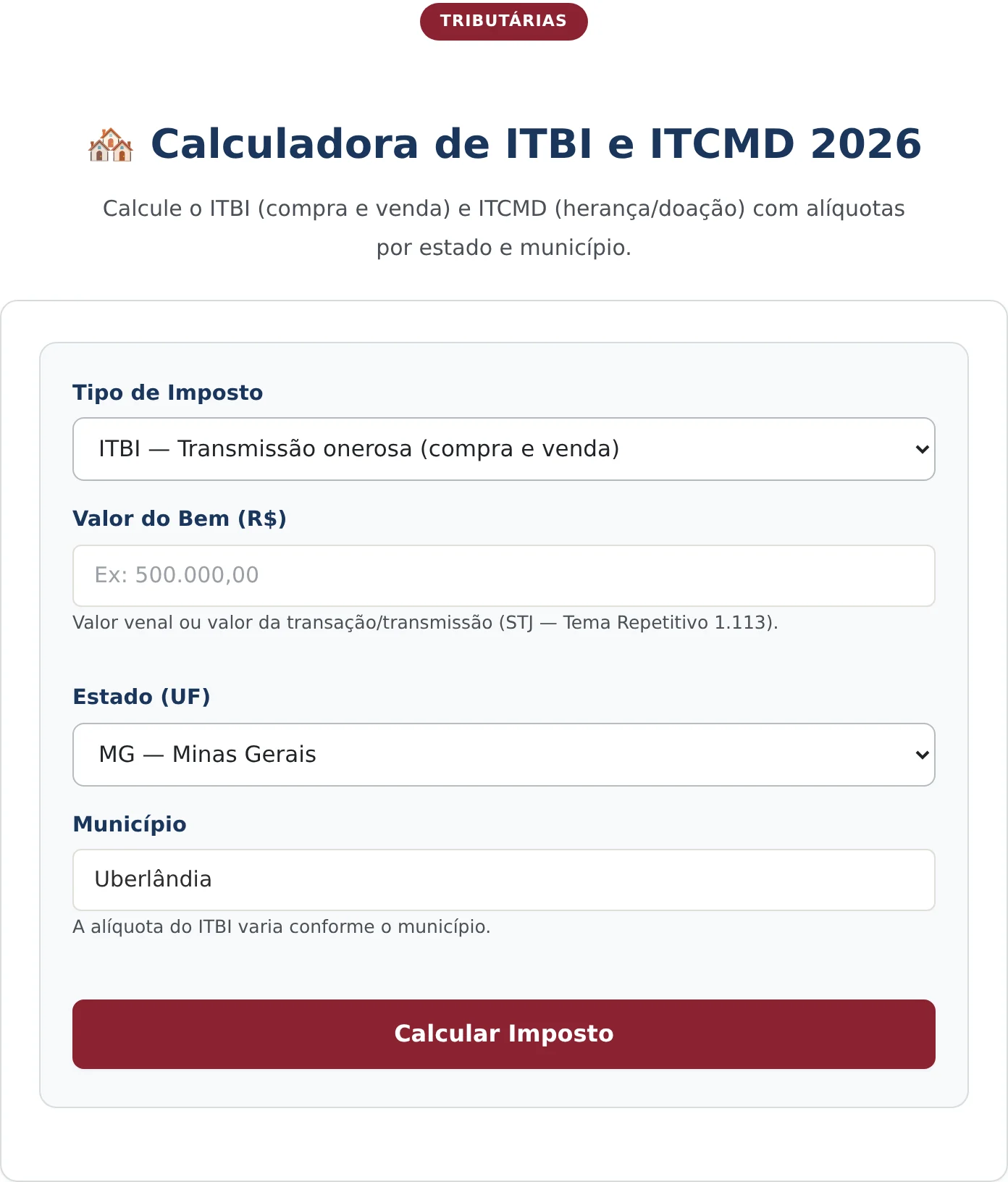
The screen has four fields. The first selects the tax: transfer for consideration, for purchases and sales, or inheritance and gift transfer, for inheritances and gifts.
The remaining fields are the asset value, the state, and the municipality. The state field matters for the state tax; the municipality field matters for the municipal tax, whose rate varies under local law.
2. Enter the transaction details
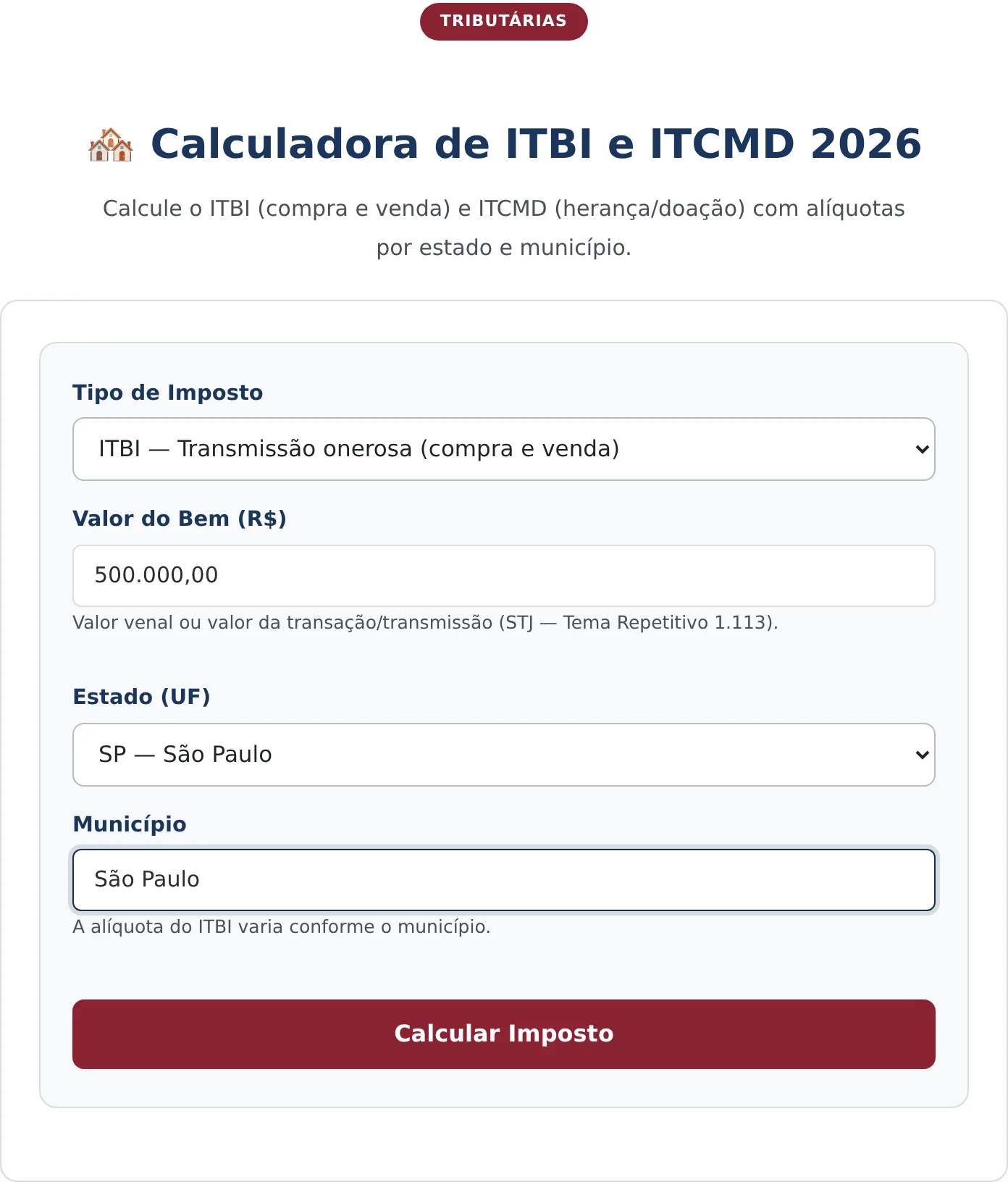
In the example, the selected tax is the tax on transfers for consideration, the asset value is R$ 500.000,00, the state is São Paulo, and the municipality is the city of São Paulo.
The spelling of the municipality matters. The tool maintains a database of rates by municipality, and the name must be entered correctly, including accents, for the registered rate to be found. When there is no matching entry, the tool states that it is displaying an estimate.
3. Calculate and read the result
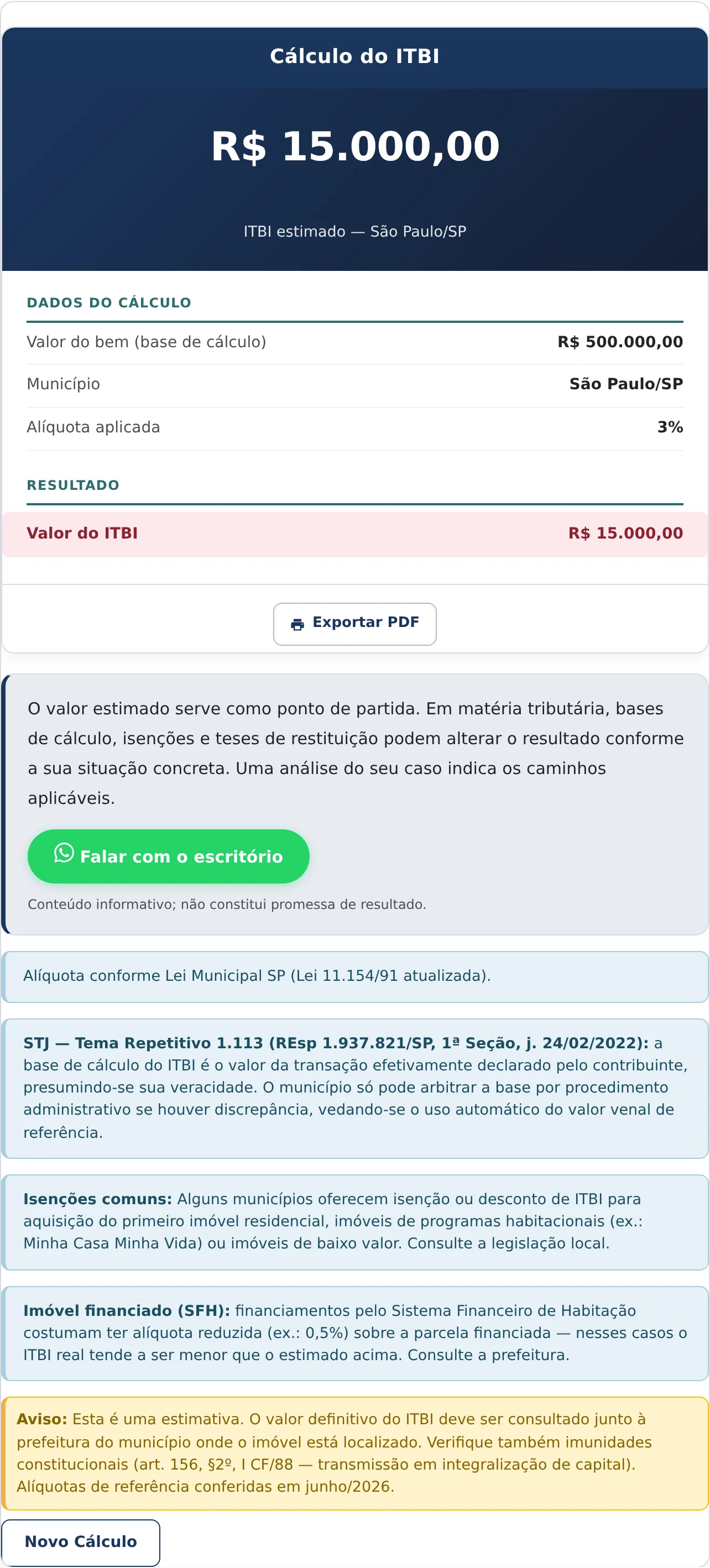
The “Calculate Tax” button opens a card showing the tax amount prominently, the information used, the rate applied, and notes on the tax base and local legislation.
How to read each line of the result
In the example, the estimated tax is R$ 15.000,00, identified as due to the municipality entered.
The information section confirms the tax base of R$ 500.000,00 and the municipality considered. The rate line shows 3%, which is the rate actually registered for that municipality, without an estimate label.
This label is a transparent feature of the tool. When the municipality is not in the database, the result displays an estimated rate of 2% and expressly states that most municipalities apply rates between 2% and 3%, recommending that you consult city hall.
The footer contains the note of greatest practical value: the reference to the repetitive-appeals ruling that established the tax base for the municipal tax as the transaction value declared by the taxpayer, with a presumption of accuracy that may be rebutted only through a proper administrative proceeding.
In a specific purchase, this information allows you to respond when the payment form is calculated using a reference assessed value far higher than the value stated in the deed.
What distinguishes the two taxes
It is worth clearly separating the two taxes, because their practical consequences are quite different.
The municipal tax applies to transfers for consideration of real property between living persons, typically purchases and sales, and is due to the municipality where the property is located. It is usually paid before registration, which cannot be completed without payment.
The state tax applies to transfers without consideration, by death or gift, of movable and immovable property. It is due to the state, and the rate varies under state law, in many cases progressively according to the value transferred.
In probate proceedings, the state tax has its own payment deadline, counted from the date of death, and late payment usually results in a fine. This is one reason why opening probate proceedings should not be delayed.
There is also the constitutional tax immunity applicable to assets incorporated into a legal entity’s assets as a capital contribution, a situation requiring specific analysis and addressed in an important Supremo Tribunal Federal decision concerning its scope.
One practical aspect is worth noting: who pays the tax and when.
In a purchase and sale, the purchaser is generally responsible for paying the municipal tax, unless the parties agree otherwise in the contract. Payment precedes registration because the relevant notarial or registry office requires the paid payment form to execute the deed and register the transfer.
This sequence explains why the tax must be included in the purchase budget from the outset. Together with deed and registration fees, the transfer cost often represents a significant portion of the transaction value, and discovering it late can jeopardize closing.
In probate proceedings, the state tax has its own deadline counted from the date of death, and late payment results in a fine imposed on the tax itself. Because probate proceedings also have a deadline for opening, delay accumulates two distinct penalties, making early organization of the succession an economic decision, not merely a legal one.
What the calculator does not do
The tool does not replace the official payment form. The assessment is made by the municipality or state, and any local discounts, exemptions, and reductions may not be reflected in the estimate.
It also does not apply the progressive rates under every state’s inheritance tax laws, which vary significantly among the states.
And it does not assess exemptions, such as those provided for properties acquired through housing programs or for low-value transfers, which depend on local law and the specific circumstances.
Frequently Asked Questions
What is the tax base for a purchase and sale?
It is the transaction value actually declared by the taxpayer, which is presumed to be accurate, according to the understanding established by the Superior Tribunal de Justiça in a repetitive-appeals ruling. The municipality may rebut this presumption only through a proper administrative proceeding.
What tax applies to an inheritance?
The state inheritance and gift transfer tax, whose rate is defined by the legislation of each state and may be progressive according to the value transferred. The municipal tax does not apply in this situation because it is not a transfer for consideration.
Why did the calculator display an estimated rate?
Because the municipality entered is not included in the tool’s rate database, in which case it provides an estimate and recommends consulting city hall. Checking the spelling of the municipality’s name, including accents, usually resolves the issue when an entry exists.
Receba novidades por e-mail
Cadastre-se gratuitamente para receber nossos novos artigos.
Seus dados estão protegidos conforme a LGPD.
Ficou com dúvidas? Fale com um advogado especialista.
📱 Falar pelo WhatsAppAs informações deste artigo são de caráter informativo e não substituem consulta jurídica individualizada. Cada caso possui particularidades que exigem análise específica.


