
Judicial Monetary Adjustment: Calculator Tutorial
Since December 2021, judgments against the Public Treasury and INSS (Brazil’s National Social Security Institute) no longer combine monetary adjustment and interest: the benchmark interest rate applies only once. The website calculator implements this and the prior rules.
What the judicial adjustment calculator does
Updating a judicial award requires answering three questions before doing any math: which rules apply, which adjustment index applies, and what default-interest rate applies. The answers vary according to the nature of the debt and the period involved.
The most important milestone is Constitutional Amendment 113/2021. As of December 9, 2021, in judgments against the Public Treasury, Brazil’s benchmark interest rate began to encompass monetary adjustment and interest, applying only once until actual payment. Adding separate interest under this system duplicates the same component.
For earlier periods, the previous rules apply, with the special broad consumer price index for judgments against the Public Treasury and the consumer price index for social security judgments, plus default interest.
The website tool implements five sets of rules and applies the transition automatically, identifying the period in which each index is in effect within the calculation.
When the tool helps in a specific case
Its most common use is to check the adjustment of a judicial award during the amount-calculation or judgment-enforcement phase.
Other recurring situations include:
- updating past-due amounts from a court-awarded social security benefit;
- checking the spreadsheet submitted by the opposing party;
- estimating the current amount of a precatório (court-ordered government payment) or a small-value payment order;
- updating a tax debt using the applicable rate;
- adjusting contract amounts using the agreed index.
Selecting the rules in the dropdown menu is the most important decision in completing the form, because it determines whether interest will be calculated separately or is already included.
Under the single-rate system, adjustment and interest are the same component. Adding separate interest means charging twice.
This tutorial uses precisely that system, with fictional figures chosen for demonstration purposes.
Step by step through the tool screens
The calculator is located in the website’s tools section, among the civil and procedural tools, and runs in your browser.
1. Open the tool and identify the fields
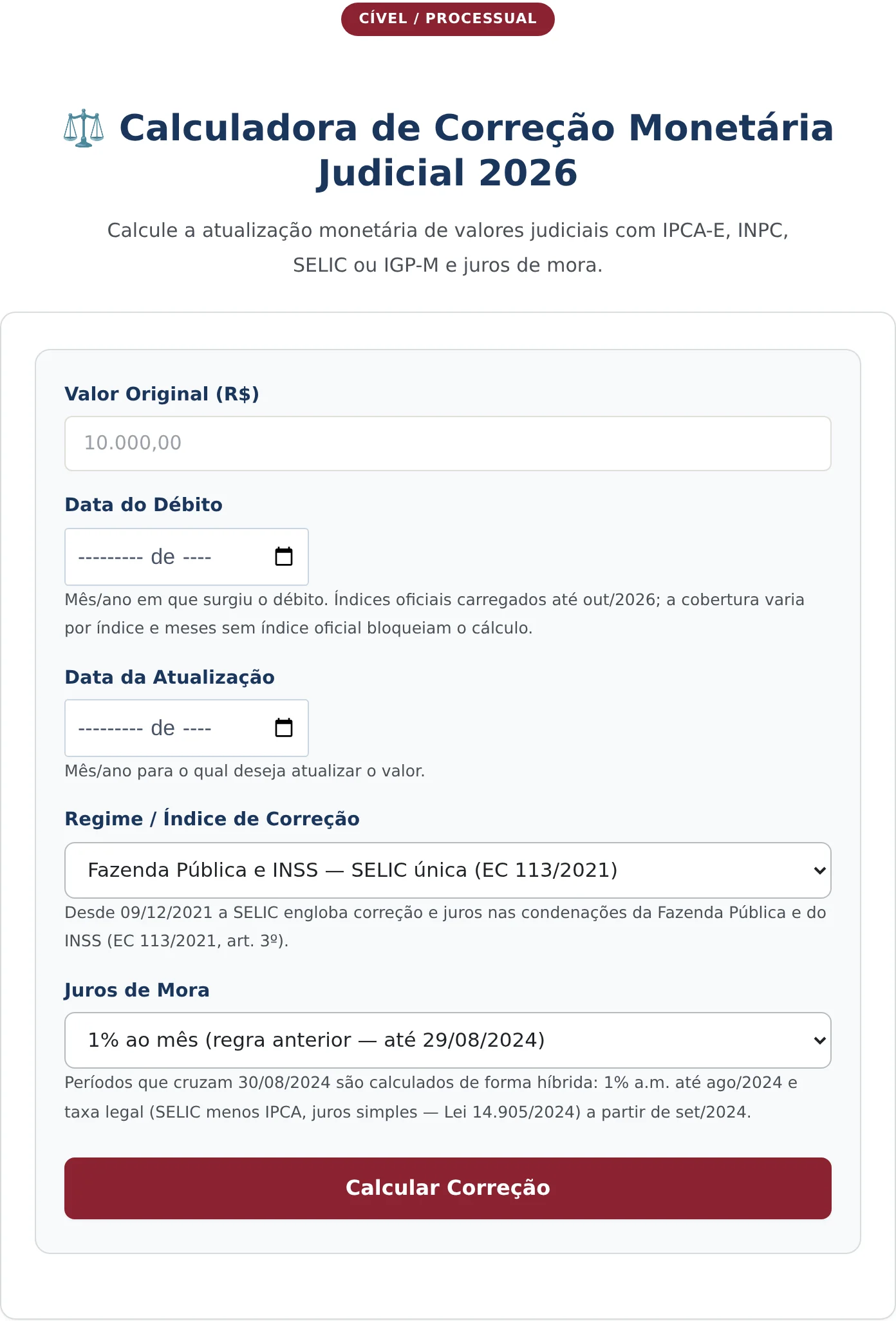
The screen has five fields. The first is the original amount. The next two are the debt date and the adjustment date, entered by month and year.
The fourth field selects the rules or index, with five options covering judgments against the Public Treasury and the social security system, tax matters, and contracts. The fifth sets default interest, with options for the previous rule, the current statutory rate, the included benchmark rate, and no interest.
2. Enter the period and select the rules
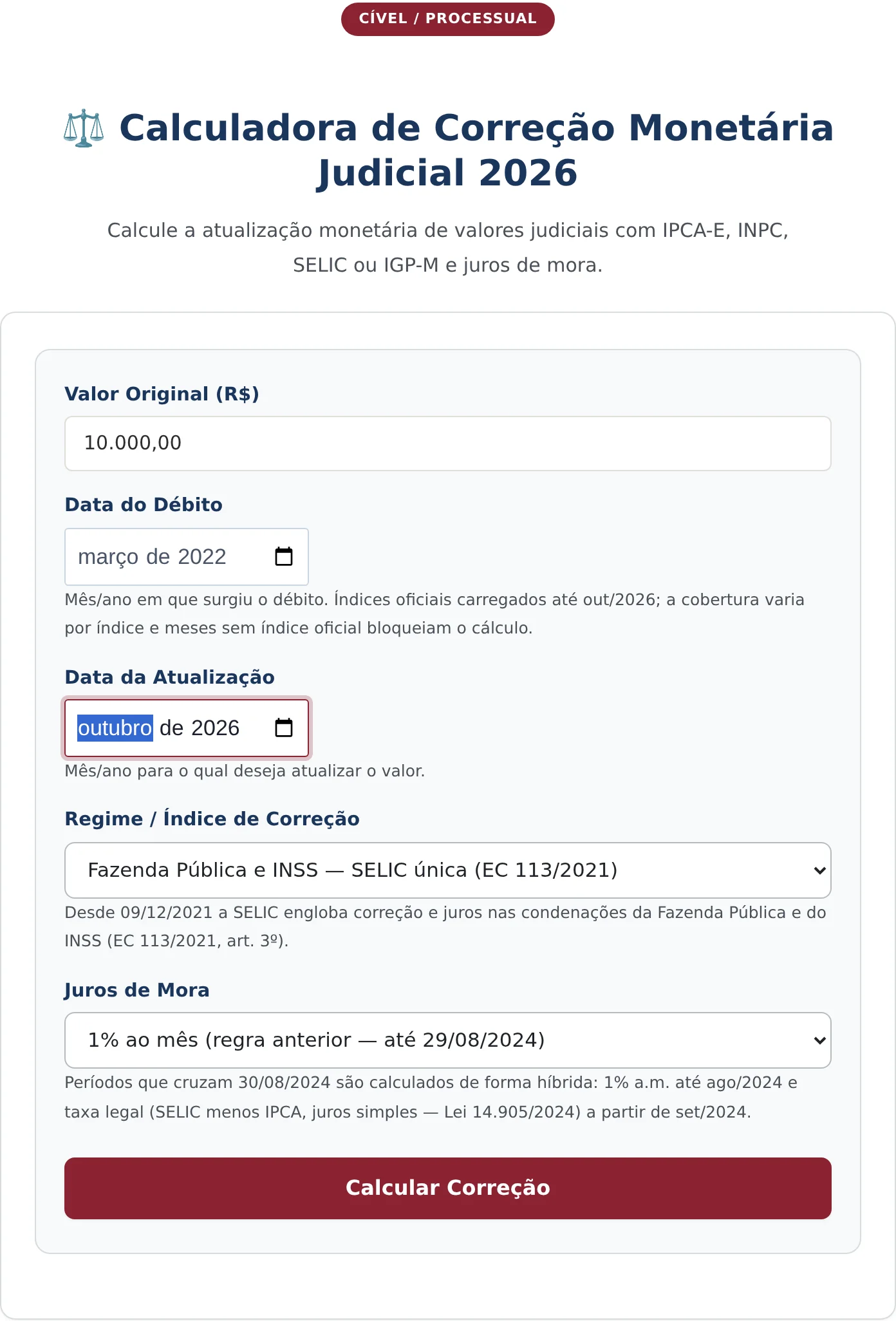
In the example, the original amount is R$ 10.000,00, the debt date is March 2022, the adjustment runs through October 2026, and the selected rules are those for judgments against the Public Treasury and the social security system with a single rate.
When you select these rules, the interest field no longer has a function because the rate already includes that component. The tool handles this automatically, and the result expressly records that fact.
3. Calculate and read the result
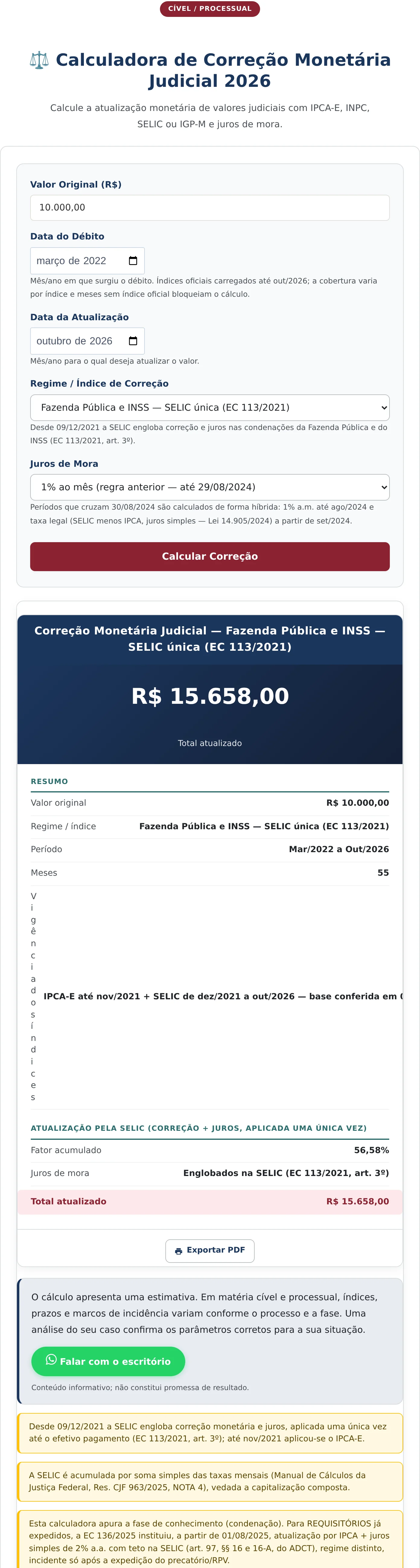
The “Calculate Adjustment” button opens a card highlighting the updated total, the calculation summary, the adjustment section, and technical notes on the methodology.
How to read each line of the result
In the example, the updated total is R$ 15.658,00, based on R$ 10.000,00. The summary identifies the rules applied and the 55-month period from March 2022 through October 2026.
The line showing when the indexes are in effect is the most instructive part of the card. It states that the special broad consumer price index applied through November 2021 and the benchmark interest rate applied from December of that year onward, along with the date the database was checked.
Because the debt in the example arose after the transition, only the benchmark interest rate applied. For older awards, the tool applies the two sets of rules in sequence, observing the relevant date cutoff, which is exactly what case law requires.
The adjustment section shows the cumulative factor of 56,58% and states that default interest is included in the rate, identifying the provision that so requires. There is no separate interest line, and that is correct under these rules.
The footer contains the decisive methodological note: the benchmark interest rate is accumulated by simple addition of the monthly rates, in accordance with the Federal Judiciary’s calculations manual, and capitalization is prohibited. Spreadsheets that capitalize the rate produce higher, indefensible amounts.
Why selecting the rules determines the result
The difference between the rules is not a matter of a few percentage points. It changes the structure of the calculation.
Under the rules before the transition, two components were added together: adjustment using a price index, which restores the effect of inflation, and default interest, which compensates for delay. Each had its own starting point, and interest often ran from service of process.
Under the current rules for judgments against the Public Treasury, there is only one component. The benchmark interest rate incorporates the inflation component and the compensation component, and applying additional interest therefore creates duplication.
In tax matters, the benchmark interest rate was already the standard for updating debts, on its own legal basis. In contract matters, the agreed index prevails, and the calculator offers the corresponding option.
In enforcement proceedings against the Public Treasury, there is also the calculation cutoff point. Adjustment runs until actual payment, but issuance of the precatório and the adjustment rules after the payment order are issued are governed by their own rules, which must be checked in the case file.
A word about checking other parties’ spreadsheets, which is the tool’s most frequent use in litigation. Three issues account for nearly all significant discrepancies.
The first is the starting point. Adjustment usually runs from the due date or disbursement, while interest under the old rules ran from service of process. Spreadsheets that combine the two starting points produce a considerable accumulated difference in older awards.
The second is the transition between rules. Awards that span December 2021 require successive application of the prior index and the single rate, rather than a single criterion for the entire period.
The third is the method of accumulation. Simple addition of monthly rates, required in judicial calculations, produces a lower result than compound capitalization, and that difference grows over time.
What the calculator does not do
The tool does not interpret the judgment. The applicable rules follow from the nature of the debt and what the decision ordered, and the user makes the selection in the dropdown menu.
It also does not determine the principal amount. For past-due social security benefits, for example, the sum of the overdue installments is calculated separately, and the website maintains a dedicated calculator for that purpose.
Nor does it account for attorneys’ fees, court costs, procedural fines, or offsets for amounts already paid administratively, all of which are components of the final enforcement calculation.
Frequently Asked Questions
When did the single rate take effect?
As of December 9, 2021, for judgments against the Public Treasury, pursuant to Constitutional Amendment 113/2021. Since then, the benchmark interest rate has included monetary adjustment and interest, applying only once until actual payment.
Can I add interest under the single-rate system?
You should not. The rate already incorporates the interest component, and adding an additional component creates duplication. The tool’s result expressly states that interest is included, precisely to prevent this error.
How is the benchmark interest rate accumulated in judicial calculations?
By simple addition of monthly rates, in accordance with the Federal Judiciary’s calculations manual, and compound capitalization is prohibited. The technical note appears in the result footer and is the first point to check when two spreadsheets differ.
Receba novidades por e-mail
Cadastre-se gratuitamente para receber nossos novos artigos.
Seus dados estão protegidos conforme a LGPD.
Ficou com dúvidas? Fale com um advogado especialista.
📱 Falar pelo WhatsAppAs informações deste artigo são de caráter informativo e não substituem consulta jurídica individualizada. Cada caso possui particularidades que exigem análise específica.


