
Survivor’s Benefit Calculator: Complete Tutorial
A survivor’s pension is no longer automatically lifelong: its duration depends on the spouse’s age at death, and the amount starts at 50% plus 10 percentage points for each dependent. The website calculator applies both rules.
What the survivor’s pension calculator does
The 2019 reform rewrote the survivor’s pension in two fundamental respects, both of which may surprise those familiar with the previous system.
The first is the amount. The pension is no longer equal to one hundred percent of the deceased person’s benefit. It is now calculated as fifty percent plus ten percentage points for each dependent. With a single dependent, the pension equals sixty percent of the base amount.
The second is its duration. For a spouse or partner, it varies according to age on the date of death, under a schedule ranging from a few years to a lifelong benefit. Those under twenty-two on the date of death receive it for a short period; from a certain age onward, the pension is lifelong.
There is also the calculation base, which differs depending on whether the deceased person was retired. In the latter case, a hypothetical permanent incapacity retirement benefit is calculated, and the percentage is applied to that amount.
The website calculator brings these variables together and provides the monthly amount, the division into shares, and the duration of each share.
When the tool helps in a specific case
It is most often used for an estimate before filing a claim, when the family needs to determine the income that will replace the deceased person’s income.
Other recurring situations include:
- checking the duration of the spouse’s share according to age at death;
- understanding how the pension is divided among multiple dependents;
- checking the amount granted administratively;
- assessing the effect of the cause of death on the requirements;
- confirming the deadline for filing a claim effective from the date of death.
This last point often goes unnoticed and has a direct financial consequence: a claim filed within the statutory deadline is effective from the date of death; if filed after that deadline, it takes effect from the date of filing.
The duration of a spouse’s pension depends on the spouse’s age at death. Before a certain age, it is time-limited; from that age onward, it is lifelong.
The example in this tutorial shows the lifelong scenario, using fictional data selected for demonstration purposes.
Step by step through the tool’s screens
The calculator is located in the website’s tools section, among the social security tools, and works in your browser.
1. Open the tool and identify the fields
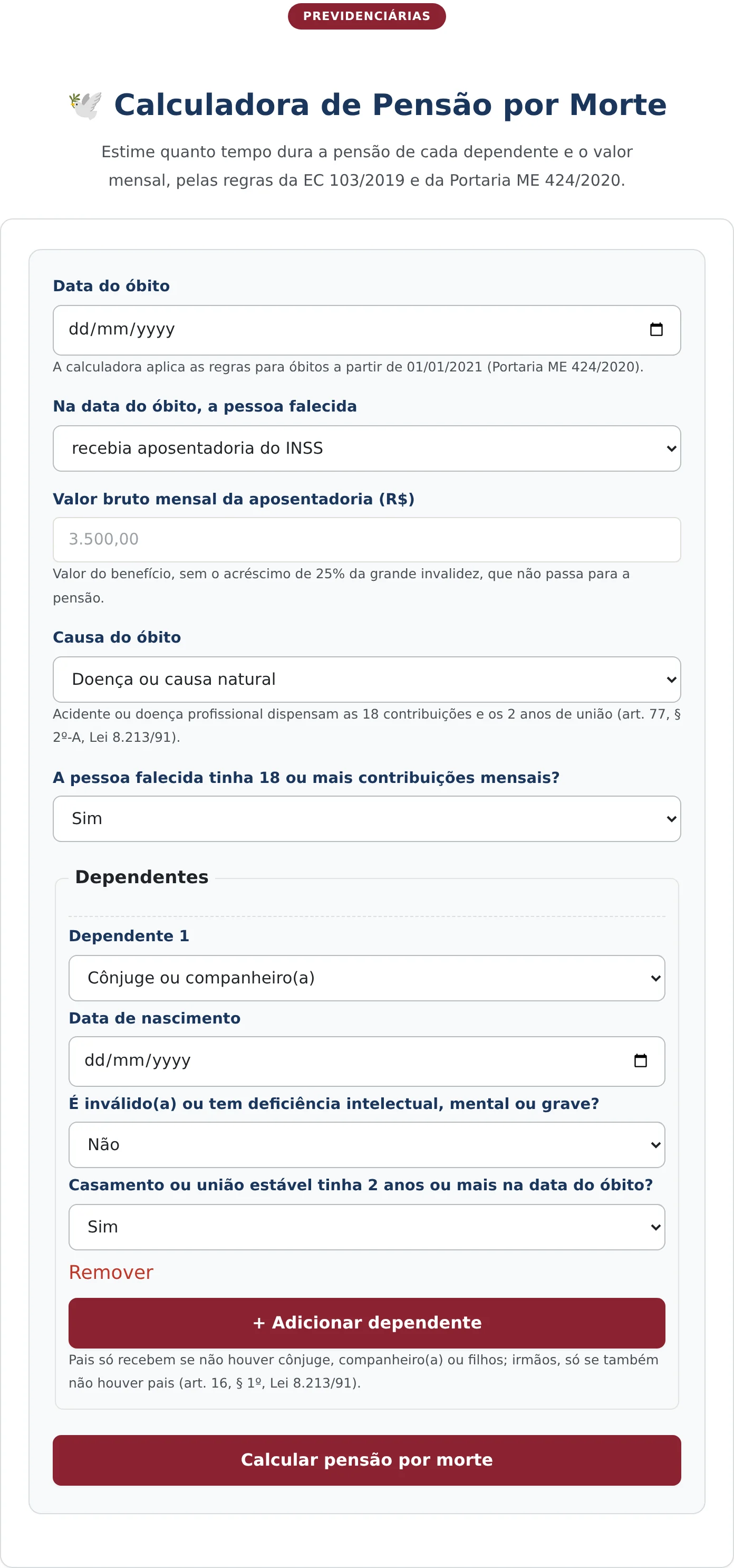
The screen brings together the deceased person’s information and the list of dependents. The former includes the date of death, status on the date of death, the retirement benefit amount or average salary, contribution period, sex, cause of death, and whether eighteen contributions have been made.
In the list of dependents, each row includes the type of dependent, date of birth, disability or impairment status and, in the case of a spouse, the duration of the marriage or partnership.
The cause-of-death field requires careful reading. An accident of any kind and an occupational disease waive the requirements of eighteen contributions and two years of marriage or partnership.
2. Fill in the details of the case
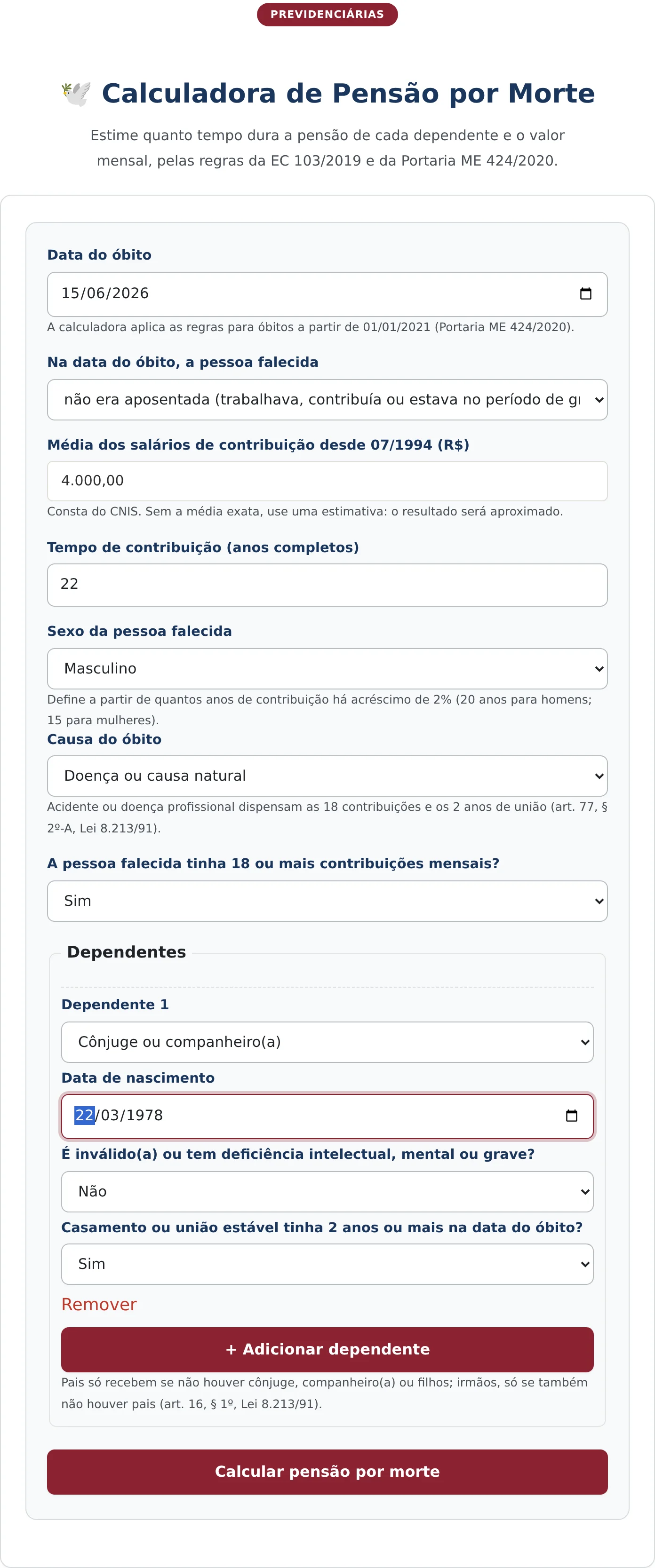
In the example, the death occurred in June 2026, the deceased person was not retired, the stated average salary is R$ 4.000,00, there were 22 years of contributions, the sex was male, the death was from natural causes, and eighteen contributions had been completed. The dependent is the spouse, born in March of 1978.
The dependent’s date of birth is not merely registration information: it determines the duration of the share, according to the applicable schedule.
3. Calculate and read the result
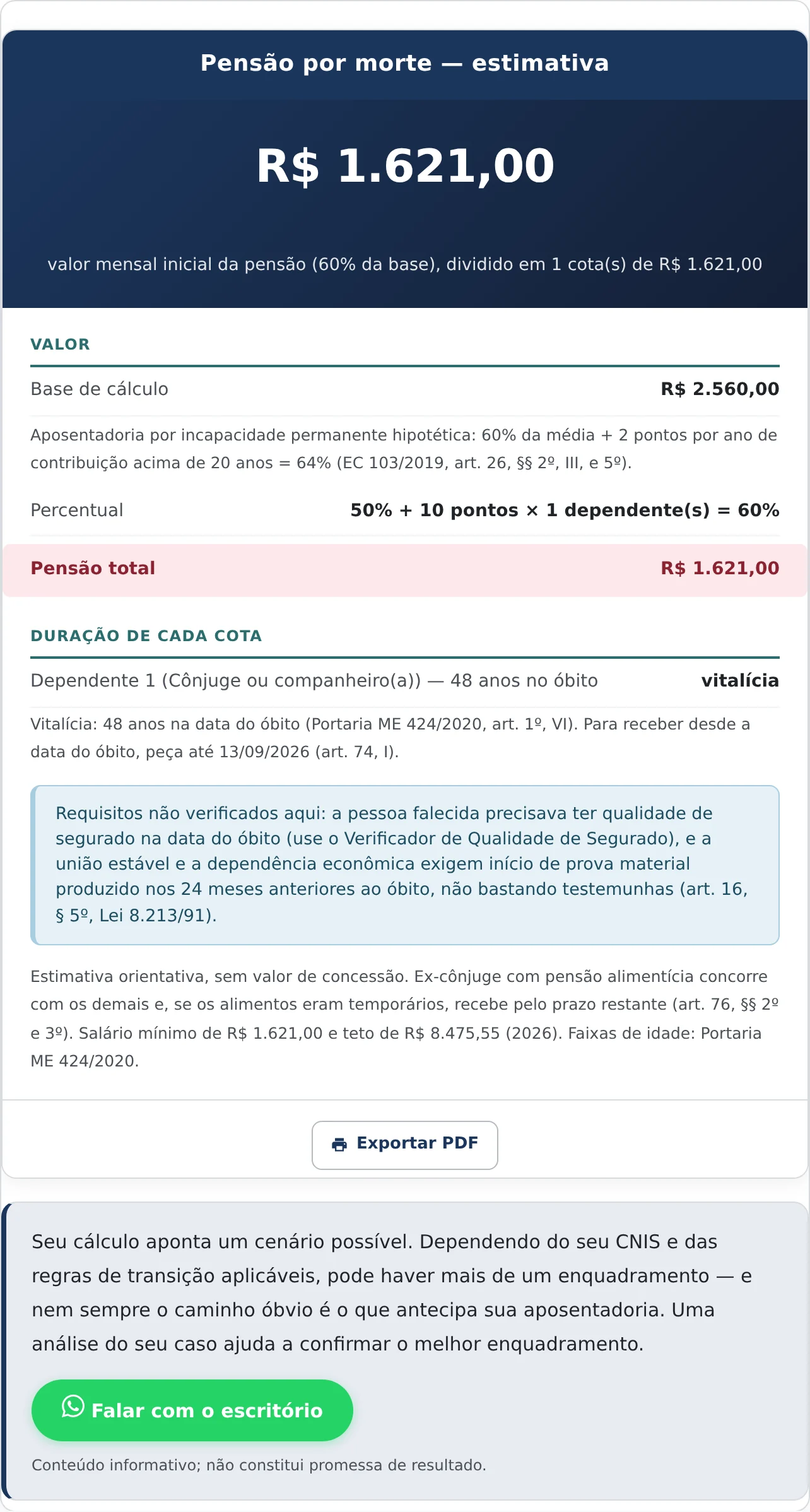
The calculation button opens a card showing the monthly amount prominently, the calculation base and its formula, the percentage applied, and the duration of each share.
How to read each line of the result
In the example, the initial monthly amount is R$ 1.621,00, corresponding to sixty percent of the base amount, in a single share.
The amount section shows the calculation. The calculation base is R$ 2.560,00, derived from a hypothetical permanent incapacity retirement benefit: sixty percent of the average plus two percentage points for each year of contributions above twenty years, resulting in sixty-four percent.
The pension percentage is applied to this base: fifty percent plus ten percentage points for each dependent, totaling sixty percent. The result of the calculation would be below the minimum wage, so the pension is raised to the constitutional minimum.
This point is relevant and frequently overlooked: benefits that replace employment income cannot be lower than the minimum wage, and the survivor’s pension is among them.
The duration section states that the spouse’s share, for someone forty-eight years old on the date of death, is lifelong, and identifies the rule that establishes the schedule.
The card also provides the deadline for filing a claim effective from the date of death and notes requirements that are not checked there, such as the deceased person’s insured status, referring you to the specific tool.
The duration schedule and division into shares
Two aspects of this benefit deserve further detail.
The duration of the spouse’s share follows a schedule based on age at the date of death. The younger the beneficiary, the shorter the period, based on the premise that the person may be able to return to the labor market. From a certain age onward, the share becomes lifelong.
Children receive benefits until they turn twenty-one, except in cases of disability or impairment, in which the share continues for as long as the condition lasts. Parents and siblings receive benefits only in the absence of the preceding classes, and their dependency must be proven.
The shares are divided equally among eligible dependents. When a share ends because of death or loss of dependent status, it is not redistributed to the others under the current rule: the total pension amount is reduced.
This rule is one of the most significant changes under the new system because it means that family income decreases as children reach adulthood.
There are also circumstances that result in loss of entitlement, such as a conviction for the insured person’s death and the simulation of a stable union, which disqualify a person from dependent status.
What the calculator does not do
The tool does not verify the deceased person’s insured status, an essential requirement for the benefit, and refers you to the specific tool in the collection.
It also does not analyze evidence of a stable union or proof of the economic dependency of parents and siblings, matters that depend on documentation.
Nor does it address pensions governed by rules preceding the reform, whose duration and amount follow the legislation in force on the date of death.
Frequently Asked Questions
Is a survivor’s pension always lifelong?
No. For a spouse or partner, its duration depends on age on the date of death, according to a graduated schedule, and it becomes lifelong only from a certain age onward. Children receive benefits until age twenty-one, except in cases of disability or impairment.
How is the pension amount calculated?
Fifty percent is applied to the base amount, plus ten percentage points for each dependent. The base is the retirement benefit amount when the deceased person was retired, or a hypothetical permanent incapacity retirement benefit when they were not.
When a dependent’s share ends, do the others receive more?
Under the current rule, they do not. The terminated share is not redistributed, and the total pension amount is reduced proportionally, which means family income declines as children reach adulthood.
Receba novidades por e-mail
Cadastre-se gratuitamente para receber nossos novos artigos.
Seus dados estão protegidos conforme a LGPD.
Ficou com dúvidas? Fale com um advogado especialista.
📱 Falar pelo WhatsAppAs informações deste artigo são de caráter informativo e não substituem consulta jurídica individualizada. Cada caso possui particularidades que exigem análise específica.


