
Unemployment Insurance Calculator: Tutorial
The amount of each unemployment insurance payment is not proportional to your salary: it follows brackets, and the calculation rule changes within each bracket. The website calculator applies the current table and shows how many payments apply to your case.
What the unemployment insurance calculator does
Unemployment insurance involves two separate questions: how much each payment is and how many payments are due. Each follows different criteria, and confusing them is the source of most frustrated expectations.
The amount is based on the average of the last three salaries and falls within a bracket table updated annually. Within each bracket, a percentage or an added amount applies, so similar salaries can result in very different payments when they fall into different brackets.
The number of payments does not depend on salary. It depends on the time worked in the months before dismissal and on how many times the benefit has already been claimed. With each new claim, the required time worked decreases, and the number of payments may vary.
The website tool takes five pieces of information and returns the payment amount, number of payments, and total, identifying the bracket applied.
When the tool helps in your specific case
Its most immediate use is financial planning for someone who has just been dismissed and needs to know what they can count on in the coming months.
Other recurring situations include:
- checking the amount stated in the application;
- confirming how many payments correspond to the time worked;
- understanding the effect of a second or third claim;
- planning a return to the job market based on the duration of the benefit;
- checking the average salary when it varied in recent months.
The field for months worked is often completed intuitively, and incorrectly. The tool instructs you to add the months worked under a formal employment record during the thirty-six months before dismissal, which is the period used to determine the number of payments.
The payment amount and number of payments are separate calculations: one depends on salary, the other on time worked and the number of claims.
The example in this tutorial presents both calculations side by side, using fictional amounts selected for demonstration purposes.
Step-by-step guide with the tool screens
The calculator is in the website’s tools section, among the employment-law tools, and works in your browser.
1. Open the tool and identify the fields
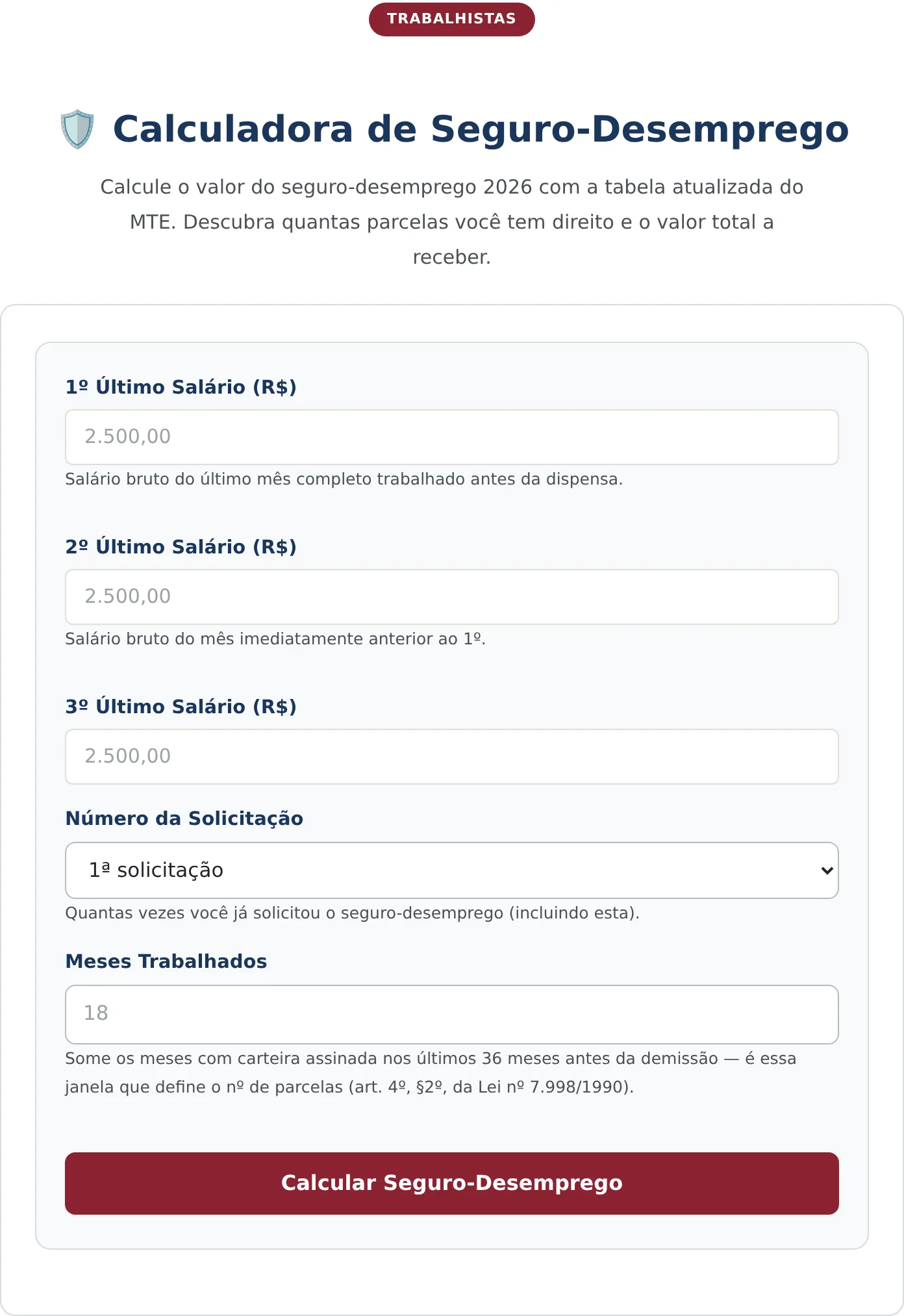
The screen has five fields. The first three are for the gross salaries from the last three full months worked before dismissal, from most recent to oldest.
The fourth field records the claim number, including the current one. The fifth is for months worked, with guidance on the thirty-six-month period that determines the number of payments.
2. Enter the dismissal information
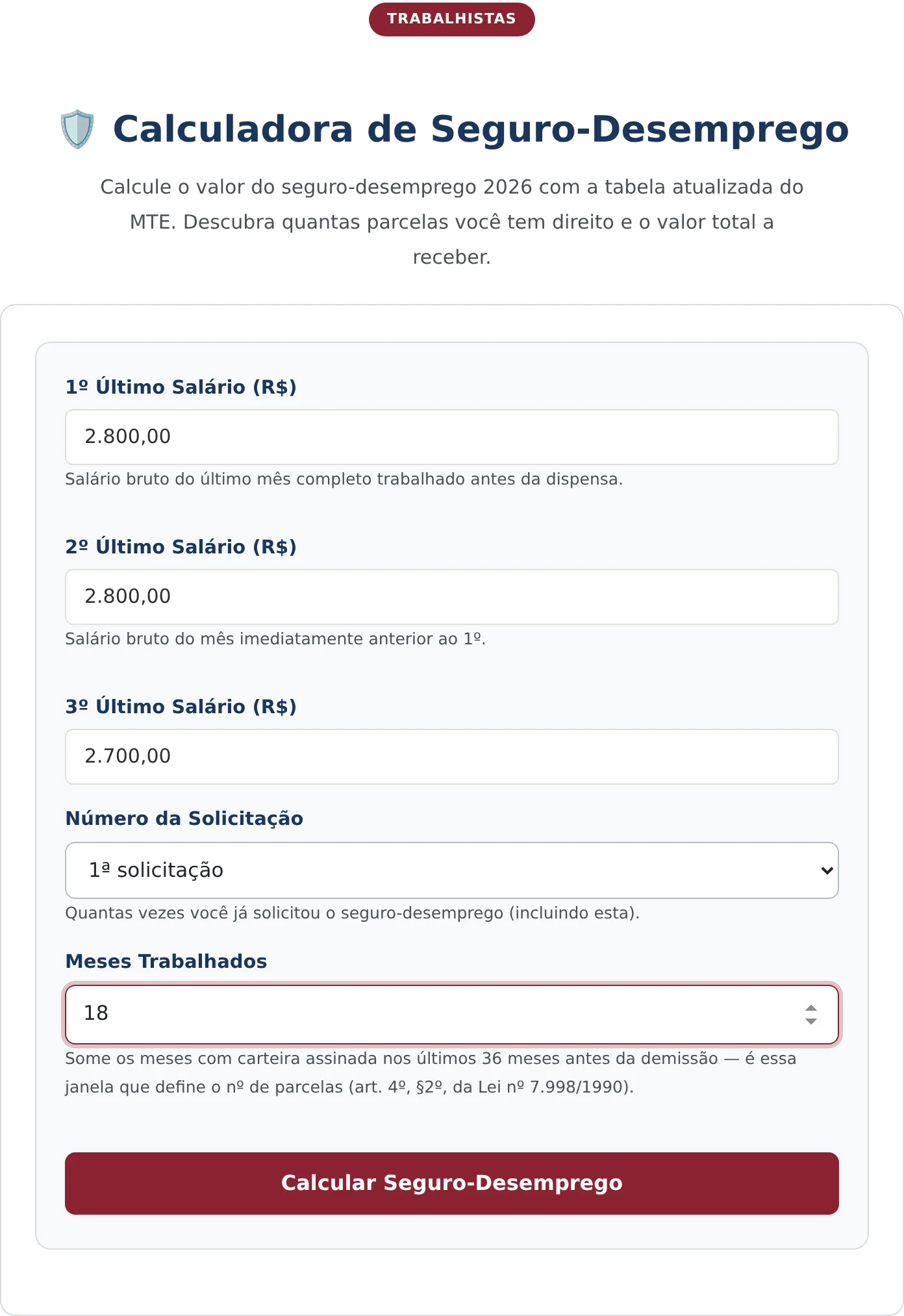
In the example, the last three salaries are R$ 2.800,00, R$ 2.800,00, and R$ 2.700,00; it is the first claim, and 18 months were worked.
The order of the salaries matters little for the average, but the choice of months matters greatly. They must be the last three full months before dismissal, not partial months, or the average, and therefore the payment amount, may be reduced.
3. Calculate and read the result
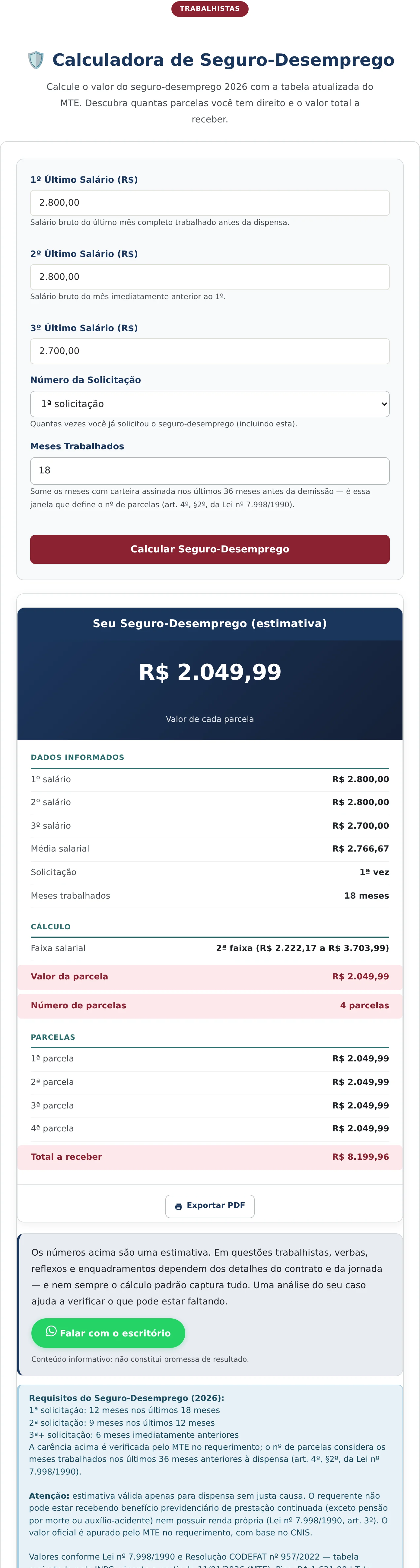
The calculate button opens a card showing the payment amount prominently, the information entered, the calculation with the bracket applied, the list of payments, and the total.
How to read each line of the result
In the example, each payment is R$ 2.049,99. The information section confirms the calculated average salary of R$ 2.766,67, based on the three salaries entered.
The calculation section identifies the bracket applied, which in this case is the second bracket of the current table, with limits from R$ 2.222,17 to R$ 3.703,99. This identification allows you to check the result against the official table for the year.
The number of payments is shown as 4, based on 18 months worked on the first claim. This number does not vary with salary, but rather with the time worked and claim history.
The list of payments repeats the amount of each one and ends with a total amount to be received of R$ 8.199,96. For financial planning, this is the important number because it indicates the coverage period.
At the bottom, the tool lists the eligibility waiting-period requirements for each claim, with the required number of months and the reference period. It also warns that the waiting period is verified by the competent authority when the application is filed, and that the number of payments takes into account the months worked during the thirty-six months before dismissal.
Requirements the calculator assumes are met
The calculation assumes that the entitlement exists. It is worth separating the requirements, because they are decided before any calculation is made.
The first is the type of termination. The benefit applies in cases of dismissal without cause and constructive dismissal. Resignation and dismissal for cause do not create entitlement, and termination by agreement also does not qualify for the benefit.
The second is the waiting period, which varies according to the claim: twelve months in the previous eighteen on the first claim, nine months in the previous twelve on the second, and the six immediately preceding months from the third claim onward.
The third is the absence of income sufficient for support and of ongoing social security benefits, subject to exceptions established by law. Someone who begins receiving retirement benefits, for example, is no longer entitled to the remaining payments.
The fourth is the application deadline, which runs from dismissal and is relatively short. Missing this deadline means losing the benefit, even if all other requirements are met.
The salary bracket merits a comment because it explains results that may seem disproportionate. The benefit table does not apply a single percentage: the first bracket applies a percentage to the average; the second adds a fixed amount to a percentage of the portion exceeding the limit of the preceding bracket; and the third applies a cap.
As a result, the benefit is substantially compressed in the higher brackets. A person who earned a high salary receives a payment that is proportionally much lower than their compensation because the benefit cap does not keep pace with salary. Identifying the bracket applied, as the result does, makes this effect understandable.
What the calculator does not do
The tool does not verify the waiting period or the type of termination. It calculates the amount and number of payments based on the information entered, and eligibility is assessed by the competent authority when the application is filed.
It also does not address special forms of the benefit, such as those for domestic workers, artisanal fishers, and rescued workers, which have their own rules and amounts.
Nor does it account for deductions, such as child support that may apply to the payments by court order.
Frequently Asked Questions
What determines the number of payments?
It depends on the time worked during the thirty-six months before dismissal and on the number of prior claims. Salary does not affect this quantity, only the amount of each payment, calculated according to the bracket into which the average falls.
Which salaries should I enter?
The gross amount for each of the last three full months worked before dismissal. Partial months should not be used because they reduce the average and lead to a payment amount lower than what is due.
Does resigning entitle me to unemployment insurance?
No. The benefit applies in cases of dismissal without cause and constructive dismissal. Resignation, dismissal for cause, and termination by agreement do not qualify you for unemployment insurance, regardless of the time worked or salary amount.
Receba novidades por e-mail
Cadastre-se gratuitamente para receber nossos novos artigos.
Seus dados estão protegidos conforme a LGPD.
Ficou com dúvidas? Fale com um advogado especialista.
📱 Falar pelo WhatsAppAs informações deste artigo são de caráter informativo e não substituem consulta jurídica individualizada. Cada caso possui particularidades que exigem análise específica.


