
Hazardous and Dangerous Working Conditions: A Tutorial
Hazardous-conditions and dangerous-conditions premiums cannot be combined: the worker chooses the more advantageous one. The website calculator compares both, adds the night-shift premium, and shows which option pays more.
What the premiums calculator does
Three premiums coexist in the workplace, with different calculation bases and rules, and confusion among them is common.
The hazardous-conditions premium is payable for exposure to harmful agents above the tolerance limits, at low, medium, and high levels, at rates of ten, twenty, and forty percent. The calculation base is the minimum wage.
The dangerous-conditions premium is payable for exposure to heightened risk, at a single rate of thirty percent of base salary, with no gradation.
The night-shift premium compensates work performed during nighttime hours, at its own rate and, in urban areas, with a reduced nighttime hour, which is shorter than sixty clock minutes.
Hazardous-conditions and dangerous-conditions premiums cannot be combined: the worker chooses one of them. The night-shift premium, in turn, is added to either one.
The website calculator takes twelve pieces of information and returns the three premiums, indicating the most advantageous option.
When the tool helps in a specific case
Its most frequent use is to review the pay stub of someone who works in a hazardous environment.
Other recurring situations include:
- comparing the hazardous-conditions premium with the dangerous-conditions premium;
- calculating the night-shift premium with the reduced nighttime hour;
- checking the rules applicable to rural workers;
- determining the effect of extending a nighttime shift;
- assessing the impact of premiums on other compensation items.
Comparing the two premiums is its most valuable use. Because the hazardous-conditions premium is based on the minimum wage and the dangerous-conditions premium on base salary, the advantage of one over the other depends directly on the worker’s salary.
The higher the salary, the more the dangerous-conditions premium exceeds the hazardous-conditions premium. The choice belongs to the worker and depends on the case.
The example in this tutorial shows the comparison in practice, using fictional figures chosen for demonstration purposes.
Step by step with the tool screens
The calculator is in the website’s tools section, among the employment-law tools, and works in the browser.
1. Open the tool and identify the fields
The screen contains twelve fields, displayed as applicable. The first ones define base salary, the level of hazardous conditions, whether dangerous conditions exist, and the type of worker, urban or rural, distinguishing between crop farming and livestock operations.
The nighttime section begins with the calculation method, which lets you enter start and end times or the total number of nighttime hours in the month directly.
Next come the fields for schedule, days worked, break minutes within nighttime hours, monthly nighttime hours, extension hours after nighttime hours end, and the monthly-hour divisor.
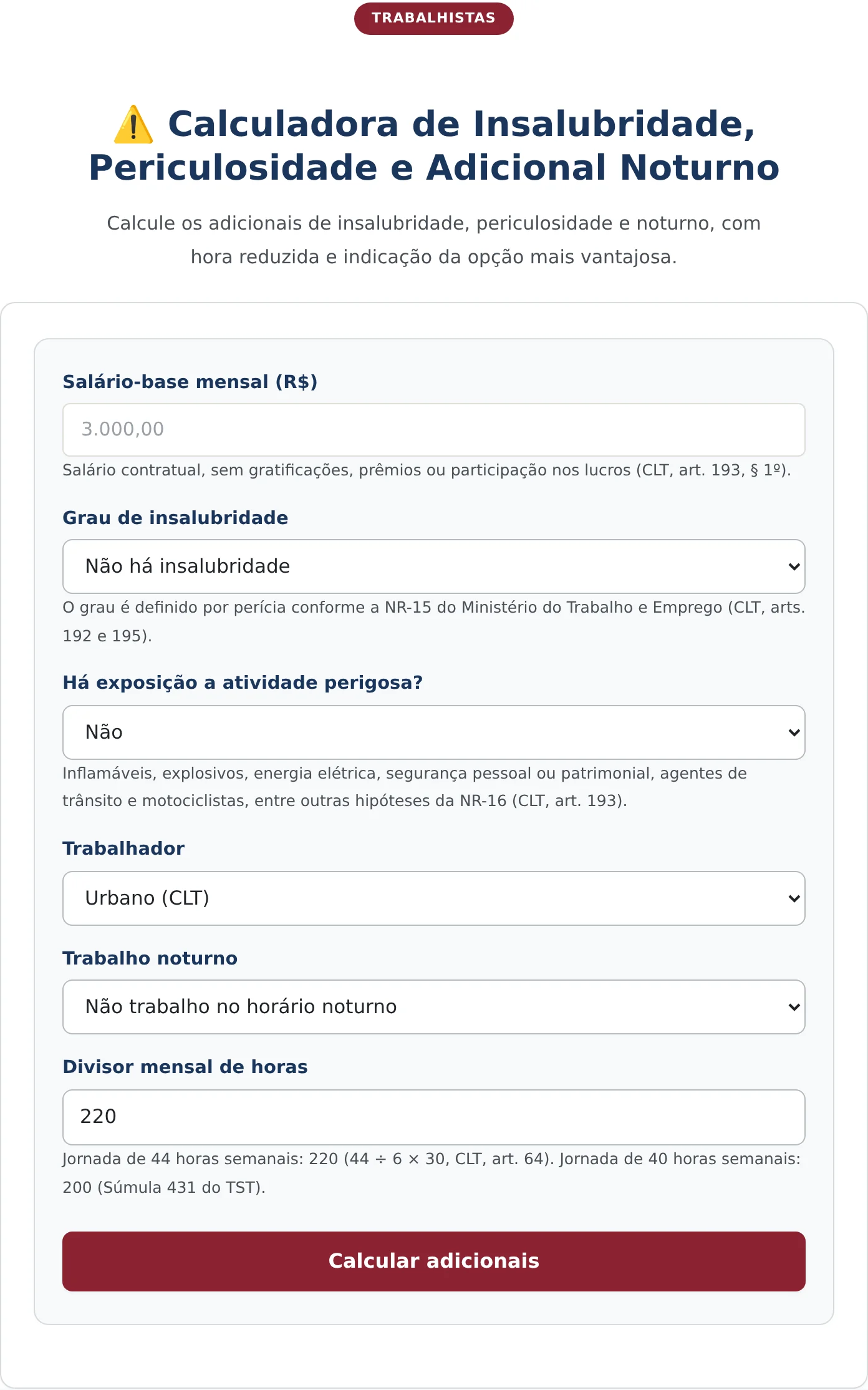
2. Fill in the contract information
In the example, base salary is R$ 3.000,00, the hazardous-conditions level is medium, there are no dangerous conditions, the worker is urban, the nighttime method is by schedule, with a start time of ten p.m. and an end time of six a.m., twenty-two days worked, sixty minutes of break time within nighttime hours, and a divisor of two hundred and twenty hours.
The divisor deserves attention because it determines the hourly rate. A forty-four-hour workweek corresponds to two hundred and twenty monthly hours; reduced schedules use smaller divisors.

3. Calculate and read the result
The calculate button opens a card showing the highlighted total, the hazardous-conditions section with its legal basis, the night-shift premium section, and the selected option.

How to read each line of the result
In the example, the total monthly premiums are R$ 804,20, with the hazardous-conditions premium selected.
The hazardous-conditions section shows the calculation for the medium level, corresponding to twenty percent of the minimum wage, resulting in R$ 324,20. The legal basis appears immediately below, with an explanation worth reading.
The tool notes that the calculation base remains the minimum wage, despite the constitutional prohibition on using it as an index, because the established understanding prevents a judge from creating another base in the absence of a law or collective bargaining rule providing otherwise.
It also notes that the precedent that established basic salary as the calculation base was canceled because it lost effectiveness, information relevant to those working with outdated material.
The tool then displays a purely informational amount: what would result if the base were base salary, applicable only when the category’s collective bargaining agreement or collective agreement so provides. The difference between the two amounts shows what is at stake in collective bargaining.
The night-shift premium section provides the daily calculation, considering the minutes within nighttime hours and deducting break time, using the rate applicable to urban workers.
The reduced nighttime hour and extended shifts
Two nighttime-work concepts deserve further detail because they are the source of many unpaid differences.
The urban nighttime hour is reduced: each clock hour worked between ten p.m. and five a.m. counts as more than one hour for payment purposes. As a result, a person who works seven clock hours during nighttime hours is paid for more than seven hours.
This reduction is independent of the twenty-percent premium. They are two separate benefits that are added together, and calculating only the percentage, without the reduction, understates the amount due.
Shift extension is the second concept. Once the full shift has been worked during nighttime hours, hours worked after those hours end continue to be paid with the premium, and the reduced hour also applies to them.
For rural work, the rules are different: there is no reduced hour, the rate is twenty-five percent, and nighttime hours vary depending on whether the activity is crop farming or livestock operations.
These details explain why the tool separates urban from rural workers and provides a specific field for extension hours.
One substantive-law point remains and guides how the result should be read: the wage nature of these premiums.
When paid regularly, they are part of compensation and affect the thirteenth salary, vacation pay plus the one-third premium, the guarantee fund, notice pay, and overtime. Their actual impact therefore exceeds the monthly amount shown.
There is also a social-security consequence: the premiums are part of contribution salary, increasing the basis for future retirement benefits.
There is also the effect of cessation. Once the harmful agent or risk is eliminated, the premium is no longer due, without constituting an unlawful salary reduction, because it is a payment contingent on the continued existence of the circumstance that justifies it.
What the calculator does not do
The tool does not replace an expert examination. Characterizing hazardous or dangerous conditions depends on a technical report classifying them under the applicable regulatory standards.
It also does not calculate the effects of premiums on the thirteenth salary, vacation pay, the guarantee fund, and notice pay, which are due when payment is regular.
And it does not account for more favorable rates or bases established by collective bargaining rules, which prevail over the legal rule when they exist.
Frequently Asked Questions
Can I receive hazardous-conditions and dangerous-conditions premiums at the same time?
No. When both circumstances are present, the worker chooses whichever is more advantageous. The calculator calculates both precisely to allow this comparison, which depends on the base-salary amount.
What is the calculation base for the hazardous-conditions premium?
The minimum wage, under the legal rule that remains applicable. Replacing it with another base depends on a law or collective bargaining rule, and the tool result separately displays the amount that would result from using base salary, for informational purposes.
What is the reduced nighttime hour?
It is the rule under which each clock hour worked during urban nighttime hours counts as more than one hour for payment purposes. It is independent of the twenty-percent premium, and both benefits are added together.
Receba novidades por e-mail
Cadastre-se gratuitamente para receber nossos novos artigos.
Seus dados estão protegidos conforme a LGPD.
Ficou com dúvidas? Fale com um advogado especialista.
📱 Falar pelo WhatsAppAs informações deste artigo são de caráter informativo e não substituem consulta jurídica individualizada. Cada caso possui particularidades que exigem análise específica.


