
Constitutional Remedies Simulator: Tutorial
Habeas corpus, habeas data, mandado de segurança (a writ protecting a clear legal right), mandado de injunção (a writ addressing the lack of implementing rules), and ação popular (a citizen action) protect different legal interests. The website’s simulator identifies the appropriate remedy and indicates the jurisdiction and deadline.
What the constitutional remedies simulator resolves
Constitutional remedies are actions governed by their own procedures, each designed for a specific type of injury. The choice is not discretionary: it follows from the legal interest affected and the nature of the challenged act.
Habeas corpus protects freedom of movement. Habeas data guarantees access to and correction of personal data held in public databases. The mandado de segurança protects a clear and certain right not covered by the first two remedies. The mandado de injunção addresses the lack of an implementing rule. The ação popular protects public property and administrative probity.
In addition to whether it is available, each remedy has its own evidentiary, deadline, and jurisdictional requirements. The mandado de segurança, for example, requires preexisting documentary evidence and has a forfeiture period of one hundred and twenty days.
The website’s simulator receives four pieces of information and returns the suggested remedy, legal basis, requirements, jurisdiction, and the súmulas (precedent summaries) that define when it is available.
When the tool helps in a specific case
Its most immediate use is screening an urgent case, when you need to decide quickly which avenue to pursue.
Other recurring situations include:
- identifying jurisdiction based on the respondent authority;
- determining whether there is sufficient documentary evidence for the chosen avenue;
- checking the forfeiture period before filing;
- distinguishing between individual and collective mandado de segurança proceedings;
- studying the situations in which relief is unavailable as established in a súmula.
Jurisdiction is where mistakes are most common. It varies according to the authority identified as the respondent, and filing in the wrong court usually means losing the deadline while transfer of the case is being discussed.
The deadline for a mandado de segurança is a forfeiture period that runs from notice of the act. Once the deadline is missed, the remaining option is an ordinary action, with full evidentiary development.
The simulator displays this deadline among the requirements, along with the other conditions for relief.
Step by step through the tool’s screens
The simulator is in the website’s tools section, among the constitutional tools, and runs in your browser.
1. Open the tool and identify the fields
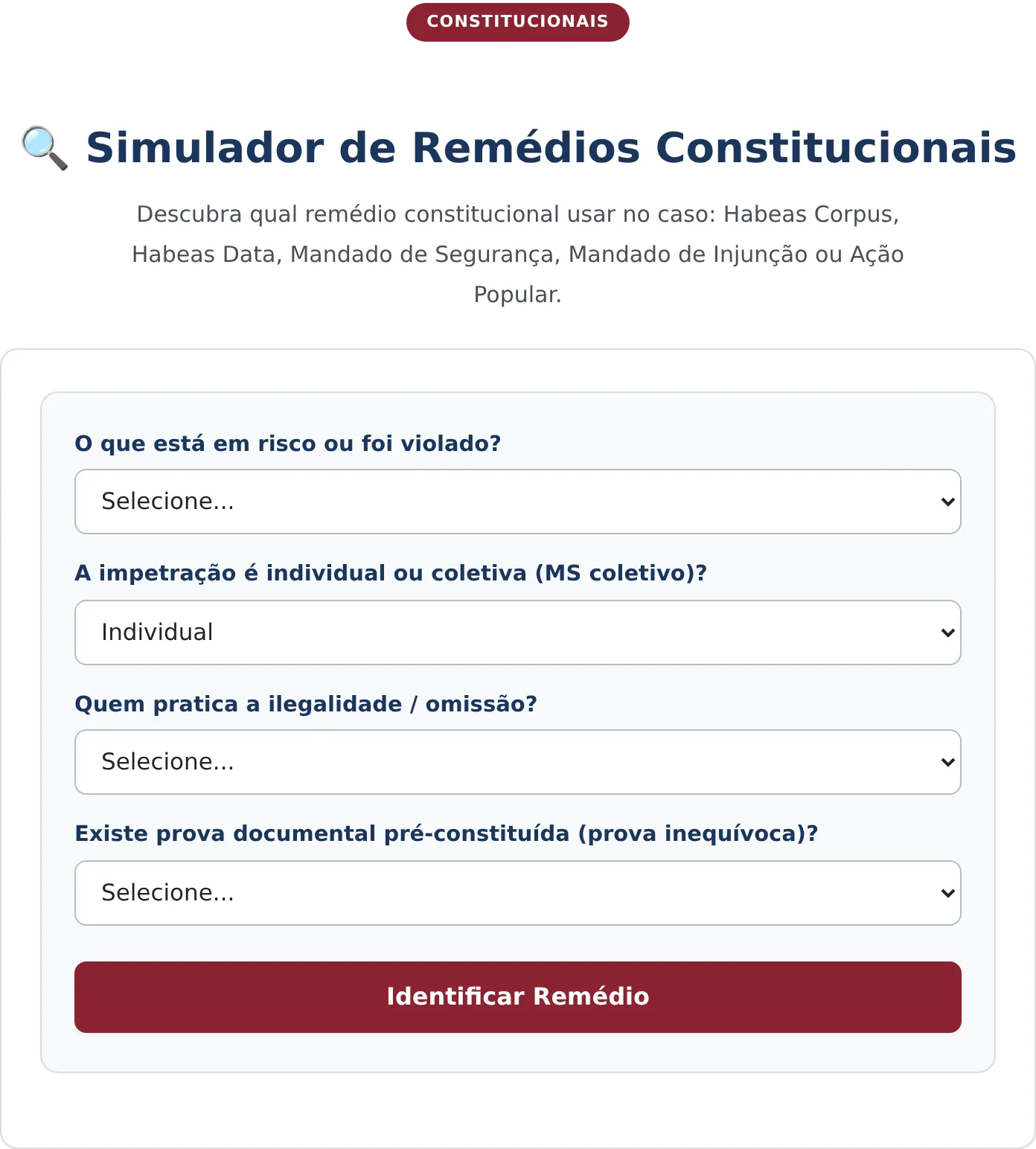
The screen has four selectors. The first identifies the legal interest at risk, with options ranging from freedom of movement to access to public information.
The second determines whether the filing is individual or collective. The third lists authorities, from a police chief to a justice of a higher court, because jurisdiction follows from the authority involved. The fourth asks whether preexisting documentary evidence exists.
2. Describe the situation
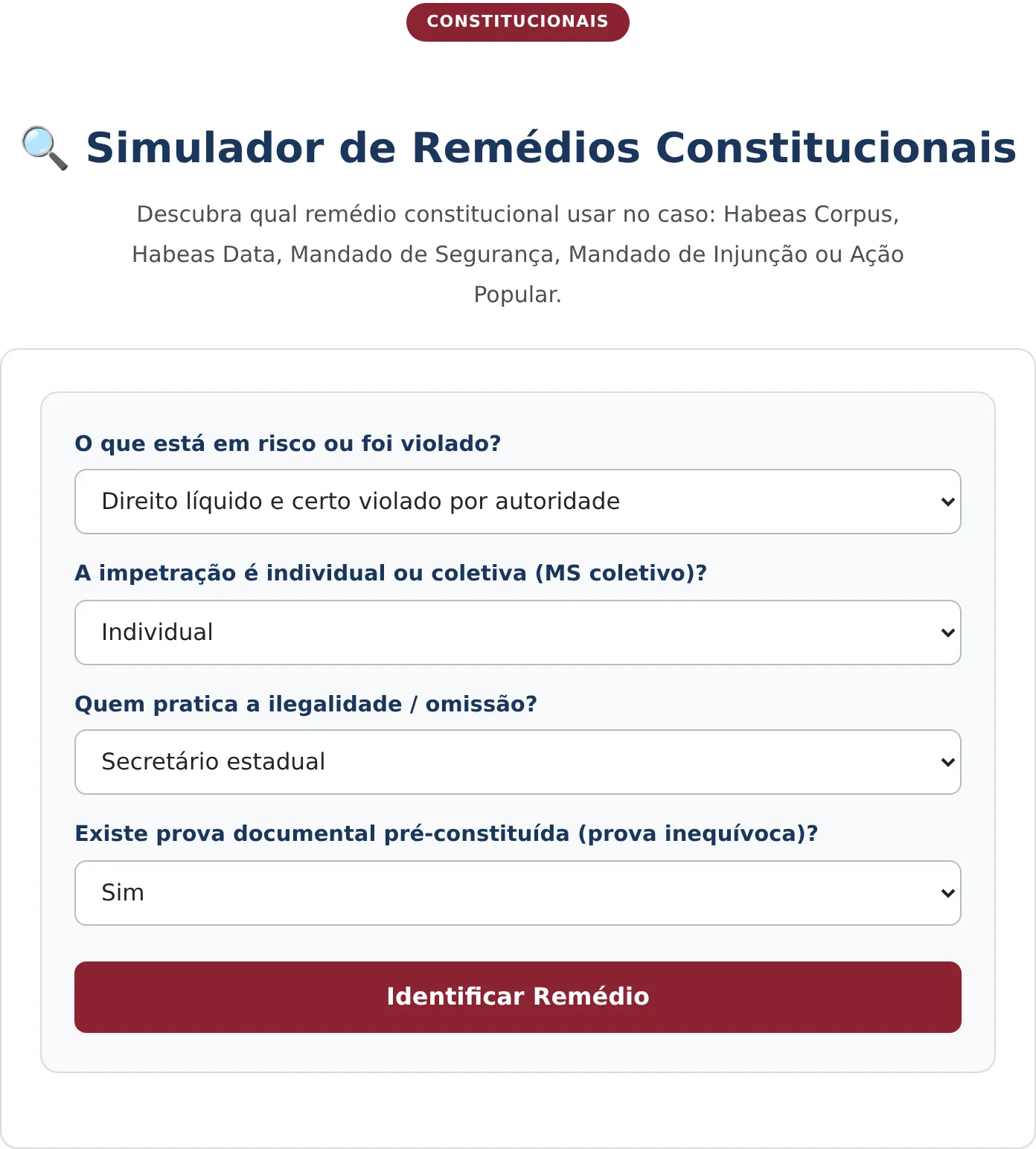
In the example, the violated interest is a clear and certain right, the filing is individual, the authority is a state secretary, and there is preexisting documentary evidence.
The evidence field is decisive. A negative answer changes the recommendation because a mandado de segurança does not permit evidentiary development: without evidence already in hand, the appropriate path is an ordinary action.
3. Identify the remedy and read the result
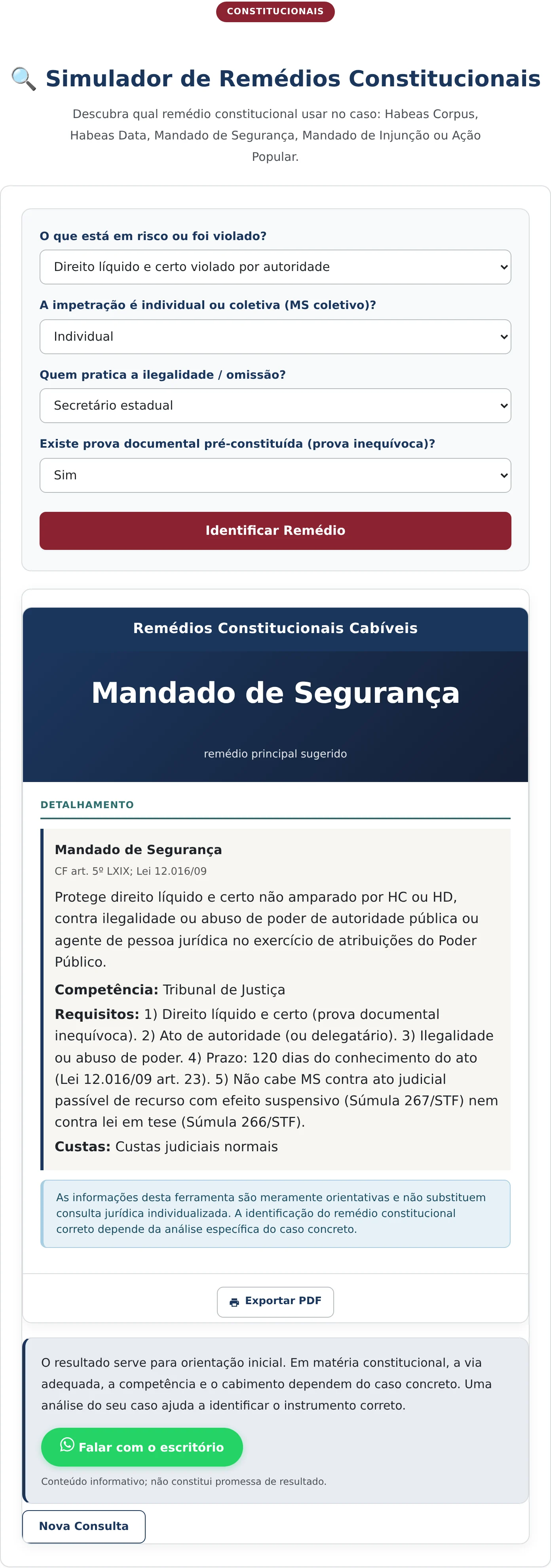
The “Identify Remedy” button opens a card highlighting the primary remedy and providing details on the legal basis, description, jurisdiction, requirements, and court costs.
How to read the result
In the example, the suggested remedy is a mandado de segurança, based on the relevant item of art. 5º of the Constitution and the law governing it.
The description defines when it is available: it protects a clear and certain right not covered by habeas corpus or habeas data, against illegality or abuse of power by a public authority or an agent of a legal entity performing public functions.
The jurisdiction line translates the choice of authority into the proper forum. In the example, the state authority gives the state Court of Justice original jurisdiction, rather than the trial court.
The requirements section lists five conditions. A clear and certain right supported by unequivocal documentary evidence. An act by an authority or delegated agent. Illegality or abuse of power. A period of one hundred and twenty days from notice of the act. And two situations in which relief is unavailable, established in súmulas: against a judicial act subject to an appeal with suspensive effect and against a law in the abstract.
These two súmulas account for a substantial portion of inadmissible filings. A mandado de segurança is neither a substitute for an appeal nor an instrument for abstract judicial review of legislation.
The five remedies and what each one protects
It is useful to keep the full framework in mind, because the tool suggests the primary remedy and an alternative may be available.
Habeas corpus protects current or threatened freedom of movement. It is free of charge, does not require a lawyer, and may be filed by anyone on another person’s behalf.
Habeas data ensures access to and correction of information about a person contained in records held by governmental entities or entities of a public nature. It requires a prior refusal through administrative channels.
The mandado de segurança is residual in relation to the two preceding remedies and protects a clear and certain right against an act by an authority. It may be brought collectively by those with standing to do so.
The mandado de injunção addresses the absence of an implementing rule that makes it impossible to exercise a constitutional right. It does not declare a rule unconstitutional: it fills the gap in the specific case.
The ação popular allows a citizen to annul an act harmful to public property, administrative probity, the environment, and historical heritage. It requires citizenship proven by a voter registration card and exempts the plaintiff from court costs, absent bad faith.
Two operational aspects of the mandado de segurança, the most commonly used remedy, deserve further detail.
The first is identifying the respondent authority. It is not the government body, but the individual who performed the act or has the power to undo it. Identifying the wrong authority may result in dismissal without a decision on the merits, although correction is permitted in certain situations when the identified authority belongs to the same legal entity.
The second is a liminar (interim relief). The procedure allows the challenged act to be suspended when there is a substantial legal basis and a risk that the remedy will be ineffective at the end of the case. This request gives the remedy practical value in urgent situations, and the law prohibits relief in certain specific situations, such as the offsetting of tax credits.
There is also the scope of decisions. In collective proceedings, the judgment reaches only the members of the represented group, and a collective filing does not prevent an individual one, although the individual petitioner must withdraw their action to benefit from the collective decision.
These details do not appear in the tool’s result, which addresses whether the remedy is available, but they affect the practical effectiveness of the chosen avenue.
What the simulator does not do
The tool does not assess whether the right exists. It addresses the availability of relief and the appropriate avenue, while the merits depend on an analysis of the facts and documentation.
It also does not calculate the deadline in the specific case or determine whether the available evidence is enough to establish a clear and certain right, a judgment that requires reviewing the documents.
And it does not replace jurisdictional research when there is a forum based on official capacity or a specific rule of judicial organization.
Frequently Asked Questions
What is the deadline for filing a mandado de segurança?
One hundred and twenty days from notice of the challenged act, a deadline that is a forfeiture period. Once the deadline has expired, the remaining option is an ordinary action, which permits full evidentiary development but does not have the speed of the mandado de segurança procedure.
Is a mandado de segurança available against a judicial decision?
As a rule, no, when the decision is subject to an appeal with suspensive effect, according to settled precedent. The proper avenue is the appropriate appeal, and a filing in this situation is likely not to be heard.
What is the difference between a mandado de injunção and an action for omission?
A mandado de injunção serves the individual interest of a person prevented from exercising a right because an implementing rule is lacking. A direct action for omission operates through concentrated judicial review and declares the failure of the competent authority to act, with general effects.
Receba novidades por e-mail
Cadastre-se gratuitamente para receber nossos novos artigos.
Seus dados estão protegidos conforme a LGPD.
Ficou com dúvidas? Fale com um advogado especialista.
📱 Falar pelo WhatsAppAs informações deste artigo são de caráter informativo e não substituem consulta jurídica individualizada. Cada caso possui particularidades que exigem análise específica.


