
Fundamental Rights Checker: Tutorial
Between the facts and the constitutional claim lies a step that is often skipped: legal classification. The website’s checker matches the issues in a case with constitutional rights and identifies the available judicial remedies.
What the fundamental rights checker does
Anyone reporting a violation describes facts, not legal categories. Withheld wages, arrest without a warrant, denial of medical care, discriminatory dismissal: these are narratives, and the technical work begins by translating them into the rights protected by the Constitution.
This classification determines everything else. It establishes the basis for the petition, the appropriate procedural remedy, and, often, jurisdiction. Classifying a case incorrectly costs time and sometimes the right itself.
There is also the issue of who committed the violation. The government is subject to strict liability, while private parties are governed by a different rule, and that difference changes the burden of proof and the litigation strategy.
The website’s checker accepts an optional account of the situation, identification of the violating party, and selection of the issues involved, then returns the related rights, their legal basis, and the available remedies.
When the tool helps in a specific case
Its most useful function is the initial organization of a case, when the facts are already known but the legal grounds still need to be structured.
Other common situations include:
- identifying alternative procedural remedies for the same violation;
- determining the liability framework based on the party involved;
- mapping related rights that the account did not reveal;
- preparing an outline for an initial consultation;
- studying the subject through specific cases.
The ability to select several issues is the most important feature. Real violations rarely involve only one right, and considering them together often reveals grounds that an isolated narrative would not suggest.
A real violation almost never affects just one right. Selecting only the most obvious issue weakens the legal grounds.
This tutorial’s example selects three issues based on a fictional account, and the result shows how they combine.
Step by step through the tool’s screens
The checker is located in the website’s tools section, under constitutional tools, and runs in your browser.
1. Open the tool and identify the fields
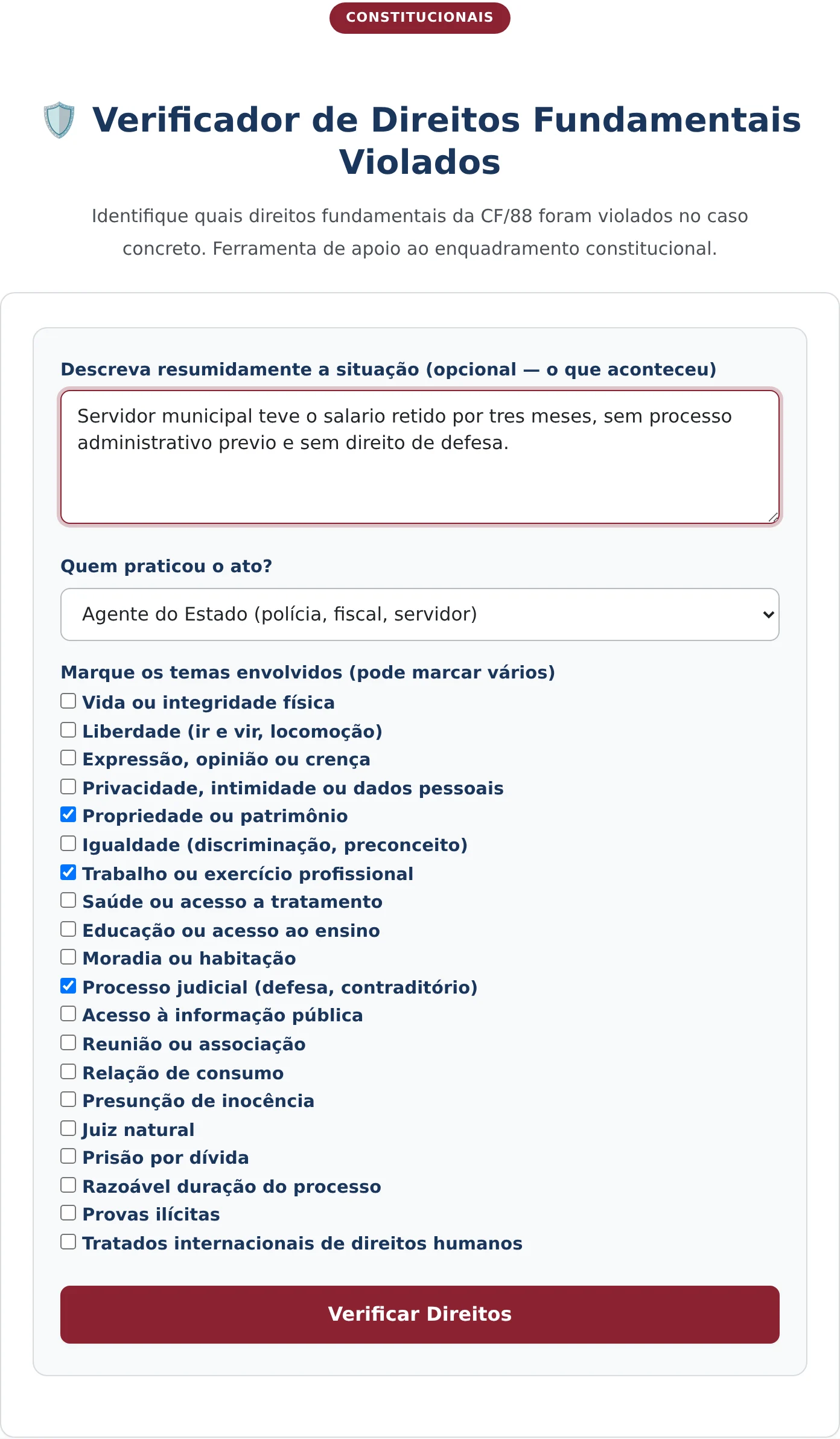
The screen has three parts. The first is a free-text field for a brief description of the situation, marked as optional. The second is a selector for the party that committed the act, with six options.
The third is a list of issues with multiple-selection checkboxes. It covers everything from classic rights, such as life, liberty, and property, to procedural guarantees, such as due process, the presumption of innocence, the juiz natural (right to a legally preassigned judge), and the exclusion of unlawfully obtained evidence.

2. Describe the situation and select the issues
In the example, the account describes a municipal public employee whose wages were withheld for three months, without prior administrative proceedings and without the right to a defense. The identified party is a government agent, and the selected issues are work, due process, and property.
Selecting three issues reflects the technical reading of the case. Withholding wages affects property, the absence of proceedings affects the procedural guarantee, and the employment relationship affects the right to work and compensation.
3. Check and read the related rights
The “Check Rights” button opens a card containing the recorded account, the rights related to each selected issue, the constitutional basis, and the available judicial remedies.

How to read the result
In the example, the card shows three selected issues and lists the corresponding rights, with one section for each.
The right to property appears with a basis in the relevant provisions of art. 5º, along with a note on its social function and the requirement of prior and fair compensation in expropriation. The indicated remedies are a mandado de segurança (a writ protecting a clear legal right), a possessory action, and a damages action.
The right to work and freely practice a profession is based on art. 5º, art. 6º, and art. 7º, with a list of related social rights. The indicated remedies include a labor claim, a mandado de segurança, and an ação civil pública (a public civil action).
The section on the violating party adds the most value. Because the case involves a government agent, the result states that the government is strictly liable, meaning it is liable regardless of fault, while retaining a right of recourse against the agent.
This information changes the evidentiary strategy. Under strict liability, it is enough to show the harm and the causal connection, without having to prove fault, which considerably simplifies the evidentiary process.
From identifying the right to choosing the remedy
The result identifies available remedies, and it is worth understanding the criterion that distinguishes one from another.
A mandado de segurança requires a clear legal right, supported by preexisting documentary evidence, and an act by a public authority. It is fast and subject to a short statute of limitations, calculated from the date the act becomes known.
An ordinary action, including a damages action, allows broad evidentiary proceedings, with expert evidence and witnesses. It is the appropriate route when the evidence is not yet ready or when monetary compensation is sought for harm that has already occurred.
An ação civil pública covers collective and diffuse interests and requires parties with specific standing. It is the appropriate route when the violation affects a group, rather than only one individual.
In the tutorial example, the choice would depend on two factors: whether documentation immediately proves the withholding, which favors a mandado de segurança, and whether the request is limited to payment or includes compensation for emotional distress, which points toward an ordinary action.
This sequence, from fact to right and from right to remedy, is precisely what the tool organizes.
It is worth noting the effect of fundamental rights in relationships between private parties, because the selector for the violating party addresses this issue.
For a long time, there was debate over whether fundamental rights bound only the government. The settled understanding is that they also apply to relationships between private parties, with varying intensity depending on the imbalance between the parties.
This application is stronger where there is an imbalance of power. In employment and consumer relationships, and in private associations that exercise authority over their members, the requirement to observe guarantees such as adversarial proceedings and nondiscrimination is firmly recognized.
The practical consequence appears in the choice of remedy and allocation of the burden of proof. The government is subject to strict liability. Private parties, as a rule, are liable only upon fault, except where the law establishes strict liability, as in consumer relationships and in the performance of hazardous activities.
That is why the field identifying the violating party is not merely descriptive: it anticipates the evidentiary effort the action will require.
What the checker does not do
The tool does not analyze the account based on its content. The text is recorded to identify the result, and the classification is based on the issues selected by the user.
It also does not assess deadlines, jurisdiction, or evidentiary feasibility, which depend on the specific case and the available documentation.
Nor does it rank the rights identified. In a legal filing, the order of presentation and the weight given to each ground are matters of argumentative strategy.
Frequently Asked Questions
Can I select more than one issue?
You can and should when the case involves more than one right. Real violations usually affect several legally protected interests at the same time, and selecting multiple issues reveals related grounds that an isolated reading of the facts would not suggest.
Why does identifying the party matter?
Because it defines the liability framework. Acts by government agents trigger strict liability, which eliminates the need to prove fault, while violations committed by private parties are governed by a different rule, with a direct effect on the evidentiary strategy.
Does the result tell me which action I should file?
It identifies the available remedies for each related right, and the choice among them depends on the available evidence, the relief sought, and the applicable deadline. A clear legal right supported by documentary evidence favors a mandado de segurança; a damages claim requiring evidence to be developed points toward an ordinary action.
Receba novidades por e-mail
Cadastre-se gratuitamente para receber nossos novos artigos.
Seus dados estão protegidos conforme a LGPD.
Ficou com dúvidas? Fale com um advogado especialista.
📱 Falar pelo WhatsAppAs informações deste artigo são de caráter informativo e não substituem consulta jurídica individualizada. Cada caso possui particularidades que exigem análise específica.


