
Over-Indebtedness Calculator: Tutorial
Not every debt is included in calculating the minimum subsistence amount: payroll-deducted credit, mortgage financing, and taxes are excluded. The calculator on the website separates what counts from what does not.
What the over-indebtedness calculator does
The law addressing over-indebtedness created a new right: the right to renegotiate consumer debts while preserving the mínimo existencial (minimum amount needed for subsistence), meaning the portion of income needed to support oneself.
Applying this right depends on a calculation, and that calculation follows a counterintuitive rule: not every debt is included. The implementing decree lists the types of credit excluded from the calculation, and the list is extensive.
Excluded are payroll-deducted credit, mortgage financing, credit secured by collateral, rural credit, credit for productive activity, taxes, and condominium fees, among others. Credit card debt, personal loans, overdraft facilities, and installment purchases are included.
This distinction radically changes the result. Someone whose entire income is committed to payroll-deducted credit and mortgage financing may not fall within the legal definition, even though they are facing real hardship.
The website calculator automatically makes this distinction based on the type entered for each debt.
When the tool helps in a specific case
Its most important use is screening before filing a renegotiation request, to determine whether the case qualifies.
Other recurring situations include:
- measuring the percentage of income committed to consumer debts;
- identifying which debts are included in the legal calculation;
- organizing an overview of debt before negotiating;
- assessing the effect of a new debt on the budget;
- preparing documentation for the renegotiation request.
Simply listing debts by type is useful in itself. Many people do not know the exact makeup of their own debt, and completing the information requires them to confront it.
Payroll-deducted credit and mortgage financing are not included in calculating the mínimo existencial. You may be overwhelmed and still not fall within the legal definition.
The example in this tutorial shows how the screening process works, using fictional figures chosen for demonstration purposes.
Step-by-step guide to the tool’s screens
The calculator is in the website’s tools section, among the civil and consumer-law tools, and works in your browser.
1. Open the tool and understand its structure
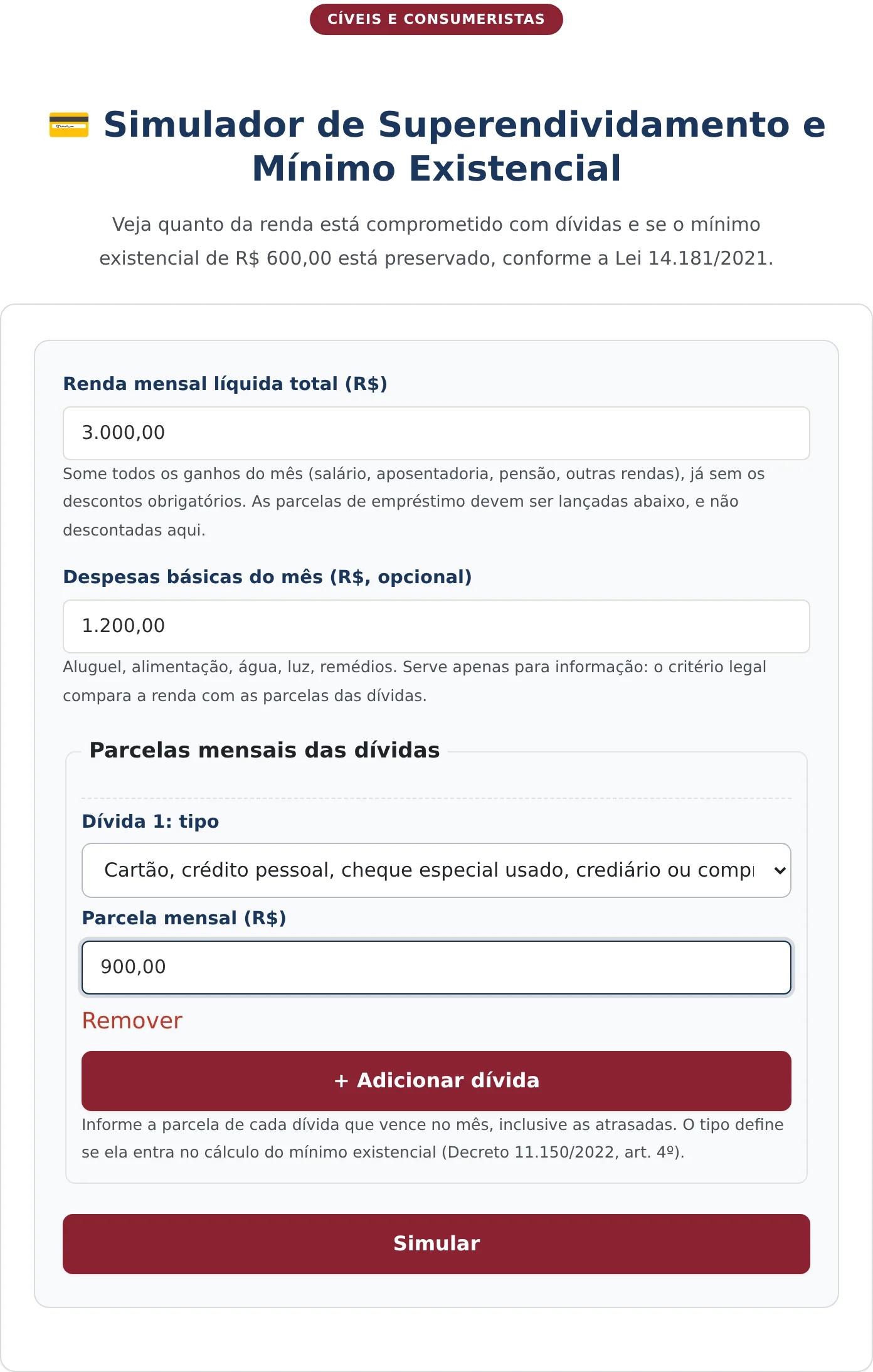
The screen has two sections. At the top are total monthly net income and basic monthly expenses, with the latter field being optional and provided for informational purposes only.
Below is the list of debts, with one line already open and a button for adding more. Each line requires the type of debt, with twelve options, and the amount of the installment due that month.
The guidance for the type field is the most important information on the screen: it explains that the type determines whether the debt is included in calculating the mínimo existencial, and identifies the applicable decree.

2. Enter income and debts
In this example, monthly net income is R$ 3.000,00, reported basic expenses are R$ 1.200,00, and there is a credit card debt with a monthly installment of R$ 900,00.
The basic-expenses field does not affect the legal criterion. It provides an overview of the budget because the law compares income with debt installments, not with living costs.
3. Run the calculation and read the result
The “Simulate” button opens a card showing the highlighted conclusion, the calculation of the mínimo existencial, a list of debts marked to show whether they are included, and guidance on renegotiation.

How to read each line of the result
In this example, the conclusion is that the mínimo existencial is preserved, with R$ 2.100,00 remaining above the reference threshold.
The calculation section shows total income of R$ 3.000,00, installments included in the calculation totaling R$ 900,00, equivalent to thirty percent of income, and the resulting remaining amount.
The final comparison is with the mínimo existencial established by the decree. The amount above it appears on its own line, allowing you to see how much room the budget has, or does not have.
The reported-debts section repeats each entry with its type and marks whether it is included in the calculation. This marking is the core of the tool because it explains why a large debt may not change the conclusion.
There is also an informational line showing the balance after all installments and basic expenses, which is useful for understanding the real budget even though it is not part of the legal criterion.
The card ends by noting that renegotiation requires a separate request to the judge and is not an automatic consequence of the conclusion displayed.
The renegotiation procedure and its limits
It is worth explaining what comes after the screening process, because the calculator is only the starting point.
An over-indebted consumer may ask the judge to initiate debt renegotiation proceedings, with all creditors present at a conciliation hearing. The proposed payment plan may extend for up to five years while preserving the mínimo existencial.
A creditor who fails to appear at the hearing has interest and charges on its claim suspended and may be included in a compulsory plan during the second phase of the procedure if conciliation is unsuccessful.
The law covers only consumer debts incurred in good faith. Debts resulting from fraud, luxury contracts, and those expressly excluded by the decree are outside the plan.
There is also a preventive dimension that is often overlooked: the law imposed disclosure duties and prohibited consumer-harassment practices, especially in payroll-deducted credit offered to older adults and beneficiaries of social programs.
This explains why initial screening matters: the procedure is advantageous, but its entry requirements are limited.
It is worth placing the legal concept in context, because it is narrower than the ordinary use of the word suggests.
Under the law, over-indebtedness is the clear inability of an individual consumer, acting in good faith, to pay all due and future consumer debts without compromising the mínimo existencial.
Three elements stand out in this definition. The first is that it applies to individuals: businesses do not qualify. The second is good faith: debts incurred with the intention not to pay are excluded. The third is the consumer nature of the debts.
The definition covers both debts already due and those that have not yet come due, allowing action before collapse, not only afterward.
This temporal scope is the least explored aspect of the legal framework. Someone who recognizes that their income is becoming increasingly committed may seek renegotiation preventively, with far more room to negotiate than someone who has already accumulated delinquent debts.
What the calculator does not do
The tool does not request renegotiation or prepare a payment plan, measures that require a court request with legal representation.
It also does not assess good faith in entering into the agreements or any potential unfairness in the contracts, matters that require examination of the documents.
Nor does it replace direct negotiation with creditors, which often resolves the problem without the need for legal proceedings.
Frequently Asked Questions
Which debts are included in calculating the mínimo existencial?
Consumer debts in the strict sense are included, such as credit card debt, personal loans, overdraft facilities, and installment purchases. Payroll-deducted credit, mortgage financing, credit secured by collateral, rural credit, productive credit, taxes, and condominium fees are excluded.
Does having your income committed guarantee renegotiation?
No. Eligibility depends on the makeup of the debts, and not every type is included in the legal calculation. You may face real hardship and still not meet the definition established by law.
Is renegotiation automatic after the simulation?
No. Renegotiation depends on a request made to the judge, with a conciliation hearing and the participation of all creditors. The calculator only organizes the figures supporting that request.
Receba novidades por e-mail
Cadastre-se gratuitamente para receber nossos novos artigos.
Seus dados estão protegidos conforme a LGPD.
Ficou com dúvidas? Fale com um advogado especialista.
📱 Falar pelo WhatsAppAs informações deste artigo são de caráter informativo e não substituem consulta jurídica individualizada. Cada caso possui particularidades que exigem análise específica.


