
Overtime Calculator: Step-by-Step Tutorial
Regular overtime does not end with the premium: it affects paid weekly rest, the 13th salary, vacation pay, FGTS, and notice pay. The website calculator adds up these effects and projects the annual amount.
What the overtime calculator does
People who receive overtime pay usually check only the premium on the corresponding line of their paystub. The full calculation, however, has layers that remain invisible on the payroll statement and only appear when someone adds up the entire year.
The first layer is the premium. The Constitution guarantees at least 50% above the regular hourly rate, and work performed on Sundays and holidays is usually paid at double time. A collective bargaining agreement may set a higher percentage, which is precisely why the tool includes a corresponding field.
The second layer is paid weekly rest. Regular overtime increases the value of weekly rest, in proportion to the working days and rest days in the month. This effect is required by law and established in a precedent of the Tribunal Superior do Trabalho (Brazil’s Superior Labor Court).
The third layer consists of the effects on other amounts due. Overtime pay, increased by the higher weekly rest amount, is included in the basis for the 13th salary (mandatory year-end bonus), vacation pay plus the one-third premium, FGTS (Brazil’s Guarantee Fund for Length of Service), and indemnified notice pay. In long-term employment relationships, this group of amounts easily exceeds the premium alone.
When the tool helps in a specific case
Its most common use is to determine what is at stake before filing a claim or entering into negotiations. The annual projection shows the order of magnitude that a monthly paystub conceals.
Other recurring situations include:
- checking the payment of overtime recorded for the month;
- verifying whether paid weekly rest was increased by regular overtime;
- calculating the effect of the more favorable percentage established in a collective bargaining agreement;
- estimating the amounts due upon termination without cause;
- comparing monthly schedules of 220 and 180 hours.
The monthly schedule field is decisive because it determines the regular hourly rate. A schedule of 44 hours per week corresponds to 220 hours per month; reduced schedules result in a higher regular hourly rate.
The premium is the smallest part of the calculation. Paid weekly rest, the 13th salary, vacation pay, FGTS, and notice pay usually add up to more than the premium itself.
The example in this tutorial shows this proportion in figures, using fictional amounts selected for demonstration purposes.
Step by step through the tool screens
The calculator is located in the website’s tools section, among the labor-law tools, and works in your browser.
1. Open the tool and identify the fields
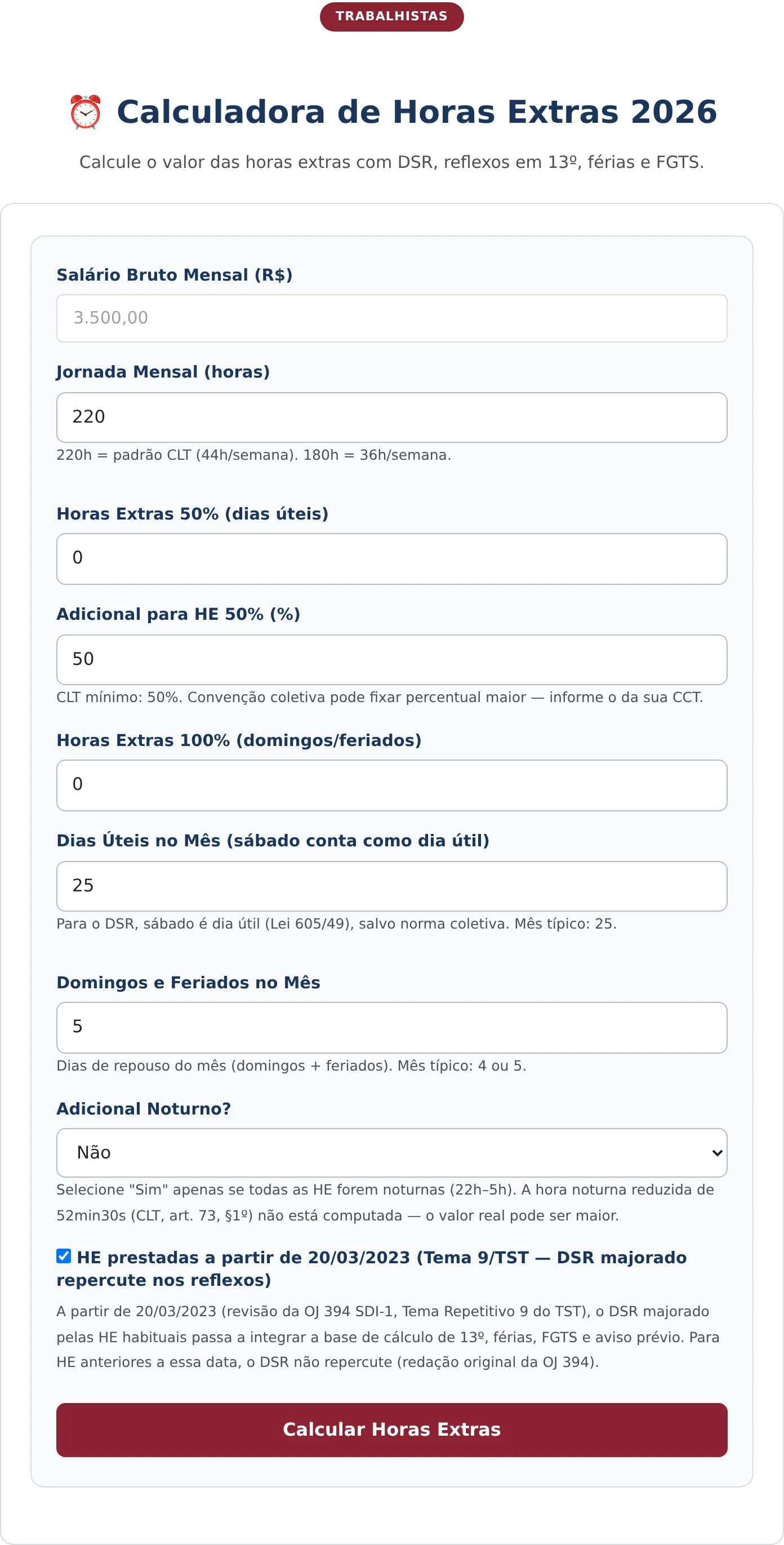
The screen contains nine fields. The first two establish the basis: gross monthly salary and monthly schedule in hours. The following fields receive the number of overtime hours at 50% and 100%, the premium percentage, the month’s working days, and rest days.
The final two fields address specific situations. The night-work premium should be selected only when all overtime hours were worked at night. The box for hours worked from March 2023 onward exists because, following the Tribunal Superior do Trabalho’s revised interpretation, increased weekly rest began to affect other amounts due.
2. Fill it in with the payroll information
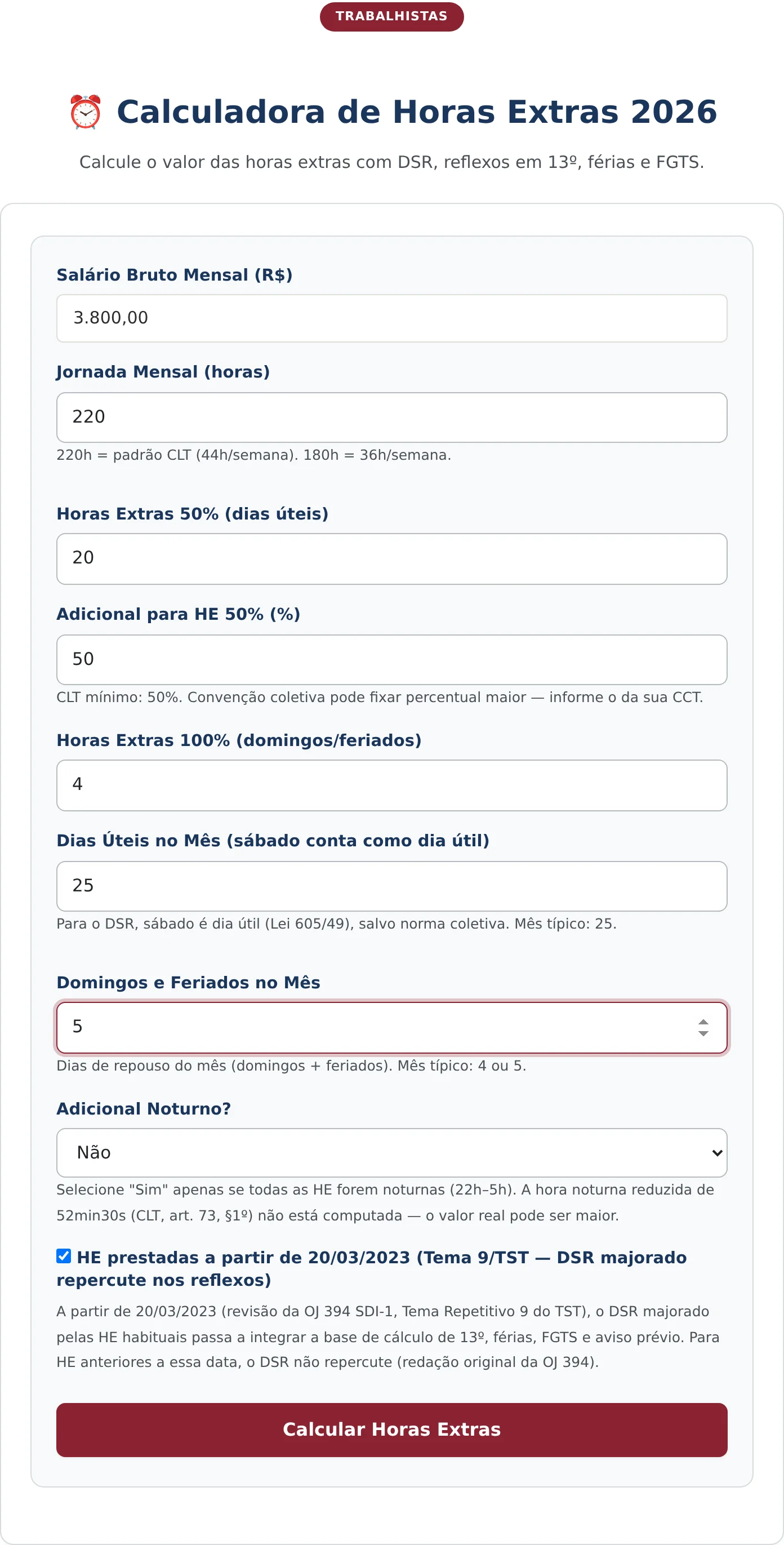
In the example, the gross salary is R$ 3.800,00, the monthly schedule is 220 hours, there are 20 overtime hours at 50% and 4 at 100%, the premium is the legal minimum of 50%, the month has 25 working days and 5 rest days, there is no night-work premium, and the box for hours after March 2023 is selected.
The working-days field deserves attention. For paid weekly rest purposes, Saturday counts as a working day, unless a collective bargaining agreement provides otherwise. Entering 22 working days because Saturdays are disregarded improperly reduces the effect.
3. Calculate and read the result
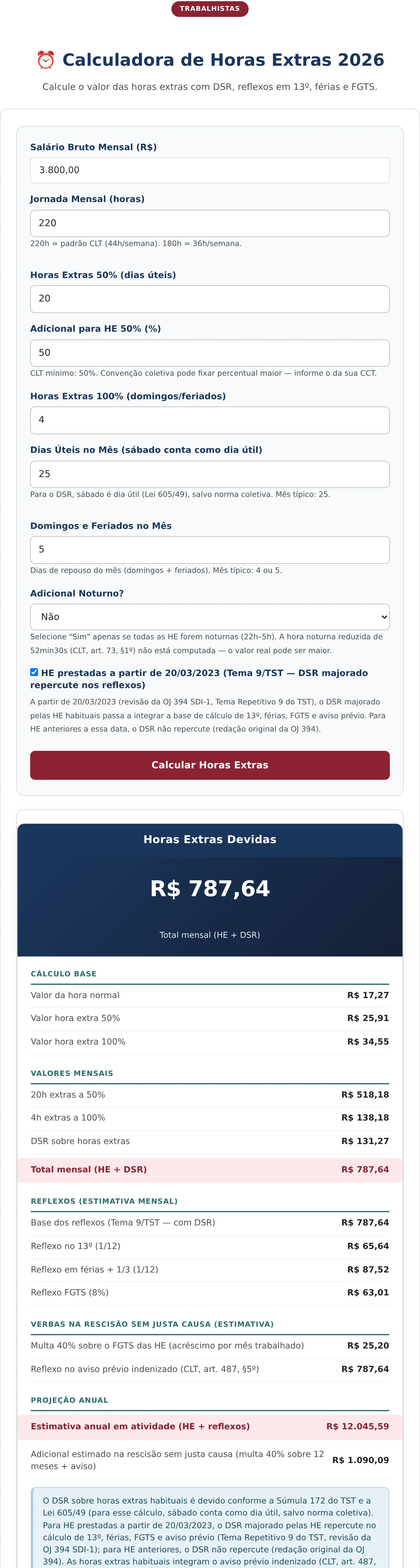
The “Calculate Overtime” button opens the card showing the highlighted monthly total, the base calculation, monthly amounts, related effects, termination-related amounts, and the annual projection.
How to read each line of the result
In the example, the monthly total is R$ 787,64, already including overtime and paid weekly rest.
The base calculation shows where everything begins: the regular hourly rate is R$ 17,27, obtained by dividing the salary by the 220-hour schedule. The overtime hourly rate at 50% is R$ 25,91, and the hourly rate at 100% is R$ 34,55.
The monthly amounts break down the calculation: 20 hours at 50% total R$ 518,18, the 4 hours at 100% total R$ 138,18, and paid weekly rest based on overtime adds R$ 131,27. This last amount is the effect that most paystubs do not itemize.
The effects section estimates the monthly impact on other amounts due, based on an amount that already includes increased weekly rest: R$ 65,64 for the 13th salary, R$ 87,52 for vacation pay plus the one-third premium, and R$ 63,01 for FGTS. The termination-related amounts appear next, including the 40% penalty on FGTS from overtime and the effect on indemnified notice pay.
The annual projection is the figure that usually surprises people: an estimated R$ 12.045,59 over one year of employment, adding overtime and its effects, plus an estimated R$ 1.090,09 as an increase upon termination without cause. This is the order of magnitude that month-by-month calculations conceal.
At the bottom, the tool lists its legal bases: paid weekly rest on regular overtime, with the observation that Saturday is a working day, and the temporal distinction between hours worked before and from March 2023 onward regarding the effect of increased weekly rest.
The monthly schedule field deserves separate comment because it determines the hourly rate and, therefore, everything else in the calculation. A schedule of 44 hours per week corresponds to a divisor of 220 hours per month. Reduced schedules result in smaller divisors, and a smaller divisor means a higher regular hourly rate.
The practical consequence is straightforward: two workers with the same salary and the same number of overtime hours receive different amounts if their contractual schedules differ. For example, for schedules of 40 hours per week, the applicable divisor is usually 200, which increases the value of each overtime hour by about ten percent.
For this reason, this field should not be completed based on habit. It must reflect the schedule actually agreed upon in the employment contract or the collective bargaining agreement for the category.
What the calculator does not do
The tool does not calculate the reduced night hour of 52 minutes and 30 seconds. The screen itself warns of this in the night-work premium field, and for predominantly nighttime schedules, the amount due tends to be higher than estimated.
It also does not calculate time banks, schedule offsets, missed intra-shift breaks, or on-call time, which have their own rules and depend on time records and the applicable collective bargaining agreement.
And it does not replace evidence. The calculation is based on the hours you provide; in a specific dispute, the number of overtime hours must be shown through work-schedule records, timecards, or other admissible means.
Frequently Asked Questions
What is the effect on paid weekly rest?
Regular overtime increases the value of weekly rest, in proportion to the working days and rest days in the month. It is a separate amount due in addition to the premium and appears as its own line in the calculator result.
Does Saturday count as a working day in the calculation?
It does for paid weekly rest purposes, unless a collective bargaining agreement provides otherwise. That is why the working-days field usually receives about 25 days in a typical month, rather than only Monday through Friday.
Does overtime increase FGTS and the 40% penalty?
Yes. Regular overtime is included in compensation and, consequently, in the basis for the monthly 8% FGTS deposit. Upon termination without cause, the 40% penalty applies to the increased balance, and the tool result estimates this increase separately.
Receba novidades por e-mail
Cadastre-se gratuitamente para receber nossos novos artigos.
Seus dados estão protegidos conforme a LGPD.
Ficou com dúvidas? Fale com um advogado especialista.
📱 Falar pelo WhatsAppAs informações deste artigo são de caráter informativo e não substituem consulta jurídica individualizada. Cada caso possui particularidades que exigem análise específica.


