
Social Security Factor Calculator: Tutorial
In this tutorial’s example, the social security factor reduces the monthly benefit by 18%, and the calculation that produces this reduction has three variables. The website’s calculator applies the official formula and shows the reduction in reais.
What the social security factor calculator does
The social security factor is a multiplier applied to the average salary to determine the initial monthly benefit. When it is below 1, it reduces the amount; when it exceeds 1, it increases it. People who retire early, at a younger age and with a long life expectancy, receive an unfavorable factor.
The legal formula combines contribution period, a fixed rate of 0.31, age on the application date, and life expectancy determined by the official mortality table. Each element enters the calculation differently, making mental calculation impracticable.
After the 2019 reform, the factor was no longer the general rule, but it did not disappear. It remains applicable to applications filed before November 13, 2019, and continues under one of the transition rules, the 50% pedágio (additional-contribution requirement) rule. Anyone disputing a benefit granted in the past or qualifying under that transition rule needs it.
The website tool takes five data points and returns the factor, the life expectancy used, a benefit simulation with and without the factor, and the score under the rule that allowed the factor to be waived.
When the tool helps in a specific case
Its most frequent use is to verify a benefit granted before the reform, when the factor was applied as a rule.
Other recurring situations include:
- assessing the 50% pedágio transition rule, under which the factor remains applicable;
- measuring how much retiring earlier would cost in monthly income;
- checking the score required under the rule that waived the factor;
- comparing the effect of one additional year of contributions on the multiplier;
- understanding the source of a monthly benefit lower than the average salary.
The average-salary field is optional, but it is what turns an abstract number into a difference in reais per month, which is the information needed to make a decision.
A factor of 0.8202 is not a technical detail: it is R$ 719,08 less per month, every month, for the rest of the life of the benefit.
This tutorial’s example shows that translation, using fictitious values selected for demonstration purposes.
Step-by-step guide using the tool’s screens
The calculator is in the website’s tools section, among the social security tools, and works in your browser.
1. Open the tool and identify the fields
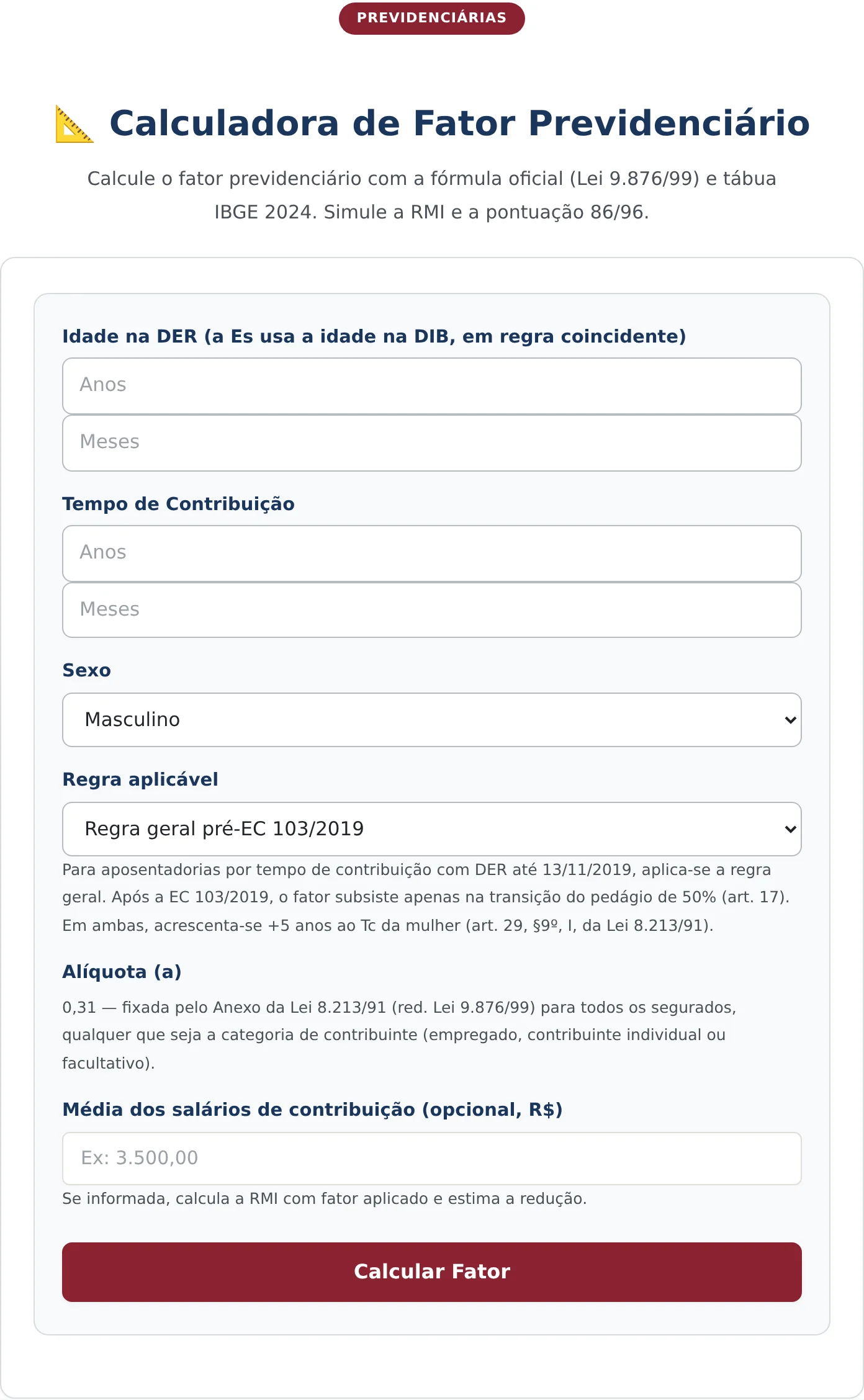
The screen contains five fields. The first two are age on the application date and contribution period, both in years. The third is sex, which matters because the law adds five years to a woman’s contribution period in the formula.
The fourth field selects the applicable rule, either the general rule before the reform or the 50% pedágio transition rule. The fifth is the average of contribution salaries, which is optional and used to estimate the benefit.
2. Enter the case information
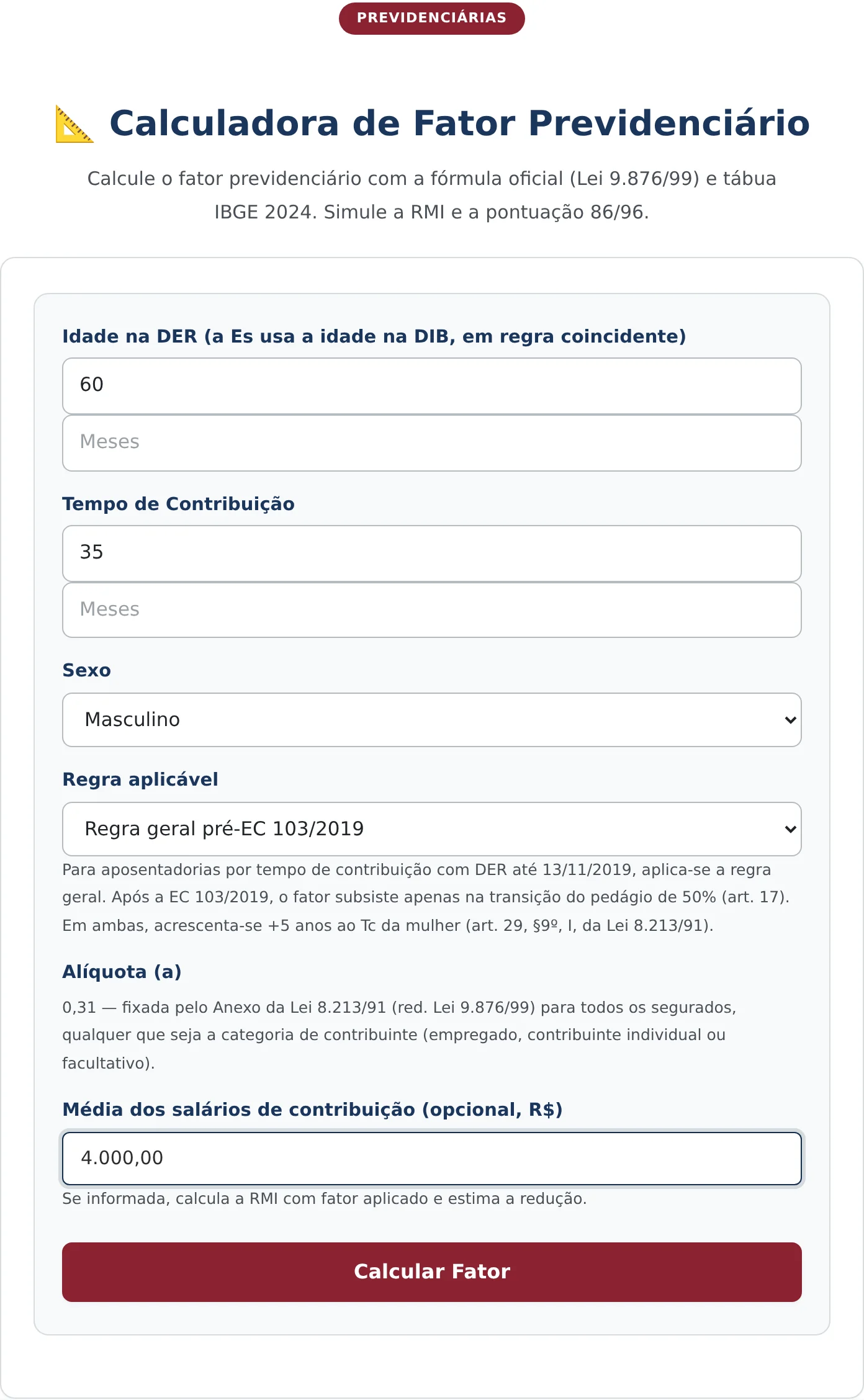
In the example, the age on the application date is 60, the contribution period is 35 years, the insured person is male, the selected rule is the general rule before the reform, and the reported average salary is R$ 4.000,00.
Age and contribution period must correspond to the application date, not today’s date. This accounts for many discrepancies when verifying older benefits, because a difference of just a few months changes both life expectancy and the result of the formula.
3. Calculate and read the result
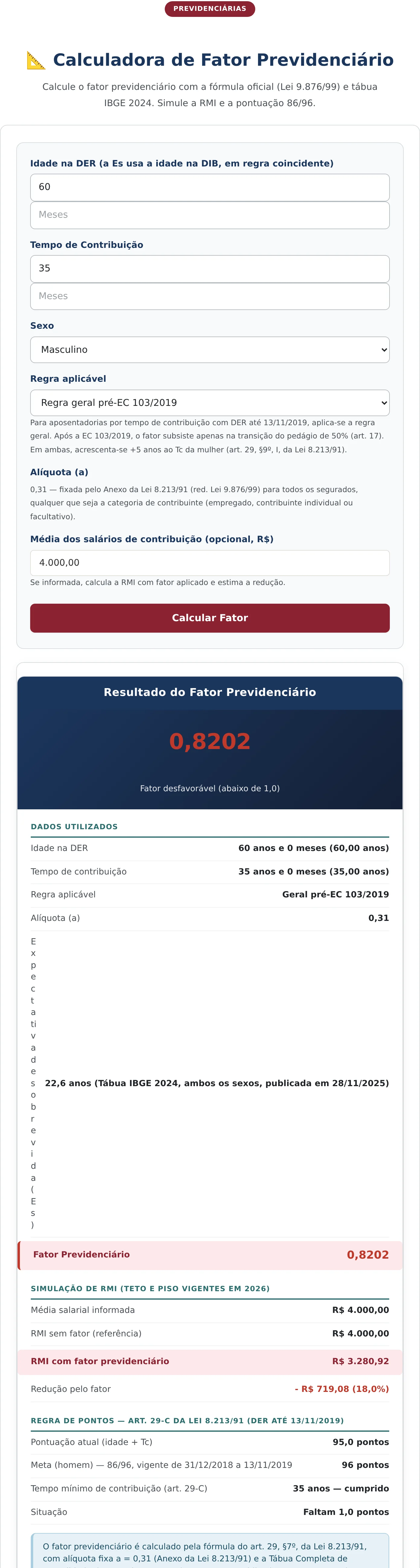
The “Calculate Factor” button opens the card showing the multiplier prominently, the data used, the benefit simulation, and the analysis of the points rule that allowed the factor to be waived.
How to read each line of the result
In the example, the factor is 0.8202, classified as unfavorable because it is below 1. The data-used section shows the variables that produced this number.
Two are provided by the user: age 60 and a contribution period of 35 years. One is set by law: the 0.31 rate. The fourth comes from an outside source: life expectancy of 22.6 years, taken from the official mortality table, with the year and publication date indicated.
This last variable explains why the factor changes from one year to the next even if the insured person has done nothing. The table is updated annually, and a longer life expectancy reduces the factor for those who retire at the same age.
The benefit simulation provides the decisive translation. Based on the average of R$ 4.000,00, the benefit without the factor would be R$ 4.000,00; with the factor, it falls to R$ 3.280,92. The reduction is R$ 719,08 per month, equivalent to 18% of the amount.
The final section analyzes the points rule that allowed the factor to be waived in applications filed before the reform. In the example, the score of 95 points is 1 point short of the 96-point target required for men during the rule’s final period of validity. In this context, one point is worth the R$ 719,08 monthly amount in the preceding line.
Why the factor still matters after the reform
The 2019 reform eliminated retirement based on contribution period in its prior form, along with the general application of the factor. This led many people to conclude that the issue had ended, which is not accurate.
The factor remains relevant on two fronts. The first is the body of benefits already granted: every review of a retirement benefit granted before the reform involves checking the multiplier applied, the age considered, and the table used.
The second is the 50% pedágio transition rule, under which the factor continues to apply to the average salary. Anyone who qualifies under this transition rule must compare the result with those under the other rules before choosing.
There is also a retrospective use. In discussions about the best time to apply for the benefit in the past, the factor is the tool that measures the cost of applying early, and the calculator makes it possible to reconstruct that calculation using the parameters in effect at the time.
What the calculator does not do
The tool does not calculate the average salary. It takes the average as an input and estimates the benefit from it, while the actual average depends on all contribution salaries since July 1994, obtained from the official registry.
It also does not automatically apply a maximum or minimum amount in every situation, nor does it calculate benefits governed by rules after the reform, which use a progressive coefficient rather than a factor.
And it does not replace the benefit grant letter. To verify a granted benefit, the official document provides the average, factor, and coefficient actually applied, and the simulation should be compared against those figures.
Frequently Asked Questions
Does the social security factor still exist?
Yes, with a reduced scope. It applies to applications filed before November 13, 2019, and remains under the 50% pedágio transition rule. For the other rules after the reform, the calculation uses a progressive coefficient, not the factor.
Why does the factor change even though I have not gotten older?
Because life expectancy is updated annually through the official mortality table. Since it is part of the formula, an increase in average longevity reduces the factor for those who retire at the same age and with the same contribution period.
Are women treated differently under the formula?
Yes. The law adds five years to a woman’s contribution period when calculating the factor, which increases the multiplier. The calculator applies this addition automatically when female is selected in the form.
Receba novidades por e-mail
Cadastre-se gratuitamente para receber nossos novos artigos.
Seus dados estão protegidos conforme a LGPD.
Ficou com dúvidas? Fale com um advogado especialista.
📱 Falar pelo WhatsAppAs informações deste artigo são de caráter informativo e não substituem consulta jurídica individualizada. Cada caso possui particularidades que exigem análise específica.


