
Special Service Time: Tutorial for the Conversion Tool
The noise threshold that qualifies work as special service time has changed three times since 1964, and using the wrong threshold sinks the classification. The site’s special service time tool shows which rule applied in each period and converts the time into ordinary service time.
What the special service time tool solves
Special service time (tempo especial) is time worked while exposed to agents that are harmful to health. Recognizing that time depends on two questions whose answers change with the date: which rule was in force, and what the tolerance limit was at that moment.
Noise is the best-known example. The limit started at 80 decibels under Decree 53.831/64, rose to 90 decibels with Decree 2.172/97, and went back down to 85 decibels with the change made by Decree 4.882/03. A single worker can have three different rules apply over the course of a career, and the proof required varies too.
There is also a milestone that divides the history of classification. Until April 28, 1995, the law allowed classification by job category, so it was enough for the position to appear in the decrees. Under Law 9.032/95, proof of actual exposure to the harmful agent became mandatory, through a form and a technical report.
The site’s tool brings these elements together in a single search, by agent, by job category, by classification code or by decree number, and it also offers a converter from special to ordinary service time.
When the tool helps in a real case
The most frequent use is checking the social security occupational profile (perfil profissiográfico previdenciário) before filing a claim. Anyone who receives the document from an employer needs to know whether the recorded level exceeds the limit that applied at the time, and the search answers that in seconds.
Other recurring situations:
- identifying the classification code for a chemical or biological agent;
- checking whether a particular job category appeared in the older decrees;
- confirming which decree governed a specific period of work;
- estimating the time gained by converting special service time into ordinary service time;
- organizing the necessary documentation before approaching the employer.
In all of these cases, the value lies in seeing the rule in force next to the date. A classification argued under the wrong rule is usually denied, and the insured person never understands why.
Between March 1997 and November 2003, noise only counted as special above 90 decibels. Applying the 85-decibel limit to that interval is the most common classification mistake.
The tool’s comparison table exists precisely to prevent that slip, and it is what appears in the result of this tutorial.
Step by step with screenshots of the tool
The tool is in the site’s tools section, among the social security tools, and it runs entirely in your browser.
1. Open the tool and get familiar with the screen
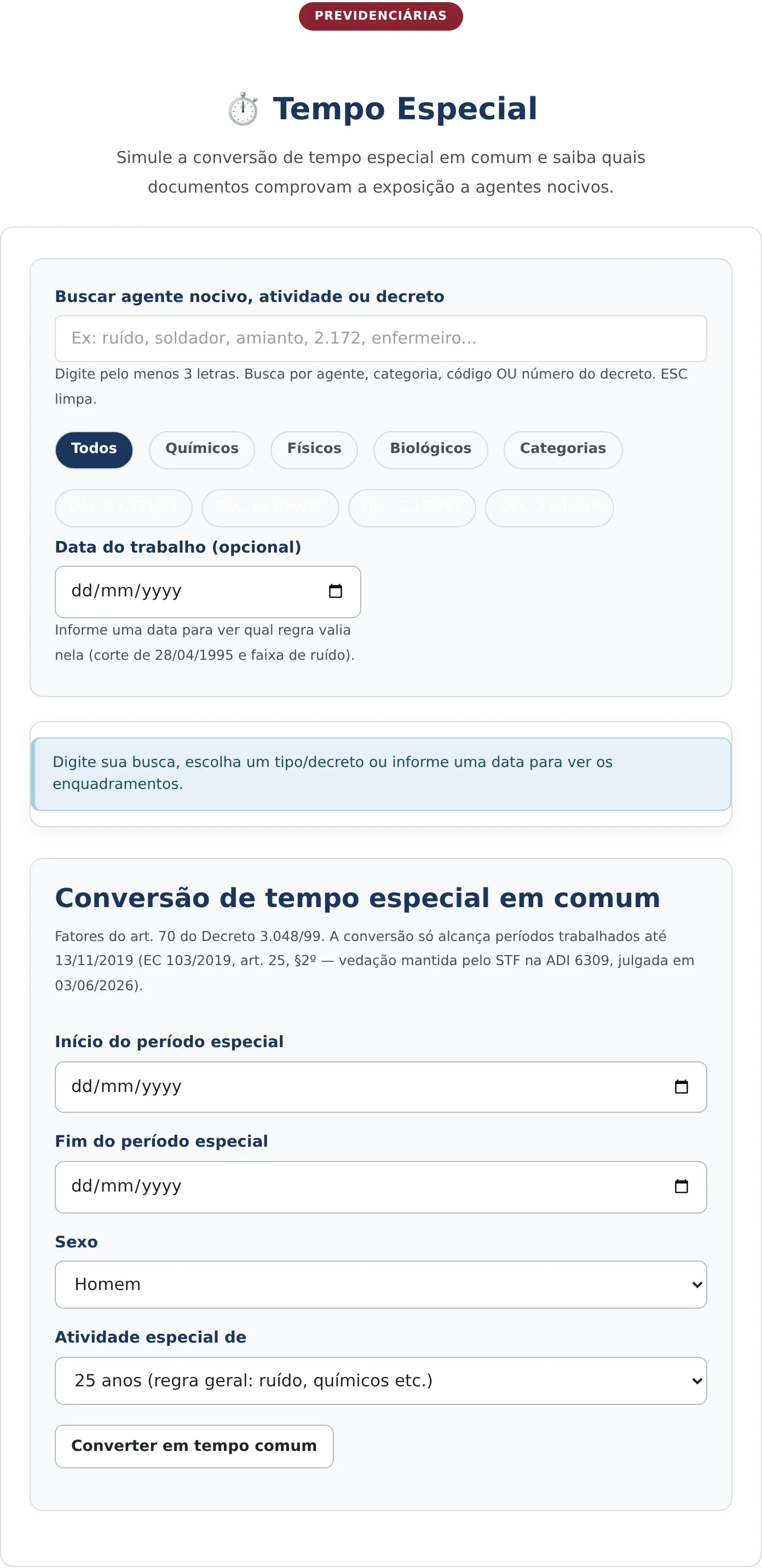
The screen is divided into two parts. At the top is the search field, with filters by agent type (chemical, physical and biological) and by job category, plus filters by decree. Below the field is an optional date, which shows which rule applied on that day.
At the bottom is the converter, with the start and end of the special service period, sex, and the reference period for the activity: 25, 20 or 15 years. The decree filters appear grayed out until a search is run.
2. Search for the agent and enter the period
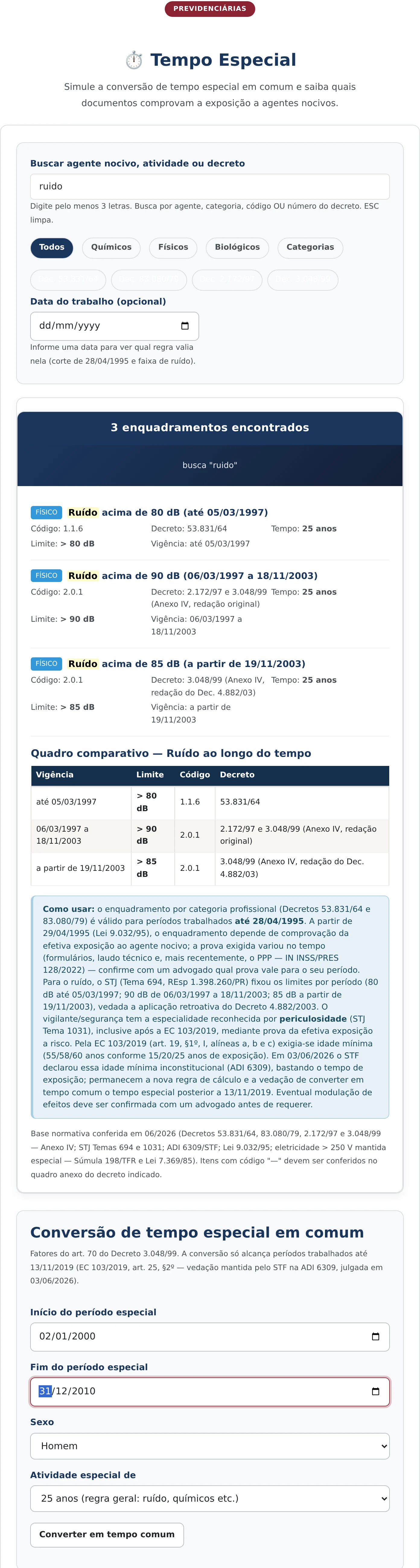
The search accepts at least three letters and looks up agents, job categories, codes or decree numbers. In the example, the search term is “ruído” (noise), and the period entered in the converter runs from January 2, 2000, to December 31, 2010, with a 25-year special activity.
The work date field deserves a closer look for what it does: once you enter a specific day, the tool shows which rule applied on that date, taking into account the April 28, 1995 cutoff and the noise range in force at the time. It is a shortcut for anyone analyzing long, fragmented periods.
3. Read the classifications found
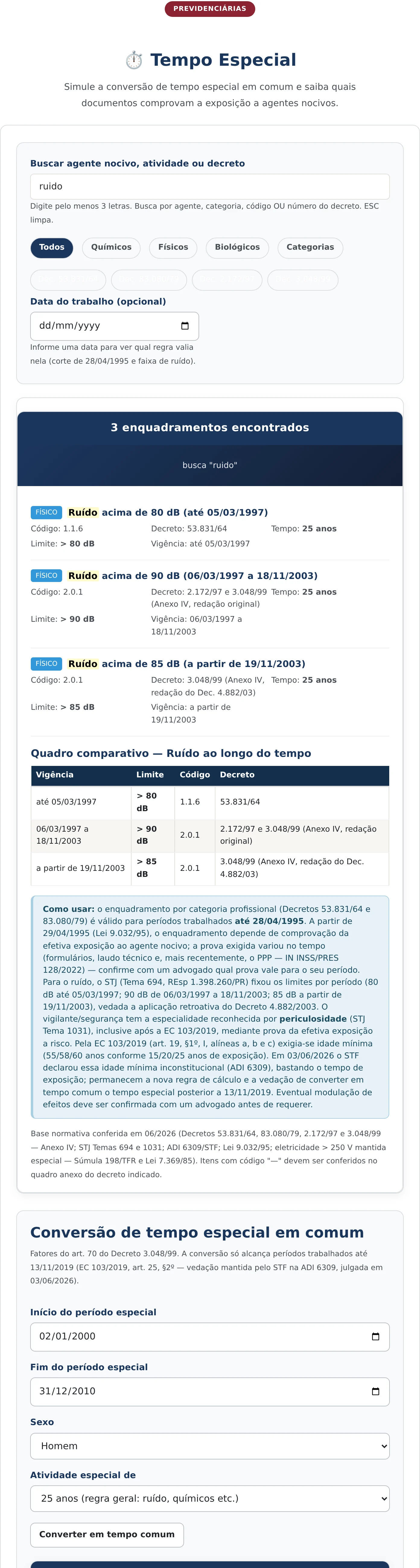
The search returns the matching classifications, each with its code, decree, reference period, tolerance limit and period of validity. Right below, on the same card, you will find the agent’s comparison table over time and the result of the conversion you requested.
How to read each line of the result
In the example, the search for noise returns three classifications. The first covers noise above 80 decibels until March 5, 1997, under code 1.1.6 of Decree 53.831/64. The second covers the interval from March 6, 1997, to November 18, 2003, with a 90-decibel limit and code 2.0.1 of Decrees 2.172/97 and 3.048/99. The third applies from November 19, 2003, with an 85-decibel limit, as worded by Decree 4.882/03.
All three show a reference period of 25 years, which is the general rule for special retirement based on noise and most chemical agents. The 20- and 15-year periods are reserved for specific situations, such as underground mining at the working face.
The comparison table repeats the information in table form, with period of validity, limit, code and decree. It is the most useful part for building the timeline of a long career, because it lets you split the total period into the intervals for each rule.
Below the table, the tool displays guidance on the April 1995 cutoff. Classification by job category applies to periods worked until April 28, 1995. From April 29, 1995, by force of Law 9.032/95, recognition depends on proof of actual exposure to the harmful agent.
What the tool does not do
The tool does not read the social security occupational profile or the technical report. It tells you the rule and converts the time, but proof of exposure remains a matter of documents and depends on what the employer issues.
Converting special service time into ordinary service time also has a time limit that must be observed. Since Constitutional Amendment 103/2019, conversion applies only to periods worked until November 13, 2019. Special service time after that date counts toward special retirement but cannot be converted into ordinary service time.
There is also the use of personal protective equipment, which can rule out recognition for certain agents but does not in the case of noise, according to the position set by Brazil’s Supreme Federal Court. The tool does not assess this question, which depends on analyzing the specific case and the technical documentation.
Frequently Asked Questions
Which noise limit applies to a period in 2001?
The 90-decibel limit, because 2001 falls within the interval from March 6, 1997, to November 18, 2003, governed by Decrees 2.172/97 and 3.048/99 in their original wording. The more favorable 85-decibel limit only took effect on November 19, 2003.
Can special service time still be converted into ordinary service time?
Only for time worked until November 13, 2019, by force of Constitutional Amendment 103/2019. Later special service time still counts toward special retirement, under the requirements specific to that type of benefit, but it does not generate an increase through conversion.
Is it enough for the position to appear in the decree for the period to count as special?
It was enough until April 28, 1995, when classification by job category still applied. From April 29, 1995, under Law 9.032/95, proof of actual exposure to the harmful agent became mandatory, through the proper form accompanied by a technical report on the working environment.
Receba novidades por e-mail
Cadastre-se gratuitamente para receber nossos novos artigos.
Seus dados estão protegidos conforme a LGPD.
Ficou com dúvidas? Fale com um advogado especialista.
📱 Falar pelo WhatsAppAs informações deste artigo são de caráter informativo e não substituem consulta jurídica individualizada. Cada caso possui particularidades que exigem análise específica.


