
13th Salary Calculator: Step-by-Step Tutorial
The 13th salary is paid in two installments with different withholding rules: the first is paid in full, and all INSS (Brazil’s National Social Security Institute) contributions and income tax are withheld from the second. The website calculator separates the two and shows where each deduction applies.
What the 13th salary calculator does
The annual bonus has a feature that can confuse recipients. The first installment, paid by November 30, equals half the amount and is not subject to any deductions. The second, paid by December 20, is the installment subject to social security contributions and income tax, calculated on the total bonus amount.
The practical effect is counterintuitive. Someone who receives half in November and expects the same amount in December receives less, because all annual deductions are concentrated in the second installment. The difference comes as a surprise every December.
There is also proportionality. The 13th salary is due at the rate of one twelfth for each month worked, and months with 15 or more days of work count as a full month. Anyone hired or terminated during the year needs to know how many twelfths they are entitled to before checking the amount.
The website tool takes the gross salary, months worked, and dependents, then returns the two installments separately, with deductions shown exactly where they apply.
When the tool helps in a specific case
Its most common use is to check the amount received in December. When the net amount of the second installment seems too low, the breakdown on the screen shows whether the deduction is correct or whether something is out of place.
Other recurring situations:
- calculating the proportional 13th salary of someone hired during the year;
- checking the proportional 13th salary paid in a termination settlement;
- December financial planning, based on the actual net amount of both installments;
- checking the effect of dependents on income tax withholding;
- checking the amount under contracts with a recently adjusted salary.
In all of these situations, the key point is understanding that the deduction is not divided between the installments. It applies once, to the total amount, and is withheld from the second installment.
The first installment of the 13th salary is paid with no deductions at all. All social security contributions and income tax are withheld from the second.
The example in this tutorial makes this concentration visible, using fictional amounts selected for demonstration purposes.
Step by step through the tool screens
The calculator is located in the website’s tools section, among the employment-law tools, and runs entirely in your browser.
1. Open the tool and identify the fields
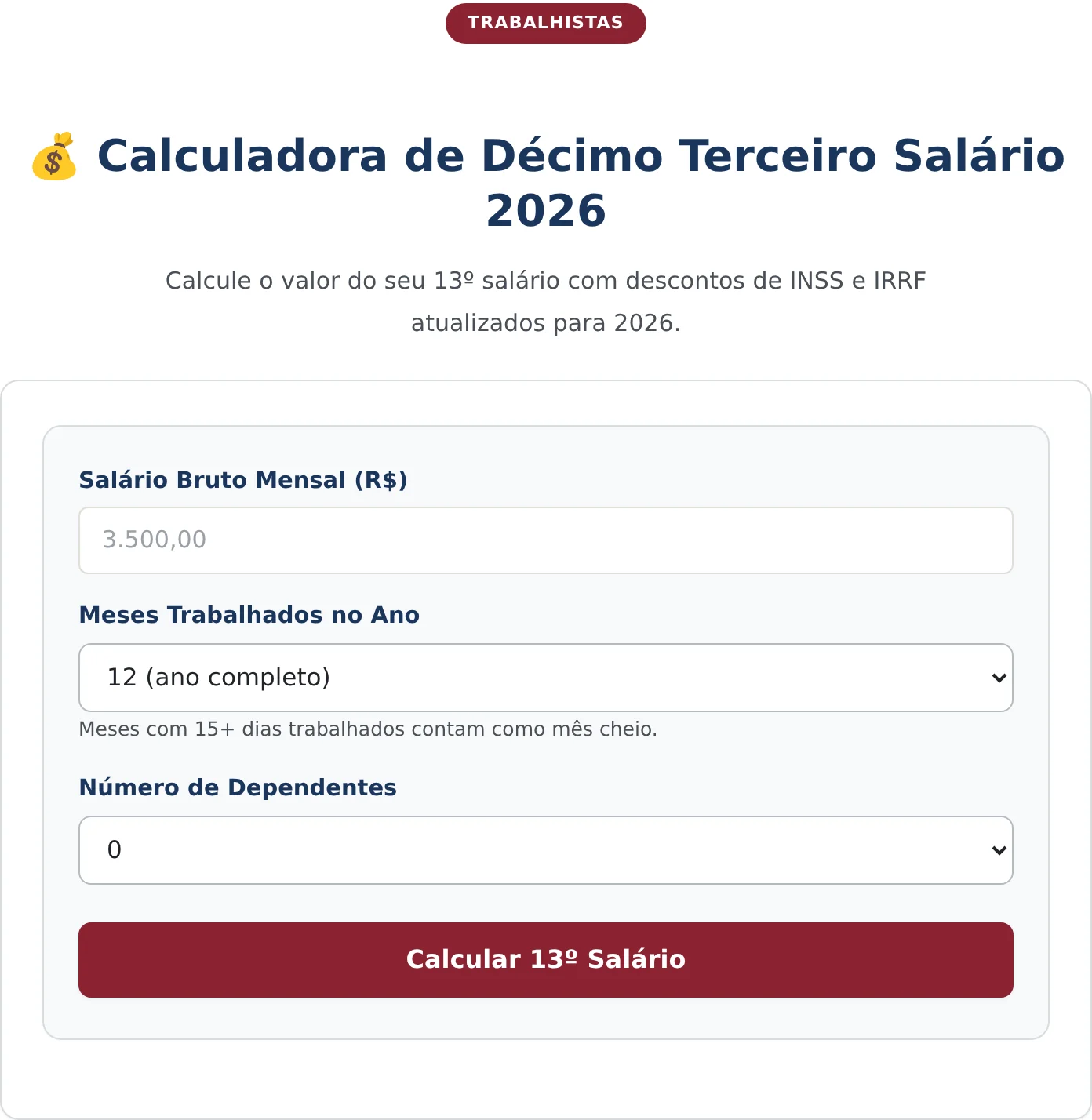
The screen displays three fields. The first is the monthly gross salary. The second is the number of months worked during the year, from 1 to 12. The third is the number of dependents, used only to calculate withheld income tax.
Below the months field is a brief but decisive instruction: months with 15 or more days worked count as a full month. For example, someone hired on May 10 has all of May counted, rather than half of it.
2. Enter the contract information
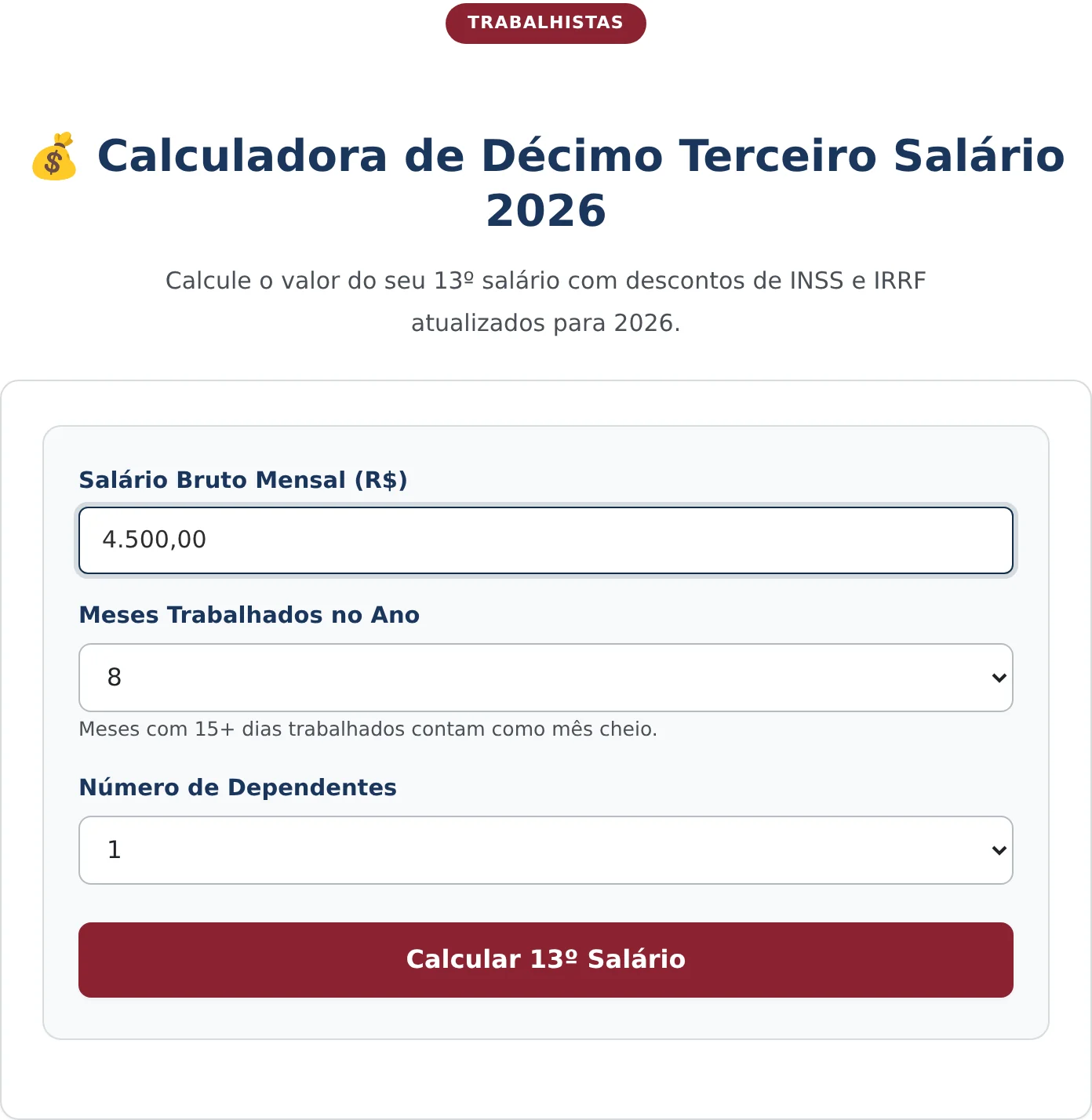
In the example, the gross salary is R$ 4.500,00, 8 months were worked during the year, and one dependent has been declared.
The choice of 8 months is not arbitrary: it shows how proportionality works. A worker entitled to eight twelfths receives two thirds of the full bonus, and the tool labels the result with that information so there is no doubt about the basis used.
3. Calculate and read the result
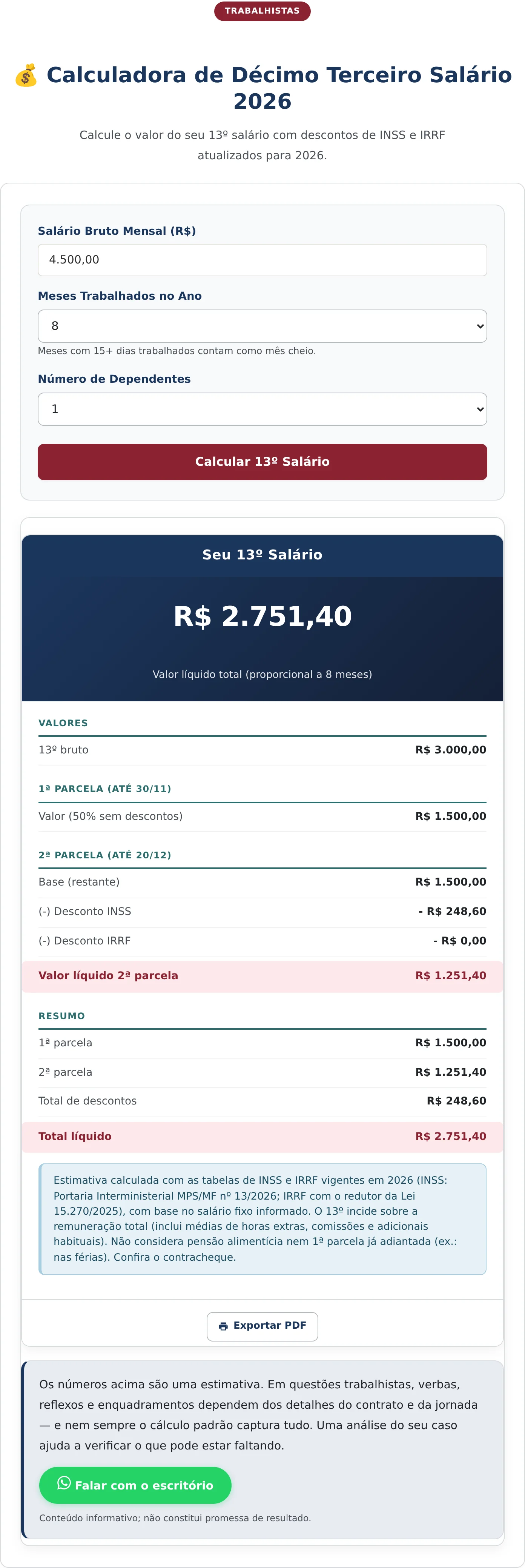
The “Calculate 13th Salary” button opens the results card with four sections: the highlighted net amount, the gross amounts, the breakdown of each installment, and the final summary.
How to read each line of the result
In the example, the total net amount is R$ 2.751,40, for eight months worked. The gross 13th salary is R$ 3.000,00, representing eight twelfths of the R$ 4.500,00 salary.
The first installment, due by November 30, appears as R$ 1.500,00 and is labeled as half the amount with no deductions. This is exactly what the law requires: an advance of half the bonus, with no withholding.
The second installment, due by December 20, starts from the same R$ 1.500,00 base, but is subject to withholding. The social security contribution is R$ 248,60, and withheld income tax is zero in this example, due to the combination of the tax base, the dependent deduction, and the current tax table. The net amount of the second installment drops to R$ 1.251,40.
The summary balances the calculation: R$ 1.500,00 in the first installment, R$ 1.251,40 in the second, and R$ 248,60 in total deductions. The difference of nearly R$ 250,00 between the two installments consists entirely of deductions, not a company calculation error.
At the bottom of the card, the tool states which tables it applied and includes an important warning: the 13th salary applies to total compensation, including averages for overtime, commissions, and customary additional payments. Anyone with variable compensation should expect a higher amount than the estimate based on fixed salary.
The payment deadlines assumed by the calculation
The two installments separated by the tool correspond to distinct statutory deadlines. The first may be paid beginning in February and must be paid by November 30. The second is due on December 20, a date that is not extended whether or not it falls on the last business day.
There is a little-used and fully lawful alternative: the employee may request that the first installment be paid together with vacation pay, provided the request is made during January of the relevant year. Anyone who chooses this option receives the advance earlier and, in December, receives only the second installment, already net of deductions.
This possibility explains a common discrepancy when checking amounts. A worker who requested the advance with vacation pay and then compares the amount received in December with the calculator result finds a lower amount, because the tool does not know that the first installment was already paid months earlier. The results footer itself warns about this.
Upon termination, the logic changes again. The proportional 13th salary is calculated as part of the termination entitlements and paid by the termination deadline, rather than on the November and December dates. Payment in lieu of notice extends the employment contract and is included in the count of twelfths, which often adds one twelfth to the total due.
What the calculator does not do
The tool works with the fixed salary entered. It does not calculate averages for variable pay, deduct support payments, or account for advances already received, such as an advance of the first installment together with vacation pay, a permitted and very common practice.
It also does not address the 13th salary of people receiving social security benefits, whose bonus follows the calendar and rules specific to Brazil’s National Social Security Institute.
To check the proportional 13th salary within a termination settlement, together with the other entitlements, the website provides a specific termination calculator that calculates all amounts due upon termination.
Frequently Asked Questions
Why is the second installment of the 13th salary lower than the first?
Because the first installment is an advance paid with no deductions, while all social security contributions and income tax on the 13th salary are withheld from the second. The difference between the two installments corresponds exactly to the total amount withheld, as the results summary shows.
How many months do I need to work to receive a proportional 13th salary?
Each month with 15 or more days of work generates one twelfth of the bonus. Anyone who worked fewer than 15 days in a given month does not earn that twelfth. The calculator’s months field must be completed using this count, not the raw number of months of employment.
Does overtime increase the amount of the 13th salary?
Yes, when it is paid regularly, because the 13th salary applies to compensation rather than only base salary. The calculator works with the fixed amount entered, so the actual result tends to be higher than the estimate for contracts involving frequent overtime, commissions, or permanent additional payments.
Receba novidades por e-mail
Cadastre-se gratuitamente para receber nossos novos artigos.
Seus dados estão protegidos conforme a LGPD.
Ficou com dúvidas? Fale com um advogado especialista.
📱 Falar pelo WhatsAppAs informações deste artigo são de caráter informativo e não substituem consulta jurídica individualizada. Cada caso possui particularidades que exigem análise específica.


