
BPC/LOAS Checker: Requirements Screening Tutorial
For BPC, the deciding calculation is income divided by the number of people in the family, and not all income is included in that calculation. The website checker organizes age, disability, family composition, and income into a screening of the requirements.
What the BPC Checker Determines
The Continuous Cash Benefit guarantees one monthly minimum wage to elderly individuals aged 65 or older and to individuals with long-term disabilities, provided that per capita family income falls within the legal limit. It is not a retirement benefit: it is a social assistance benefit, does not require contributions, and does not provide a thirteenth-month payment or survivor’s pension.
The requirement most likely to result in a denial is the financial one. The calculation is simple in form but tricky in practice: the income of all members of the family group is added together and divided by the number of people. The result must be within one-quarter of the minimum wage.
The challenge is knowing what belongs in the sum and who belongs in the division. The law excludes from the calculation BPC already received by another member and, under certain conditions, retirement benefits or pensions of up to one minimum wage received by an elderly member of the group. Including this income in the calculation produces a falsely negative result.
The website tool organizes these variables into five fields and returns a screening in which each requirement is assessed separately.
When the Tool Helps in a Specific Case
Its most common use is screening before filing an application, to determine whether it is worthwhile to begin the application or whether a requirement is missing that can be addressed beforehand.
Other recurring situations include:
- assessing the effect of a change in family composition on per capita income;
- checking the current legal limit, which follows the minimum wage;
- organizing documents before the appointment;
- understanding why a previous application was denied based on income;
- checking the situation of someone who already receives another benefit in the family.
Enrollment in the single registry is also a condition for applying, and the form asks about it precisely to flag this outstanding requirement before the application is filed.
A social assistance benefit received by another family member is not included in the income total. Including it by mistake disqualifies an application that would otherwise be viable.
That is why the screen provides guidance on what to exclude from the total directly below the income field.
Step-by-Step Guide to the Tool Screens
The checker is in the website’s tools section, among the social security tools, and works without registration.
1. Open the Tool and Identify the Fields
The screen brings together five fields: the applicant’s age, the existence of a long-term disability, the number of family members including the applicant, total family income, and enrollment in the single registry.
The disability field includes a summary of the legal definition: a long-term physical, mental, intellectual, or sensory impairment that, in interaction with barriers, obstructs full and effective participation in society, lasting at least two years. Having a medical condition alone is not enough, and this is a frequent misunderstanding.
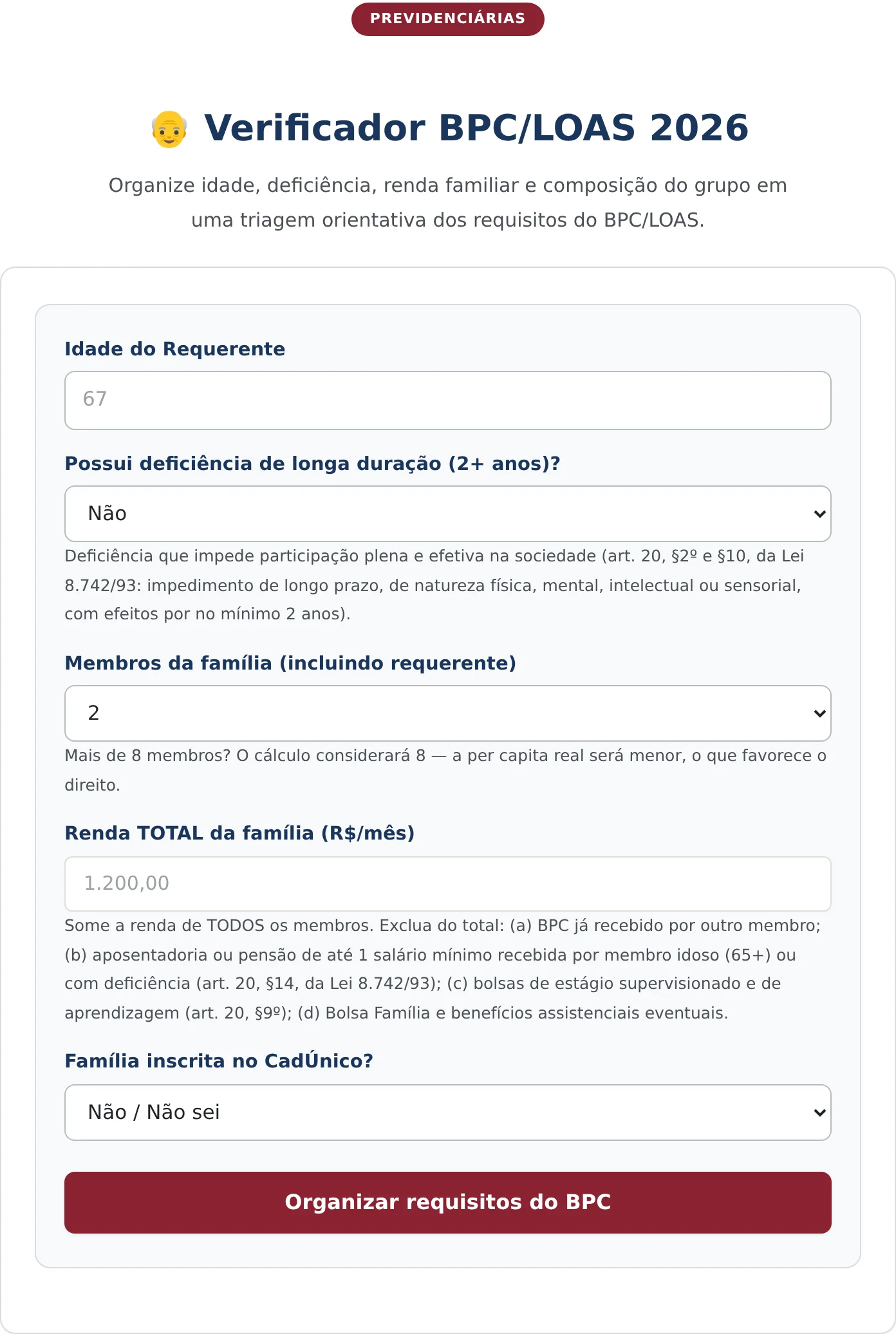
2. Fill It Out with the Family’s Information
In the example, the applicant is 67 years old, no disability is declared, the family has 3 members, total income is R$ 1.200,00 per month, and the family is enrolled in the single registry.
The income field requires the most care. The screen’s guidance instructs you to add the income of all members and indicates what must be excluded from the total, including a social assistance benefit already received by another member and a retirement benefit or pension of up to one minimum wage received by an elderly individual, subject to the legal conditions.
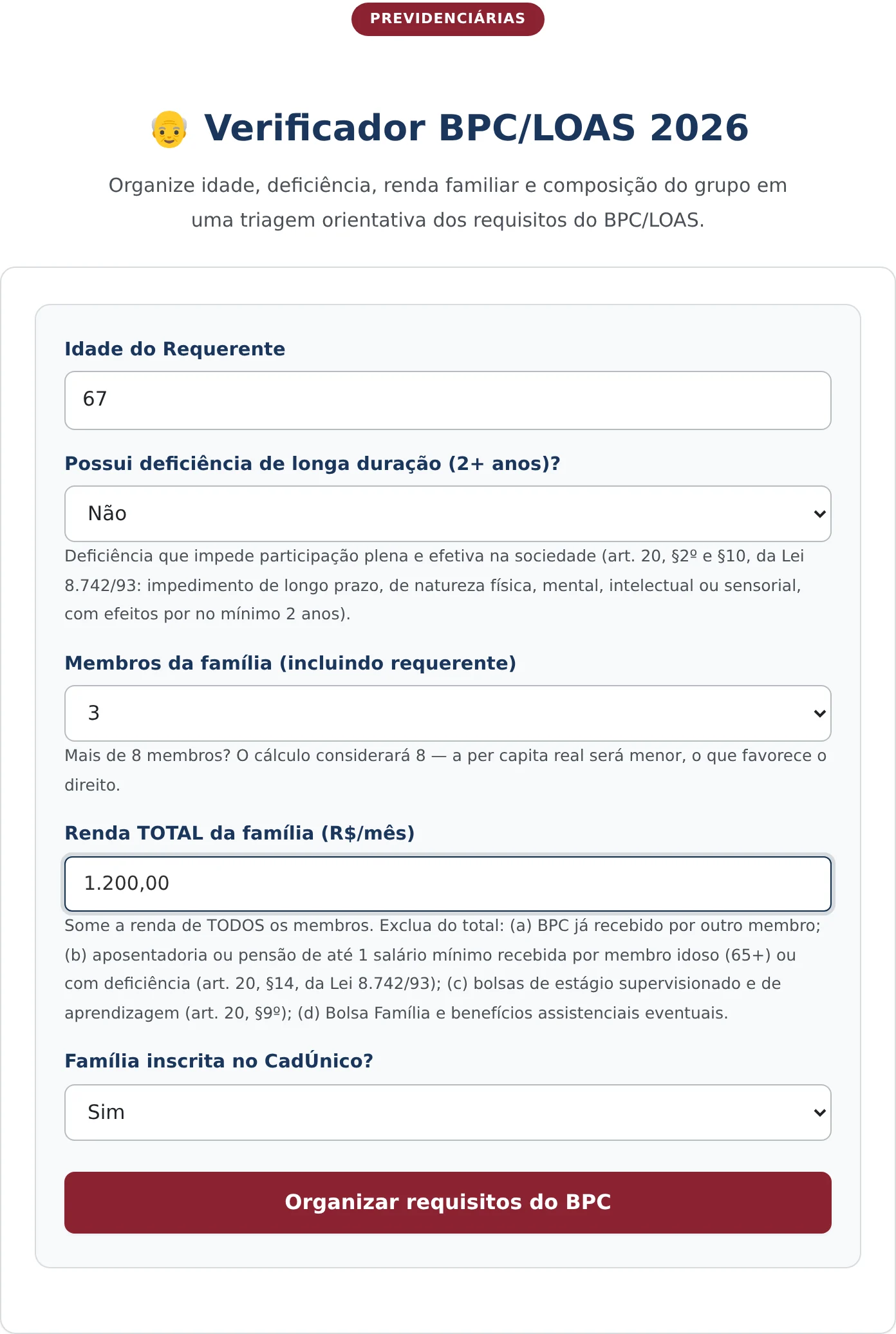
3. Organize the Requirements and Read the Result
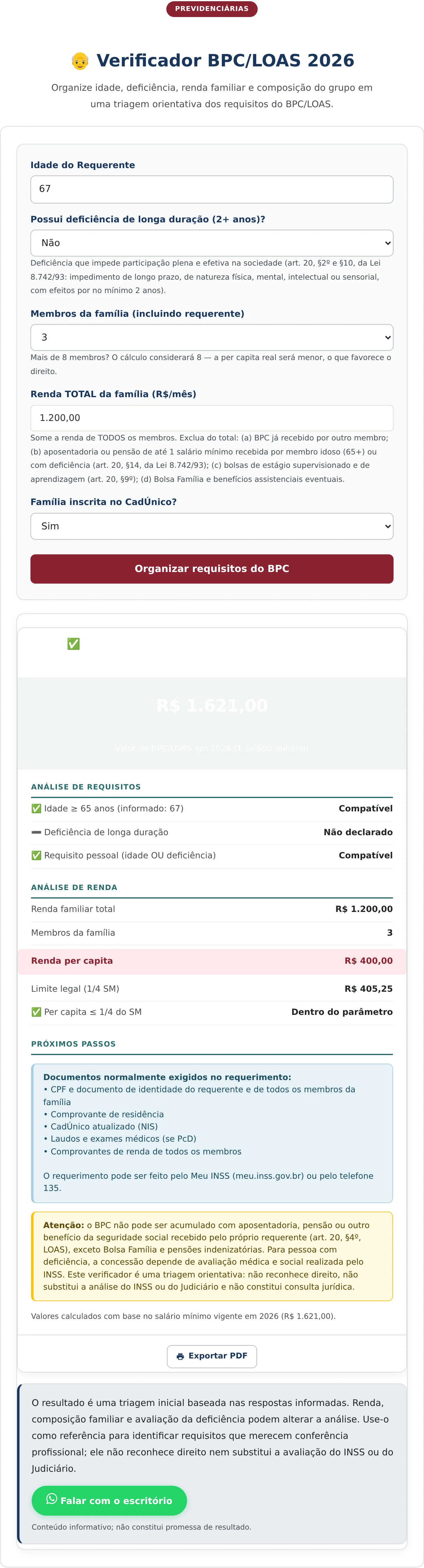
The button to organize the requirements opens a card with the conclusion highlighted, an analysis of each requirement, the per capita income calculation, and a list of documents normally required.
How to Read Each Line of the Result
In the example, the screening indicates that the information provided is compatible with the requirements and displays the 2026 benefit amount, equivalent to one minimum wage of R$ 1.621,00.
The requirements analysis separates what was checked. An age of 67 meets the minimum of 65. Disability is shown as not declared, which is neutral because the personal requirement is alternative: either age or disability is sufficient. The next line confirms that the personal requirement has been met.
The income analysis shows the deciding calculation. Total family income of R$ 1.200,00 divided by 3 members results in R$ 400,00 per person. The legal limit, equivalent to one-quarter of the minimum wage, is R$ 405,25. The difference of just over five reais is what separates approval from denial and shows why correctly determining income is decisive.
The next-steps section lists the documents usually required: identification documents for the applicant and all members, proof of residence, an updated single registry, medical reports and test results where there is a disability, and proof of income for everyone. It also identifies the official application channels.
The card ends with two relevant warnings. The first is the prohibition against combining benefits: the benefit cannot be combined with retirement benefits, pensions, or another social security benefit received by the applicant, subject to the exceptions provided by law. The second is that, for an individual with a disability, approval depends on a medical and social assessment conducted by the agency.
Two aspects of the benefit’s duration fall outside the initial screening and should be noted. The first is periodic review: approval is not final, and the conditions that authorized it are reassessed every two years, which may lead to suspension when family income no longer meets the limit.
The second is keeping the registry current. Enrollment in the single registry must remain up to date, and outdated information is a frequent cause of payment suspension, even when the requirements continue to be met. Updates are usually required at their own intervals, independently of the benefit review.
There is also a consequence that is often overlooked: because it is a social assistance benefit rather than a contributory one, it does not provide a survivor’s pension to dependents or a thirteenth-month payment, and it ends upon the beneficiary’s death. This characteristic distinguishes the benefit from any retirement benefit and must be considered in family planning.
What the Tool Does Not Do
The screening does not recognize entitlement or replace the analysis of the social security agency or the courts. It organizes the requirements declared and indicates compatibility, which is different from approval.
It also does not assess the degree of disability, which depends on a medical examination and social assessment, or evaluate circumstances of vulnerability that, in court, have already allowed the strictly arithmetic income criterion to be set aside in specific cases.
Finally, the tool does not consider extraordinary expenses, such as ongoing healthcare costs, which under certain circumstances may be deducted from family income under a specific legal provision. That analysis depends on the documentation in the case.
Frequently Asked Questions
What Is the Income Limit for BPC?
Monthly income per person in the family group must fall within one-quarter of the minimum wage. With the minimum wage at R$ 1.621,00 in 2026, the limit is R$ 405,25 per member, an amount the tool itself displays in the income analysis.
Who Is Counted in the Family Group?
The group includes the applicant and family members who live under the same roof, in the circumstances defined by the social assistance law. The composition directly changes per capita income, which is why the field asks for the total number of members, including the applicant.
Can Someone Receiving a Retirement Benefit Apply for BPC?
No, because the social assistance benefit cannot be combined with retirement benefits, pensions, or another social security benefit received by the applicant, except as provided by law. The warning appears in the tool’s own result.
Receba novidades por e-mail
Cadastre-se gratuitamente para receber nossos novos artigos.
Seus dados estão protegidos conforme a LGPD.
Ficou com dúvidas? Fale com um advogado especialista.
📱 Falar pelo WhatsAppAs informações deste artigo são de caráter informativo e não substituem consulta jurídica individualizada. Cada caso possui particularidades que exigem análise específica.


