
MEI DAS Calculator: Step-by-Step Guide
The microentrepreneur’s fixed monthly amount does not depend on revenue, but the annual limit has a twenty percent tolerance margin that changes everything. The website calculator shows the amount due and how close you are to the cap.
What the tax collection document calculator does
The individual microentrepreneur regime has its own logic: taxation is based on a fixed monthly amount, not a percentage of revenue. Those who earn little and those who earn a great deal pay the same amount, as long as they remain within the limit.
The fixed amount consists of three possible components. The social security contribution, equivalent to five percent of the minimum wage, is always due. The state component applies to commerce and industry. The municipal component applies to the provision of services.
Because the social security contribution follows the minimum wage, the amount of the document changes every year, requiring annual review.
The point that raises the most questions is the revenue limit. Exceeding it has different consequences depending on whether the excess falls within or outside the twenty percent tolerance margin.
The website calculator takes four pieces of information and returns the monthly amount, the applicable limit, and the revenue status.
When the tool helps in a specific case
Its most common use is tracking revenue throughout the year to anticipate the risk of losing eligibility for the regime.
Other recurring situations include:
- checking the monthly amount due based on the activity;
- calculating the proportional limit in the year of registration;
- assessing the consequences of exceeding the cap;
- checking the treatment of self-employed cargo carriers;
- planning the transition to another regime before losing eligibility.
The proportional calculation for the year of registration is often overlooked. Someone who registers in July does not have the full annual limit: they have the portion corresponding to the months of activity, with the month of commencement counted in full.
Exceeding the cap within the twenty percent tolerance margin results in loss of eligibility in the following year. Above that margin, the loss of eligibility applies retroactively to the beginning.
This distinction determines whether there will be retroactive payment under the regular regime or only a prospective change.
Step-by-step guide using the tool screens
The calculator is located in the website’s tools section, among the tax tools, and works in your browser.
1. Open the tool and identify the fields
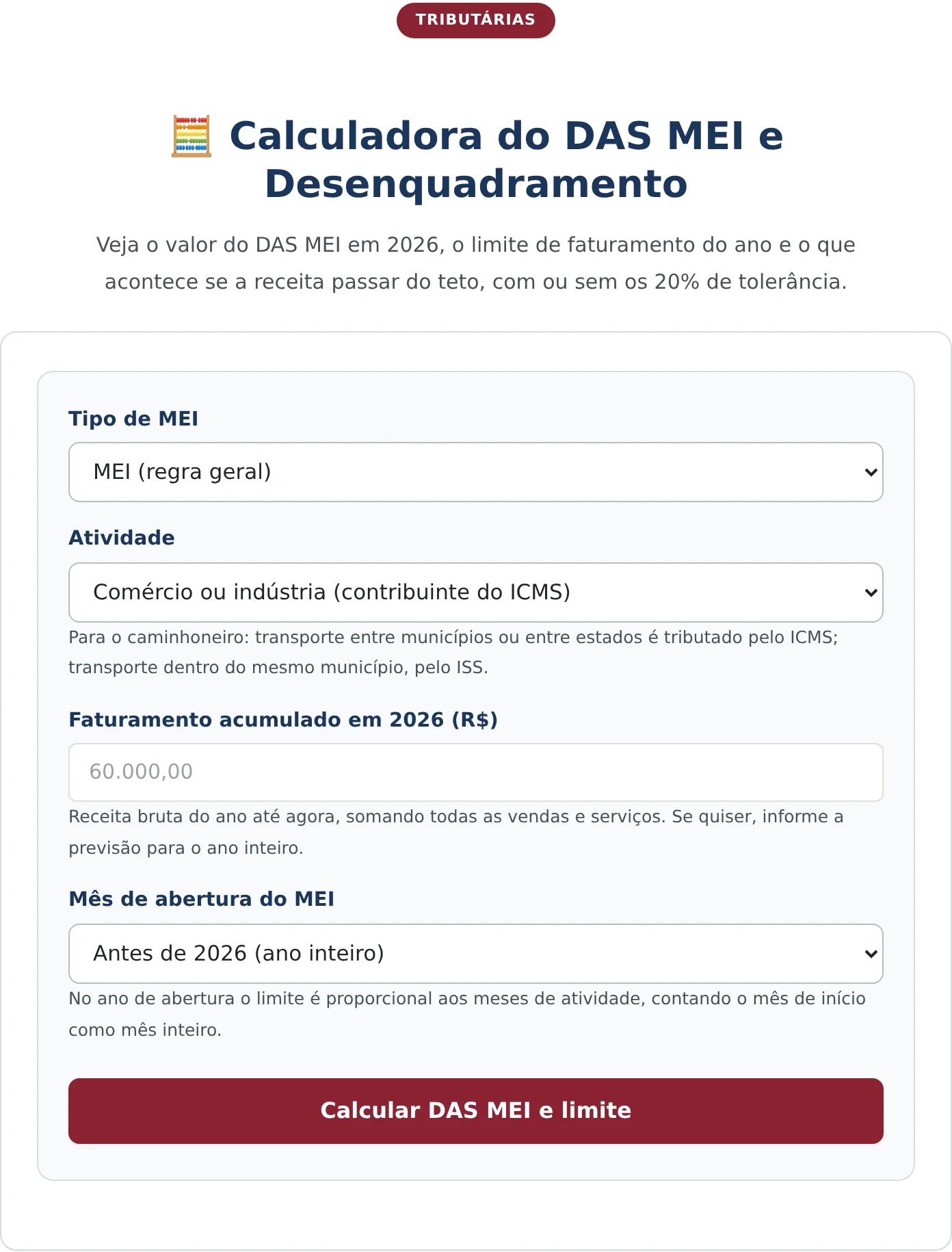
The screen has four fields. The first distinguishes a regular microentrepreneur from a self-employed cargo carrier, a category with its own limit and amounts.
The second identifies the activity as commerce or industry, provision of services, or both, which determines the components included in the tax collection document.
The third field receives the year-to-date revenue, and the fourth receives the registration month, used to calculate the proportional limit when the registration was completed in the current year.
2. Enter the activity information
In the example, this is a regular microentrepreneur engaged in commerce or industry, with year-to-date revenue of R$ 60.000,00 and registration before the current year.
The selected activity changes the monthly amount. Commerce and industry pay the state component; services pay the municipal component; those engaged in both pay both, resulting in a higher monthly amount.
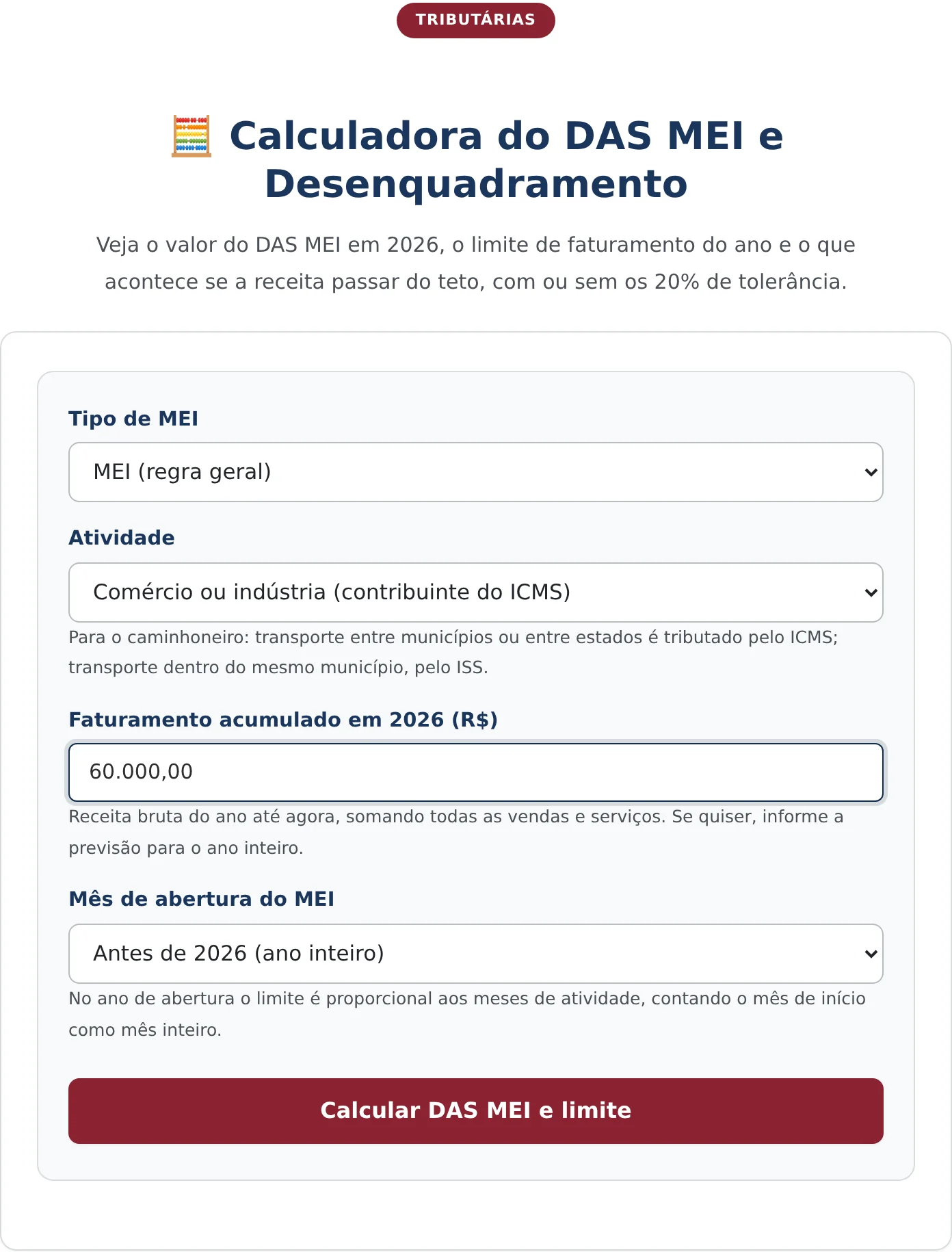
3. Calculate and read the result
The calculate button opens a card highlighting the monthly amount, the composition of the document, the annual total, and the revenue-limit section.

How to read each line of the result
In the example, the monthly amount is R$ 82,05, made up of R$ 81,05 in social security contributions and R$ 1,00 for the state component.
The social security contribution line states the calculation basis: five percent of the current minimum wage, with the amount shown. This link is what causes the document to change every year.
The annual total appears next, multiplying the monthly amount by the months of the year, showing the tax cost of the regime.
The revenue-limit section contains four key lines: the annual limit, the limit increased by the twenty percent tolerance margin, the reported revenue with its corresponding percentage of use, and the amount still available during the year.
In the example, revenue represents approximately seventy-four percent of the limit, leaving a meaningful margin. The tool concludes by stating that the revenue is within the limit and that the document remains a fixed amount, regardless of the month’s revenue.
The footer states the legal basis for the limit, the social security contribution, and the state and municipal components, allowing you to verify each component in the applicable rule.
Loss of eligibility and its two ranges
It is worth detailing what happens when the limit is exceeded, because the consequences differ radically depending on the excess.
If revenue exceeds the annual limit but remains within the twenty percent tolerance margin, loss of eligibility takes effect in January of the following year. The current year is preserved, and the microentrepreneur pays the difference on the excess.
If revenue exceeds the tolerance margin, loss of eligibility applies retroactively to the beginning of the year, or to the registration date if later. The entire period is then taxed under the regular simplified regime, with payment of the differences.
This second situation is the most burdensome because taxation as a percentage of revenue replaces the fixed amount retroactively, creating accumulated debt.
There is also loss of eligibility for other reasons, such as hiring more than one employee, engaging in a prohibited activity, or holding an ownership interest in another company.
For this reason, monthly monitoring of accumulated revenue is part of managing the regime, not merely an accounting curiosity.
It is worth noting what the monthly payment guarantees, because the low amount conceals the social security coverage it provides.
The five percent minimum-wage contribution ensures insured status and access to benefits under the general regime, including retirement by age, disability benefit, maternity benefit, and survivors’ pension for dependents.
There is, however, an important limitation: this reduced rate does not entitle you to retirement based on contribution time. Anyone who intends to count that time must supplement the payment by the difference between five and twenty percent of the minimum wage.
Another practical consequence is that benefits tend to equal the minimum wage because that is the contribution basis. Anyone seeking higher social security income must also contribute as an individual contributor on a higher basis.
Late payment, in turn, compromises insured status and may result in loss of coverage, in addition to generating charges on outstanding contribution periods.
What the calculator does not do
The tool does not issue the tax collection document or replace the official portal, which is the channel for generating the payment slip.
It also does not calculate the tax treatment applicable in the event of loss of eligibility, which depends on the regime to which the taxpayer will transition and on the taxpayer’s activity.
Nor does it verify whether the activity performed appears on the list of permitted occupations, a requirement that must be checked under the applicable rule.
Frequently Asked Questions
Does the monthly amount change according to revenue?
No. The regime is based on a fixed amount, and the document remains the same regardless of the month’s revenue, as long as accumulated revenue respects the annual limit. What changes annually is the social security component, which is tied to the minimum wage.
What happens if I exceed the limit?
Within the twenty percent tolerance margin, loss of eligibility takes effect in January of the following year. Above that margin, it applies retroactively to the beginning of the year or to the registration date, with the entire period taxed under the regular regime.
Does someone who registers in the middle of the year have the full limit?
No. The limit is proportional to the months of activity, with the registration month counted in full. The registration-month field exists in the tool precisely to apply this proportionality to the calculation.
Receba novidades por e-mail
Cadastre-se gratuitamente para receber nossos novos artigos.
Seus dados estão protegidos conforme a LGPD.
Ficou com dúvidas? Fale com um advogado especialista.
📱 Falar pelo WhatsAppAs informações deste artigo são de caráter informativo e não substituem consulta jurídica individualizada. Cada caso possui particularidades que exigem análise específica.


